Geniculum of facial nerve (Latin: geniculum nervi facialis)
Also called the external genu of facial nerve
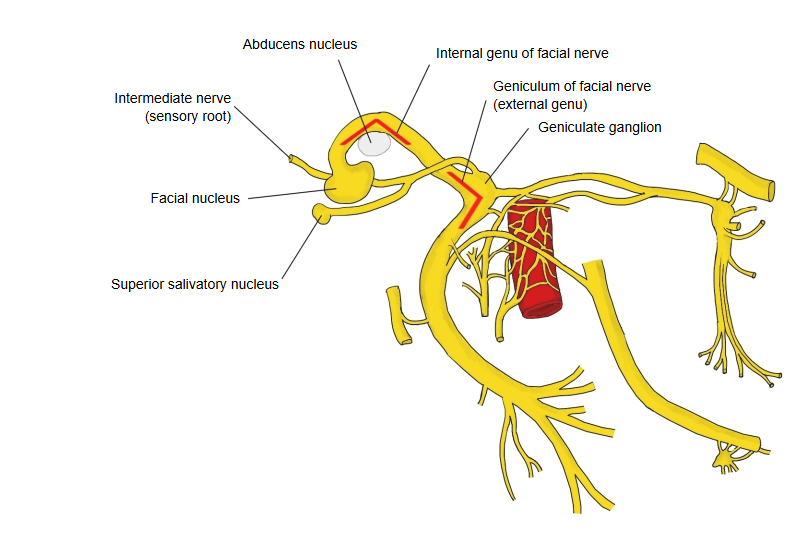
Note: sources use the names of the two bends differently. In current terminology (Terminologia Anatomica), the geniculum is the bend in the facial canal (the external genu), and the loop in the pons is the genu of the facial nerve (internal genu).
Geniculum of the facial nerve
Internal genu (in the pons)
Internal genu
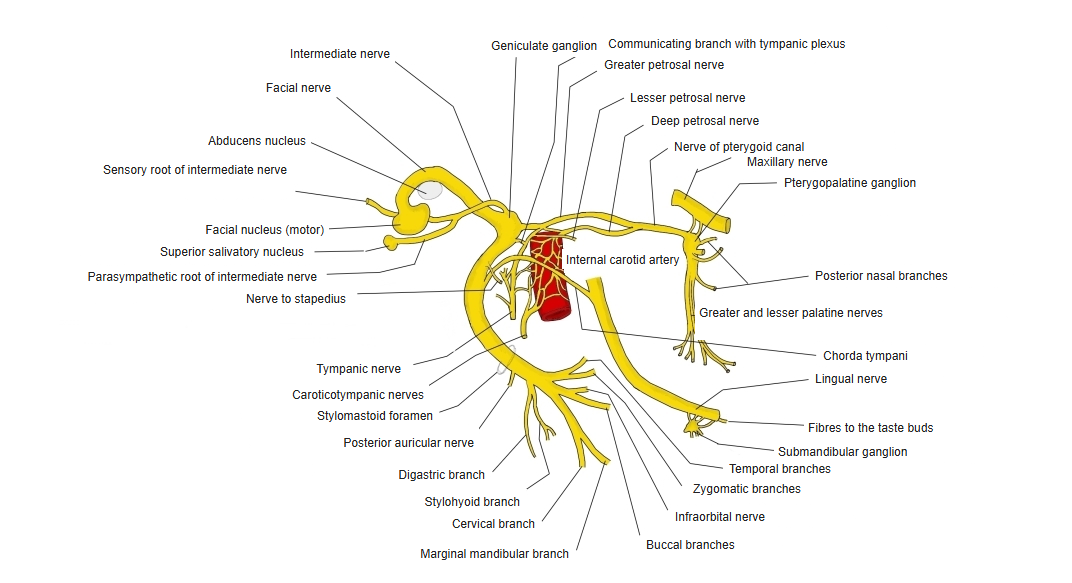
The facial nucleus is motor and lies in the lateral part of the dorsal pons; it receives fibres from the lower part of the precentral gyrus. The fibres arising from it first run backward (dorsally), loop around the abducens nucleus to form the genu of the facial nerve, the so-called internal genu, which raises the facial colliculus in the floor of the fourth ventricle. They then run forward and laterally and leave the brainstem between the pons and the pyramid of the medulla oblongata, medial to the vestibulocochlear nerve.
Course of the fibres through the internal genu
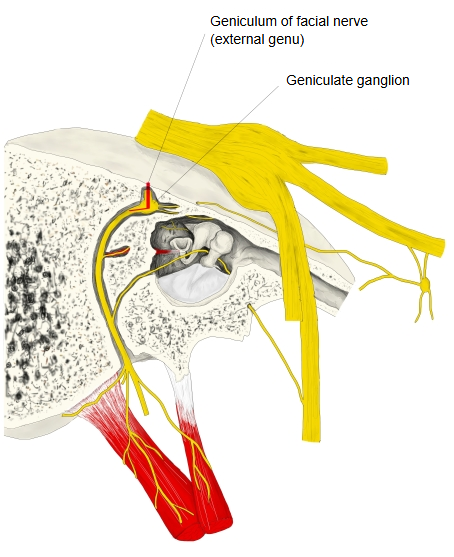
External genu (geniculum, in the facial canal)
External genu
After leaving the brainstem the facial nerve enters the internal acoustic meatus and, at its fundus, the facial canal. In the canal it runs straight forward and laterally to the level of the hiatus for the greater petrosal nerve. There it turns sharply, almost at a right angle, backward, laterally and downward; it runs back along the medial wall of the tympanic cavity, then descends vertically and leaves the skull through the stylomastoid foramen onto the external cranial base. The bend is the geniculum of the facial nerve; here lies the small geniculate ganglion, the sensory ganglion of the intermediate nerve, and the greater petrosal nerve leaves here and runs forward.
Course of the facial nerve through the external genu
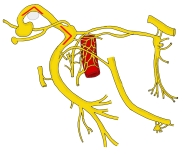 Facial nerve (model)
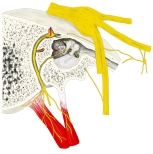 Right temporal bone, petrous part (lateral view)
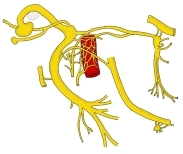 Facial nerve and its branches (model)
Reference websites
[Wikipedia]
· Facial nerve, Wikipedia.
· Facial canal, Wikipedia.
[Websites with illustrations]
· Vestibulocochlear and facial nerves in the temporal bone, with the geniculum (figure) (Netter Images)

· Course of the facial nerve in the temporal bone, with the geniculate ganglion (figure) (Elsevier)

Related terms
- Facial nerve
- Geniculate ganglion
- Greater petrosal nerve
- Prominence of facial canal
- Introitus of facial canal
- Stylomastoid foramen
- Petrous part
References and sources
- Further reading: Facial nerve, Wikipedia.
- Further reading: Facial canal, Wikipedia.
- Federative International Programme for Anatomical Terminology (FIPAT). Terminologia Anatomica, 2nd ed. (TA2), 2019.