Stylomastoid foramen (Latin: foramen stylomastoideum)
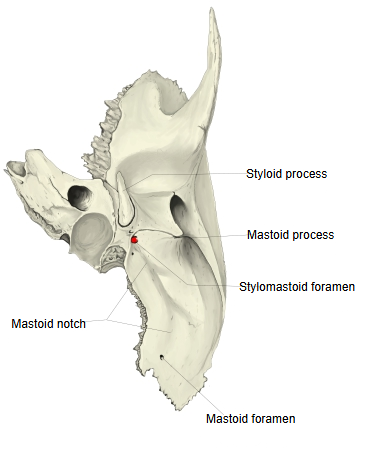
The stylomastoid foramen is an opening on the inferior surface of the temporal bone, near the back of the root of the styloid process; a nerve and vessels pass through it.
Temporal bone: one of the bones of the neurocranium (8 bones of 6 kinds)The facial nerve, the stylomastoid artery (usually a branch of the posterior auricular artery) and the stylomastoid vein
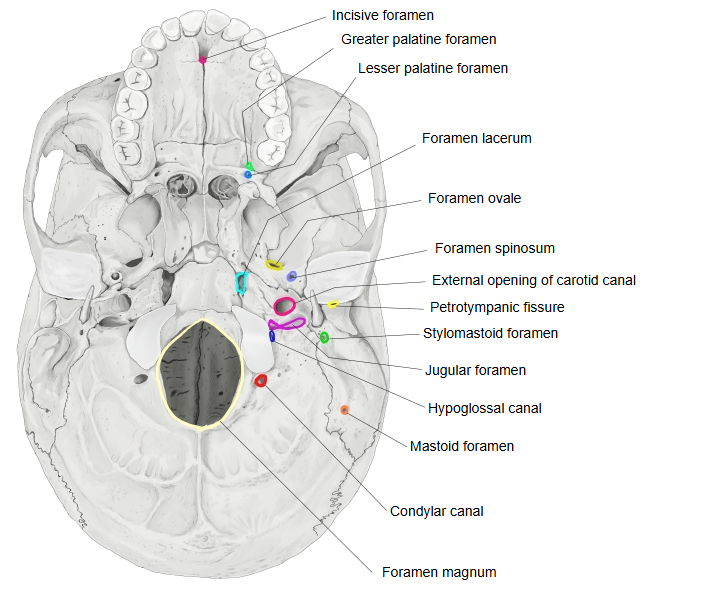
· Many sources describe it as opening between the styloid process and the mastoid process: it lies behind the root of the styloid process, in front of the mastoid process, and lateral to the jugular foramen. In newborns the mastoid process is not yet developed, so the foramen lies close to the surface and the facial nerve is easily injured there.
- Squamous part : the part that takes up the middle and the whole upper part of the bone; it has a temporal surface and a cerebral surface.
- Petrous part
- Mastoid part : below the squamous part (from the mastoid process to the parietal notch). Related terms: mastoid process, mastoid notch, groove for the occipital artery, groove for the sigmoid sinus, mastoid foramen, occipital border, stylomastoid foramen, canaliculus for the chorda tympani, petrotympanic fissure.
- Pyramid : runs forwards and medially from the boundary of the squamous and mastoid parts: a three-sided pyramid with three surfaces and three borders (the petrous part in the narrow sense).
- Tympanic part : the smallest part: a thin, half-tube-shaped plate of bone that forms the front and lower walls of the external acoustic meatus.
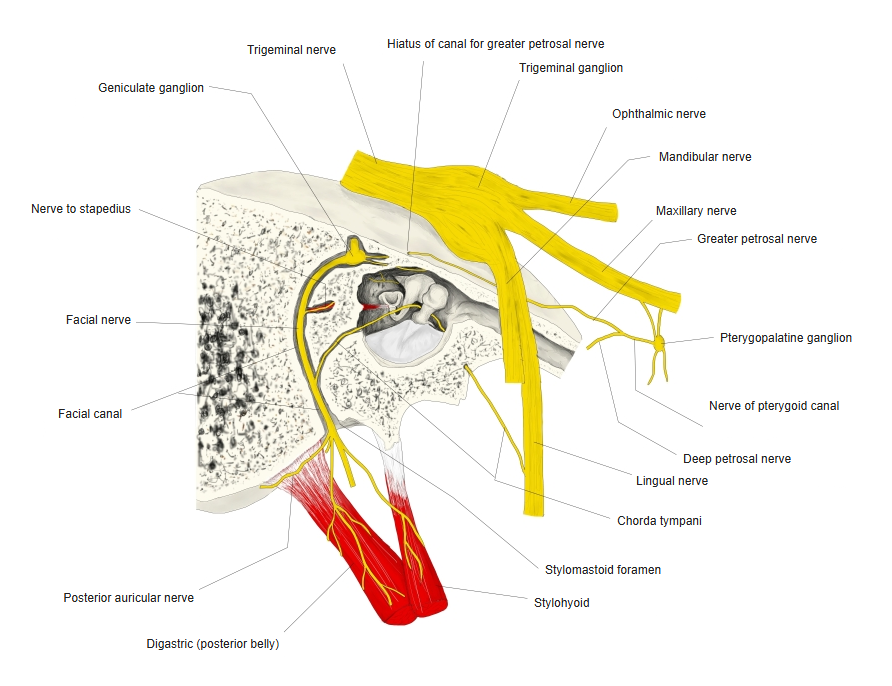
The stylomastoid foramen is the opening of the facial canal on the side of the cranial base: the exit of the canal, where the facial nerve leaves the skull.
The facial canal runs from the introitus of the facial canal to the stylomastoid foramen
- Inside the facial canal : the nerve enters the canal from the internal acoustic meatus at the introitus and turns sharply at the geniculate ganglion. Branches given off in the temporal bone: the greater petrosal nerve, the communicating branch with the tympanic plexus, the nerve to stapedius and the chorda tympani.
- After the stylomastoid foramen : just below the foramen: the posterior auricular nerve and the branches to the posterior belly of the digastric and the stylohyoid. It then enters the parotid gland and forms the parotid plexus, which gives the temporal, zygomatic, buccal, marginal mandibular and cervical branches.
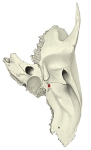 Temporal bone (inferior view)
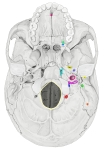 External surface of the cranial base
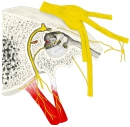 Right tympanic cavity (lateral view)
Reference websites
[Wikipedia]
· Stylomastoid foramen, Wikipedia.
· Facial nerve, Wikipedia.
[Websites with illustrations]
· Left temporal bone, inferior surface (Gray's Anatomy, fig. 141) (Wikimedia Commons)

· The facial nerve (CN VII) (TeachMeAnatomy)
Where it is found
Related terms
- Styloid process
- Mastoid process
- Temporal bone
- Jugular foramen
- Carotid canal
- Facial nerve
- Stylomastoid vein
References and sources
- Further reading: Stylomastoid foramen, Wikipedia.
- Federative International Programme for Anatomical Terminology (FIPAT). Terminologia Anatomica, 2nd ed. (TA2), 2019.