Endomysium
The endomysium is one of the membranes that wrap a muscle:
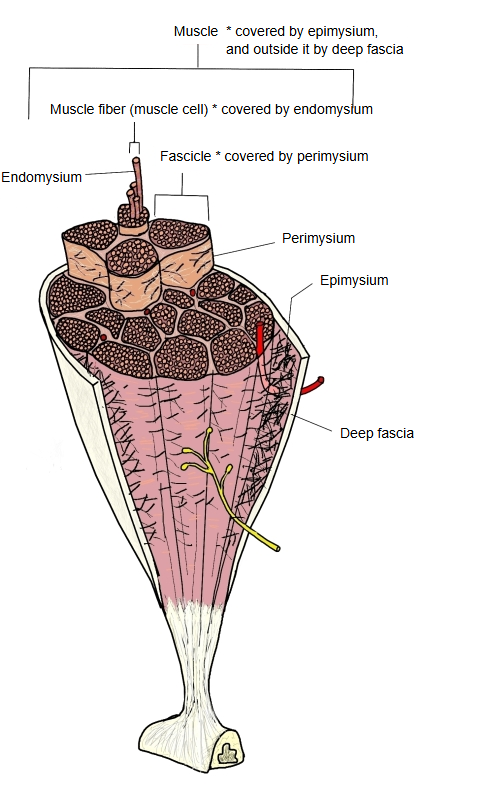
The three membranes that cover a muscle are:
wrapping
a muscle
- Endomysium : loose connective tissue that wraps each muscle fiber (muscle cell)
- Perimysium : a thicker layer of connective tissue that wraps each fascicle (a bundle of a few to dozens of muscle fibers)
- Epimysium : dense connective tissue that wraps the whole muscle, made of many fascicles
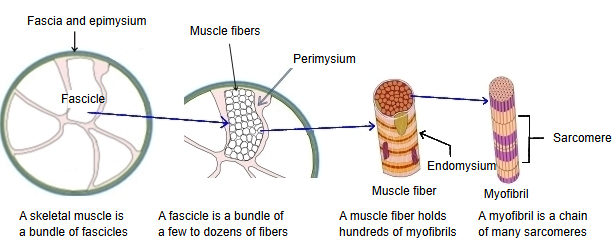
 Connective-tissue sheaths of a muscle
The chart below shows where the endomysium stands within the fascia. Note, however, that Terminologia Anatomica does not recommend dividing fascia into superficial and deep fascia in this way.
- Superficial fascia : the subcutaneous tissue, containing blood vessels, nerves, lymph nodes and fat
- Deep fascia : sheets of connective tissue deep to the subcutaneous tissue that cover the deep structures; two main kinds:
- 1. Muscular fascia : the membranes that wrap the muscles directly: endomysium, perimysium, epimysium
- 2. Visceral fascia : the membranes that wrap the organs and glands
The word "fascia" covers not only the membranes that wrap the muscles but also those that wrap the organs, so it easily causes confusion. Terminologia Anatomica (TA) recommends the following:
· Superficial fascia ⇒ subcutaneous tissue
· Deep fascia ⇒ muscular fascia and parietal or visceral fascia
Composition
The endomysium around each muscle fiber is made of fine collagen fibers (reticular fibers), a small number of elastic fibers and fibroblasts. It also carries the capillaries that nourish the muscle fibers and the nerve fibers that bring the signals from the brain and spinal cord. It lies just outside the fiber's cell membrane and basal lamina; it is not the same as the sarcolemma, which is the cell membrane of the muscle fiber itself.
- Composition : collagen fibers, (a few) elastic fibers, fibroblasts
- Running in it : capillaries, nerve fibers
The endomysium is the deepest and finest layer of the connective tissue of a muscle, a delicate layer of loose (areolar) connective tissue. Its collagen is mainly of types I and III. It gives each fiber the surroundings in which ions such as calcium, sodium and potassium are exchanged for the excitation of the fiber. It joins with the perimysium and epimysium and continues into the collagen fibers of the tendon, so the pull of every fiber reaches the bone. In the heart a similar network surrounds each cardiac muscle cell.
Related terms
- Muscle
- Muscle fascicle
- Fascia
- Sarcomere
- Tendon
- Tendon sheath
- Involuntary muscle
- List of Skeletal Muscles
References and sources
- Further reading: Endomysium, Wikipedia.
- Federative International Programme for Anatomical Terminology (FIPAT). Terminologia Anatomica, 2nd ed. (TA2), 2019.