Palatine aponeurosis (Latin: aponeurosis palatina)
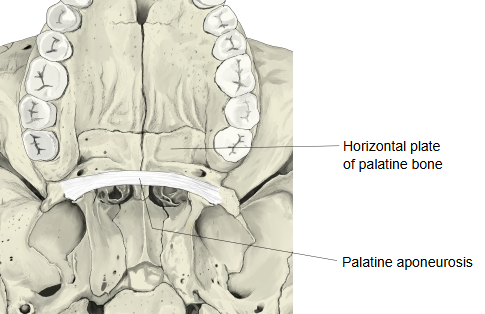
The palatine aponeurosis is a strong, thin fibrous sheet that spreads from side to side near the border between the hard palate and the soft palate.
It is attached to the posterior border of the horizontal plates of the palatine bones, at the back of the hard palate.
· Laterally it is continuous with the pharyngeal aponeurosis (pharyngobasilar fascia). It is thicker in front, near the bone, and thins out towards the back of the soft palate. It is mainly formed by the spread-out tendons of the right and left tensor veli palatini.
It supports the soft palate and is the attachment of the muscles of the soft palate and fauces.
Soft palate: the back part of the palate (the roof of the mouth), which has muscle as its framework
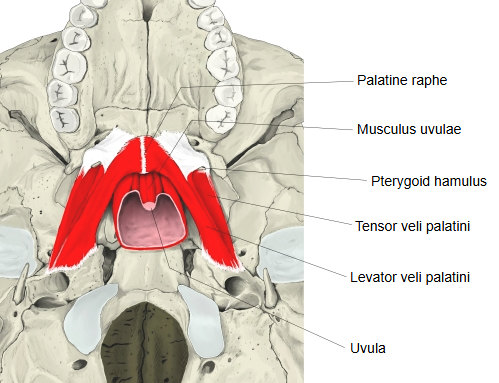
Muscles attached to the palatine aponeurosis: arising from it: musculus uvulae, palatopharyngeus and palatoglossus;
inserting on it: levator veli palatini and tensor veli palatini.
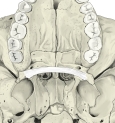 Palatine aponeurosis (inferior view)
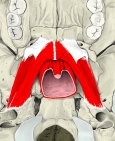 Muscles of the soft palate (inferior view)
Reference websites
[Wikipedia]
· Palatine aponeurosis, Wikipedia.
[Websites with illustrations]
· Palatine aponeurosis (slide 26) (SlideShare)

· Muscles of the soft palate and the palatine aponeurosis (diagram) (Jaypee Brothers (book figure))

Related terms
- Soft palate
- Hard palate
- Horizontal plate
- Tensor veli palatini
- Levator veli palatini
- Musculus uvulae
- Pharyngobasilar fascia
References and sources
- Further reading: Palatine aponeurosis, Wikipedia.
- Federative International Programme for Anatomical Terminology (FIPAT). Terminologia Anatomica, 2nd ed. (TA2), 2019.