Anal triangle (Latin: trigonum anale)
Also called Anal region
· The anus lies in the midline of the anal triangle, and the pelvic diaphragm lies deep to it.
· In contrast, the triangular area in front, between the two ischial tuberosities and the pubic symphysis, is called the urogenital triangle.
· The anal triangle contains many structures, such as muscles, nerves and blood vessels; they are listed below.
· A line joining the two ischial tuberosities divides the diamond-shaped perineum into the urogenital triangle in front and the anal triangle behind; this line lies along the back edge of the perineal membrane. The sides of the anal triangle run along the sacrotuberous ligaments, which are overlapped by the lower border of the gluteus maximus.
· In the midline it contains the anal canal with the external anal sphincter, and behind the anus the anococcygeal body, which joins the anus to the coccyx. On each side lies a fat-filled ischioanal fossa; its lateral wall carries the pudendal canal with the internal pudendal vessels and the pudendal nerve, and the inferior anal vessels and nerves cross the fossa to the anus.
· Its deep boundary (roof) is the pelvic floor, formed mainly by the levator ani and coccygeus; the obturator internus lines the side wall above the fossa. The anal region is another name for the same area, used especially for its surface; it is not a separate part.
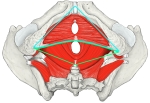 Urogenital and anal triangles
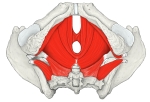 Female pelvic floor muscles
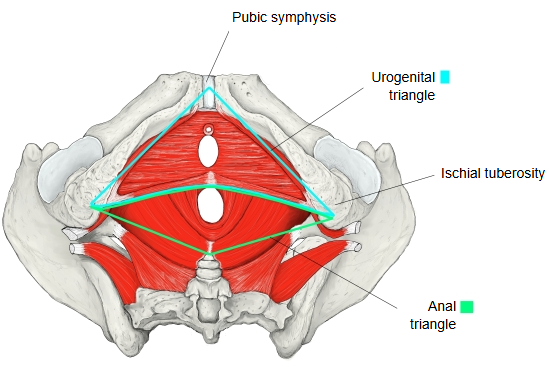
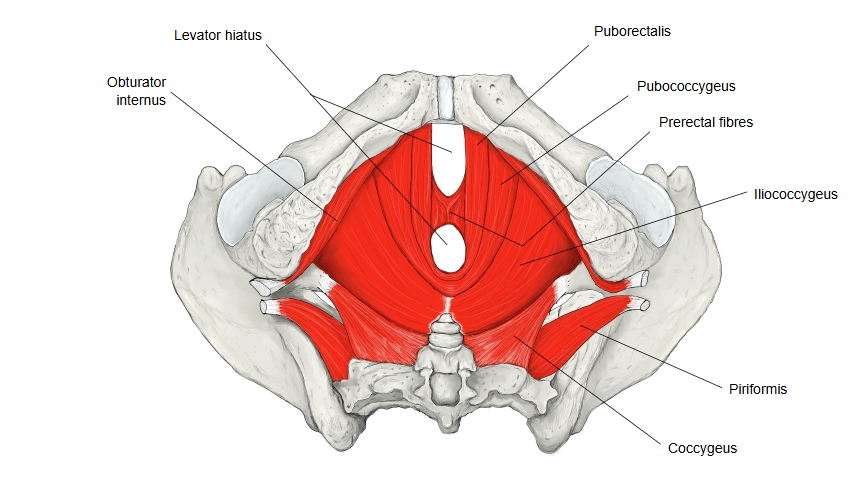
The anal triangle is the posterior part of the perineum. It contains the anal canal.
Structure
The anal triangle can be described either by its corners or by its sides.
Corners
One corner at the tip of the coccyx.
Two corners at the ischial tuberosities of the hip bones.
Sides
(the posterior border of the perineal membrane forms the anterior border of the anal triangle)
The two sacrotuberous ligaments
Contents
Structures in the anal triangle include:
· Ischioanal fossa (ischiorectal fossa)
· Anococcygeal body (anococcygeal ligament)
· Internal pudendal artery and internal pudendal vein
Muscles
Reference websites
[Wikipedia]
· Anal triangle, Wikipedia.
· Ischioanal fossa, Wikipedia.
[Websites with illustrations]
· Urogenital and anal triangles (slide) (SlideServe)

· Urogenital and anal triangles (figure) (AnatomyQA)

Related terms
- Anal region
- Anal muscles
- Anococcygeal body
- Perineal region
- Anal canal
- Anus
- Pudendal canal
- Sacrotuberous ligament
- Levator ani
- Inferior anal nerve
References and sources
- Further reading: Anal triangle, Wikipedia.
- Further reading: Ischioanal fossa, Wikipedia.
- Federative International Programme for Anatomical Terminology (FIPAT). Terminologia Anatomica, 2nd ed. (TA2), 2019.