Tympanic ring (Latin: anulus tympanicus)
Also called the tympanic annulus
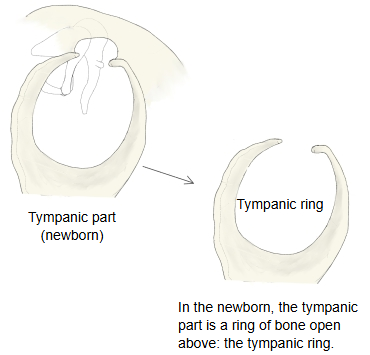
In the newborn the bony external acoustic meatus is not yet formed, and the tympanic part is only a curved bar of bone, the tympanic ring (anulus tympanicus), shaped like a horseshoe. Its front end is the greater tympanic spine and its back end the lesser tympanic spine. Both ends are free and touch the lower edge of the squamous part; the gap left between them is the tympanic notch, which the squamous part closes.
On the inner (concave) side of the ring runs a groove, the tympanic sulcus, to which the rim of the tympanic membrane is attached. The ring is still open at birth; afterwards it grows outwards and becomes the tympanic part of the temporal bone, which forms most of the bony meatus and the wall of the middle ear (tympanic cavity) towards the canal. It ossifies in membrane from a single centre, which appears in about the third month of fetal life.
Reference websites
[Wikipedia]
· Tympanic part of the temporal bone, Wikipedia.
· Temporal bone, Wikipedia.
[Websites with illustrations]
· Parts of the temporal bone at birth, with the tympanic ring (Gray's Anatomy) (Theodora.com)

Related terms
- Tympanic part
- Tympanic membrane
- External acoustic meatus
- Squamous part
- Tympanic cavity
- Middle ear
- Temporal bone
References and sources
- Further reading: Tympanic part of the temporal bone, Wikipedia.
- Further reading: Temporal bone, Wikipedia.
- Federative International Programme for Anatomical Terminology (FIPAT). Terminologia Anatomica, 2nd ed. (TA2), 2019.