Tympanic sulcus (Latin: sulcus tympanicus)
The tympanic sulcus is a ring-shaped groove that is incomplete above, at the boundary between the external acoustic meatus and the tympanic cavity in the temporal bone; the pars tensa of the tympanic membrane is fixed in it.
Temporal bone: one of the bones of the neurocranium (8 bones of 6 kinds)Pars tensa: the lower part, which takes up most of the tympanic membrane
· The sharp upper ends of the sulcus are the greater tympanic spine (in front) and the lesser tympanic spine (behind); the notch between the two spines is the tympanic notch.
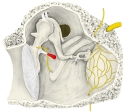 Right tympanic cavity (anterior view)
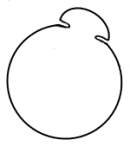 External–middle ear boundary (model)
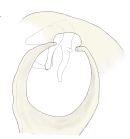 External–middle ear boundary
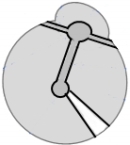 Right tympanic membrane (schematic)
 Right tympanic membrane (lateral surface)
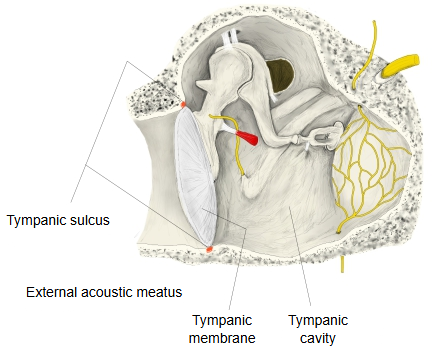
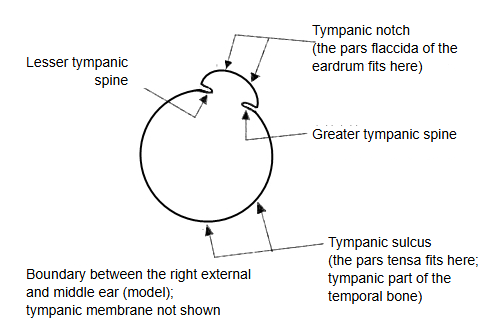
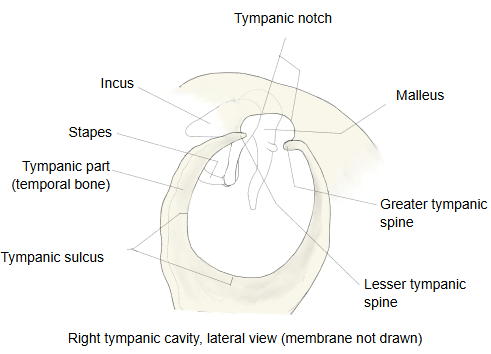
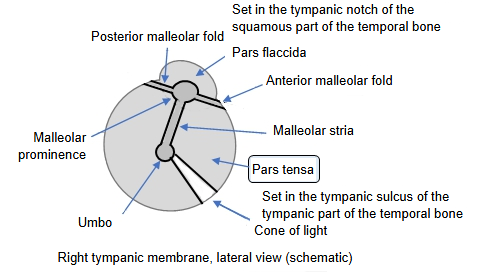
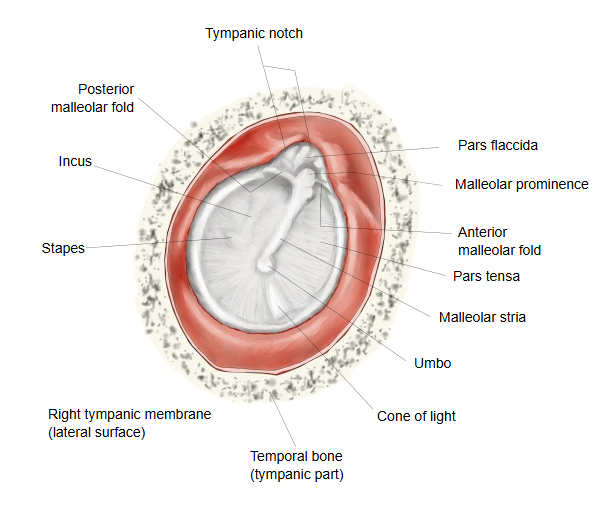
The sulcus is a fine groove on the inner end of the bony external acoustic meatus, in the tympanic part of the temporal bone, and marks the boundary between the outer ear and the middle ear. The thickened edge of the pars tensa (the fibrocartilaginous ring) sits in the sulcus; the pars flaccida, which has no such ring, fills the notch above. In the newborn the tympanic part is still a separate, incomplete tympanic ring, and the sulcus is on its inner side.
Related terms
References and sources
- Further reading: Tympanic membrane, Wikipedia.
- Further reading: Tympanic part of the temporal bone, Wikipedia.
- Federative International Programme for Anatomical Terminology (FIPAT). Terminologia Anatomica, 2nd ed. (TA2), 2019.