Segmental bronchial branches (Latin: rami bronchiales segmentorum)
Also called Subsegmental bronchi
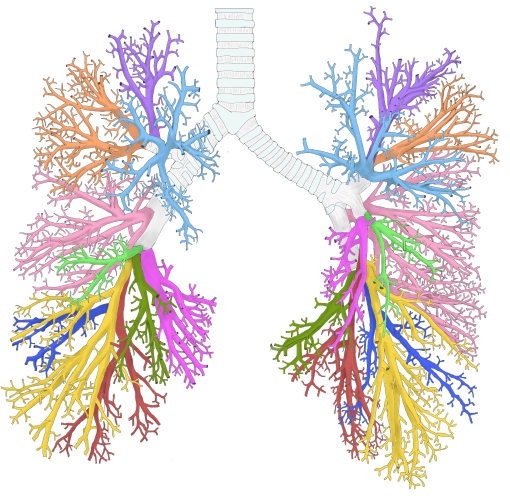
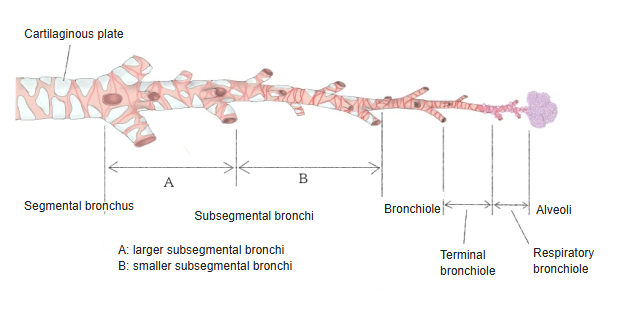
· Each segmental bronchus divides into many segmental bronchial branches. Many atlases do not use this name and call these airways the large and small subsegmental bronchi instead.
The name of a bronchus changes as it branches: main bronchus → lobar bronchus → segmental bronchus → segmental bronchial branches → bronchioles. The segmental bronchial branches still have irregular plates of cartilage (bronchial cartilages) and bronchial glands in the wall; these disappear where the airway becomes a bronchiole (about 1 mm across). Their final branches enter the pulmonary lobules as bronchioles, which then divide into terminal bronchioles. All these airways only conduct air; gas exchange starts at the respiratory bronchioles.
From the main bronchi to the alveoli
 Segmental bronchial branches (colour-coded)
 Beyond the segmental bronchial branches
Related terms
- Bronchopulmonary segments
- Bronchi
- Bronchiole
- Terminal bronchiole
- Bronchial cartilages
- Bronchial glands
- Lung
References and sources
- Further reading: Bronchus, Wikipedia.
- Further reading: Bronchiole, Wikipedia.
- Federative International Programme for Anatomical Terminology (FIPAT). Terminologia Anatomica, 2nd ed. (TA2), 2019.