Saddle joint (Latin: articulatio sellaris)
Also called Sellar joint
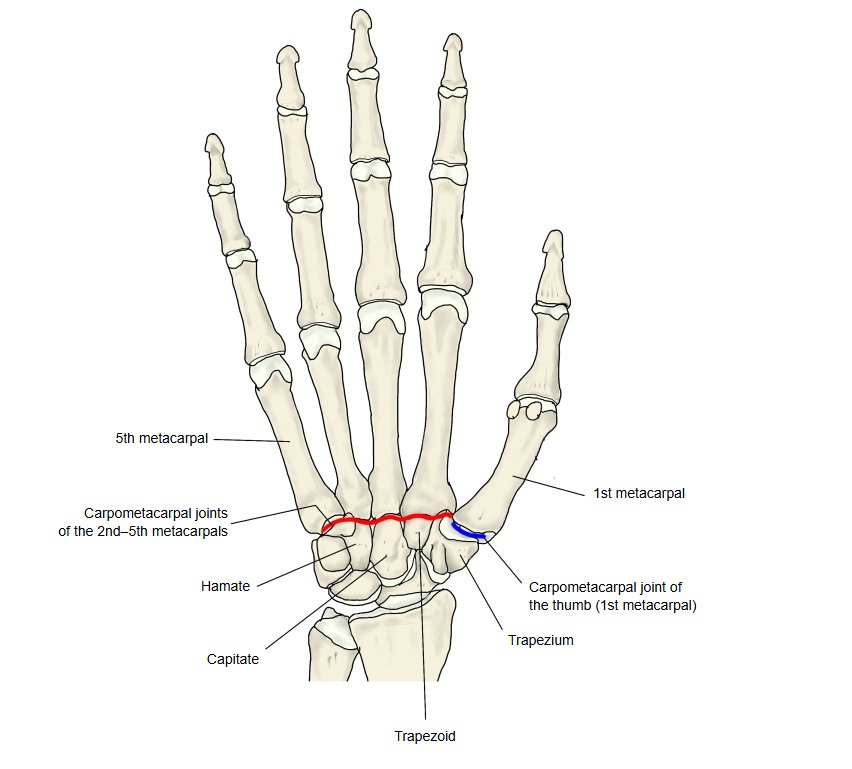
Example: the carpometacarpal joint of the thumb.
Besides this joint, the following are also often classed as saddle joints:
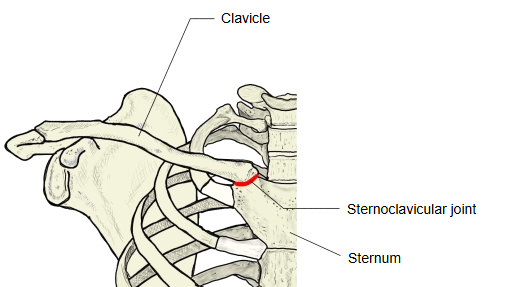
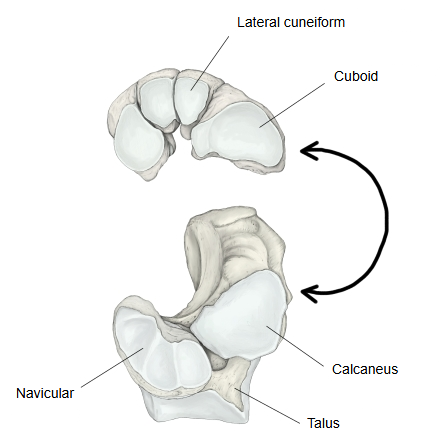
· Sternoclavicular joint · Incudomalleolar joint · Calcaneocuboid joint
joints
- Uniaxial joints : move about one axis only: hinge joints, spiral joints and pivot joints.
- Biaxial joints : move about two axes at right angles: ellipsoid joints (= condylar joints) and saddle joints.
- Multiaxial joints : move about three or more axes: ball-and-socket joints (enarthroses) and plane joints.
In more detail:
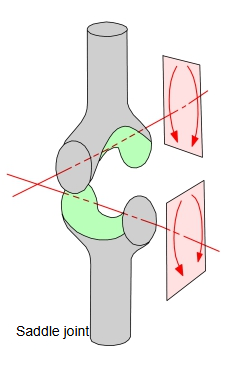
If one articular surface is concave along its length and convex across it, the opposing surface is convex along its length and concave across it, so the two fit together like a rider on a saddle. The joint is biaxial; the classic example is the carpometacarpal joint of the thumb, between the trapezium and the first metacarpal, which makes opposition of the thumb possible.
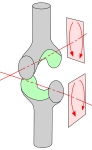 Saddle joint (model)
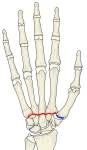 Carpometacarpal joint of the thumb
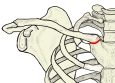 Sternoclavicular joint
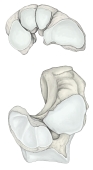 Calcaneocuboid joint
Reference websites
[Wikipedia]
· Saddle joint, Wikipedia.
· Synovial joint, Wikipedia.
[Websites with illustrations]
· Saddle joint (model, e.g. the CMC joint of the thumb) (Radiopaedia)

· Carpometacarpal joint of the thumb with a saddle model (anatomy.co.uk)

· First carpometacarpal joint (bone photograph) (Learn Muscles)

Structure
In a saddle joint one bone surface is concave where the other is convex; the interlocking curved surfaces give the joint good stability for its range of movement.
Movements
Its movements are like those of a condylar joint: flexion and extension, abduction and adduction, and circumduction, which combines them. True axial rotation is very limited. Being biaxial, it moves in the sagittal and frontal planes. Examples are the carpometacarpal joint of the thumb, the sternoclavicular joint, the incudomalleolar joint of the middle ear and the calcaneocuboid joint of the foot. Sources differ on some of them: the sternoclavicular joint is sometimes listed as a plane joint, and because of its articular disc it moves almost like a ball-and-socket joint.
Related terms
- Carpometacarpal joint
- Sternoclavicular joint
- Calcaneocuboid joint
- Incudomalleolar joint
- Condylar joint
- Ball-and-socket joint
- Plane joint
References and sources
- Further reading: Saddle joint, Wikipedia.
- Further reading: Synovial joint, Wikipedia.
- Federative International Programme for Anatomical Terminology (FIPAT). Terminologia Anatomica, 2nd ed. (TA2), 2019.