Equator of eyeball (Latin: equator bulbi oculi)
The equator of the eyeball is the largest circumference of the eyeball, midway between the anterior pole and the posterior pole.
It is the boundary between the front half and the back half of the eyeball
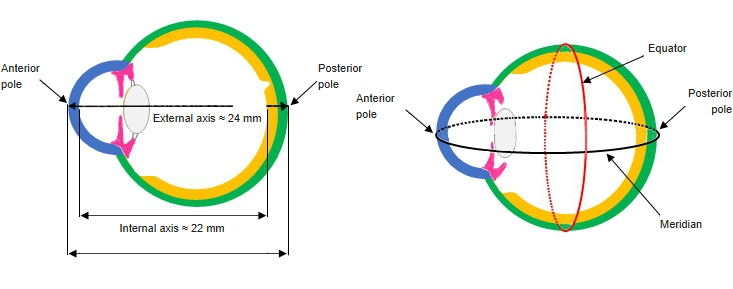
The equator is an imaginary circle that divides the eyeball into a front half and a back half. Its plane is at right angles to the external axis of the eyeball (see also optic axis), and every meridian crosses it at a right angle. The vortex veins leave the wall of the eyeball just behind the equator, and the oblique muscles of the eye attach behind it. The lens has an equator of its own, the equator of the lens: its rounded outer rim, where the zonular fibres attach.
Related terms
- Eyeball
- Meridians of eyeball
- External axis of eyeball
- Posterior pole of eyeball
- Optic axis
- Wall of eyeball
References and sources
- Further reading: Human eye, Wikipedia.
- Federative International Programme for Anatomical Terminology (FIPAT). Terminologia Anatomica, 2nd ed. (TA2), 2019.