Anterior cranial fossa (Latin: fossa cranii anterior)
The foremost of the three cranial fossae, and the shallowest.
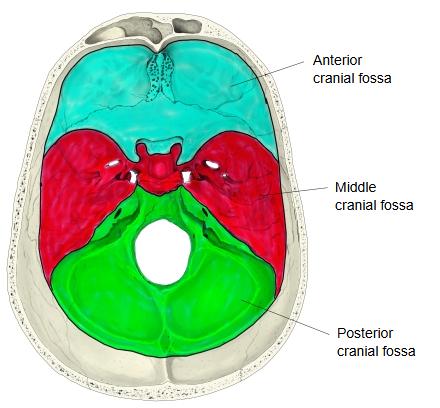
- Anterior cranial fossa : the shallowest.
- Middle cranial fossa
- Posterior cranial fossa : the deepest.
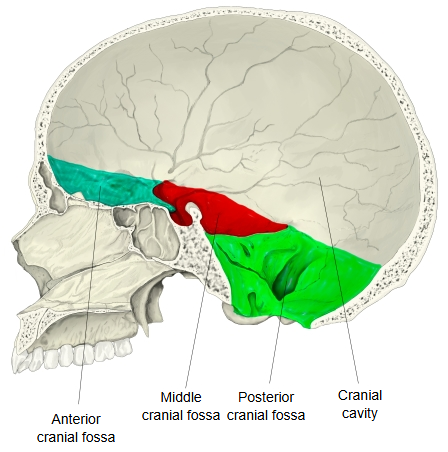
The floor of the cranial cavity rises in three steps: the anterior, middle and posterior cranial fossae. They become deeper from front to back.
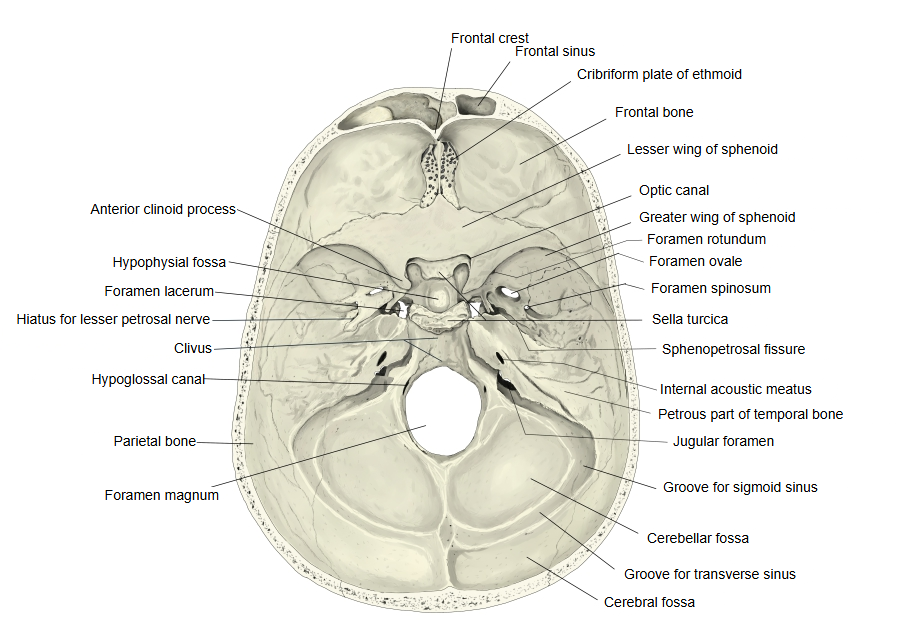
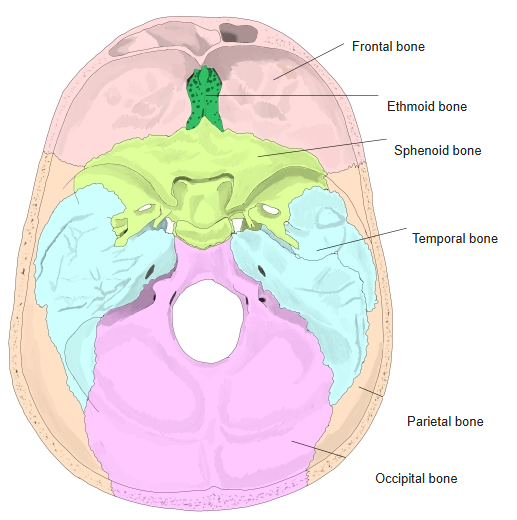
The anterior cranial fossa is formed by the orbital parts of the frontal bone, the cribriform plate of the ethmoid bone, and the body and lesser wings of the sphenoid bone.
Behind, it ends at the free edges of the lesser wings and the front of the sulcus chiasmaticus, where the middle cranial fossa begins.
It holds the frontal lobes of the brain and the olfactory bulbs. Its floor is also the roof of the orbits and of the nasal cavity.
In the midline are the crista galli and, in front of it, the frontal crest and the foramen caecum.
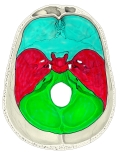 Cranial fossae (superior view)
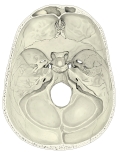 Internal surface of the cranial base
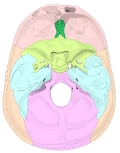 Internal surface of the cranial base (bones colour-coded)
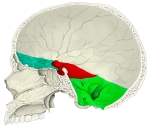 Cranial fossae (lateral view)
Related terms
- Cranial fossa
- Cranial cavity
- Cranial base
- Cranial synchondroses
- Basilar part of occipital bone
- Middle cranial fossa
- Opening of frontal sinus
- Septum of frontal sinuses
- Frontal crest
- Frontal region
- Posterior cranial fossa
- Internal cranial base
- Cribriform plate
- Crista galli
- Orbital part of frontal bone
- Lesser wing
- Frontal bone
References and sources
- Further reading: Anterior cranial fossa, Wikipedia.
- Federative International Programme for Anatomical Terminology (FIPAT). Terminologia Anatomica, 2nd ed. (TA2), 2019.