Superior cribriform area (Latin: macula cribrosa superior)
Also called the macula cribrosa superior
The superior cribriform area is one of the maculae cribrosae on the medial wall of the vestibule; it is found in the elliptical recess.
Maculae cribrosae: groups of small holes that let through the nerve fibres coming from the vestibular ganglionElliptical recess: the hollow that holds the utricle
Holes in the
medial wall of the
vestibule that
let nerves through
medial wall of the
vestibule that
let nerves through
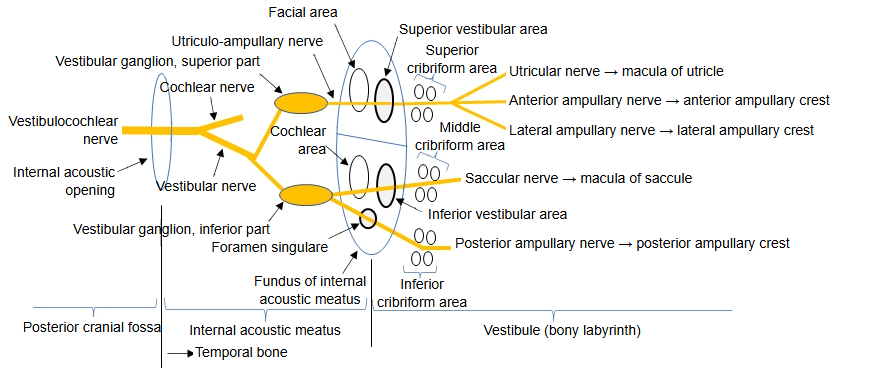
- Superior cribriform area : Site: above the pyramid of the vestibule and in the adjacent elliptical recess. Nerve: the utriculo-ampullary nerve, which it leads to the superior vestibular area.
- Middle cribriform area : Site: the floor of the spherical recess. Nerve: the saccular nerve, which it leads to the inferior vestibular area.
- Inferior cribriform area : Site: from near the cochlear recess to the opening of the bony ampulla of the posterior semicircular canal. Nerve: the posterior ampullary nerve, which it leads to the foramen singulare.
Through the superior cribriform area passes the utriculo-ampullary nerve, which comes through the superior vestibular area of the fundus of the internal acoustic meatus.
It comes from the upper part of the vestibular ganglion; after passing through, it divides into three: the utricular nerve (to the macula of the utricle) and the anterior and lateral ampullary nerves (to the ampullary crests of the anterior and lateral semicircular ducts)
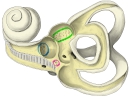 Maculae cribrosae
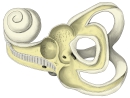 Left bony labyrinth, inner surface (opened from the lateral side)
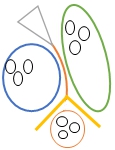 Maculae cribrosae, recesses and the vestibular crest (model)
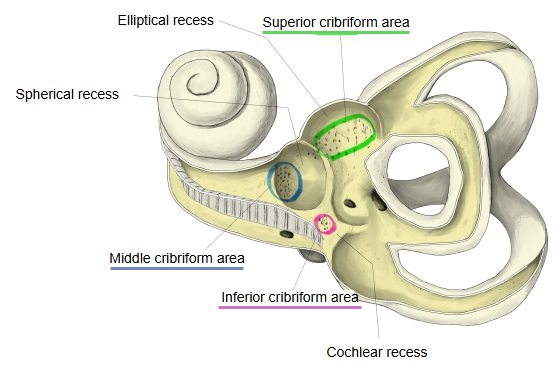
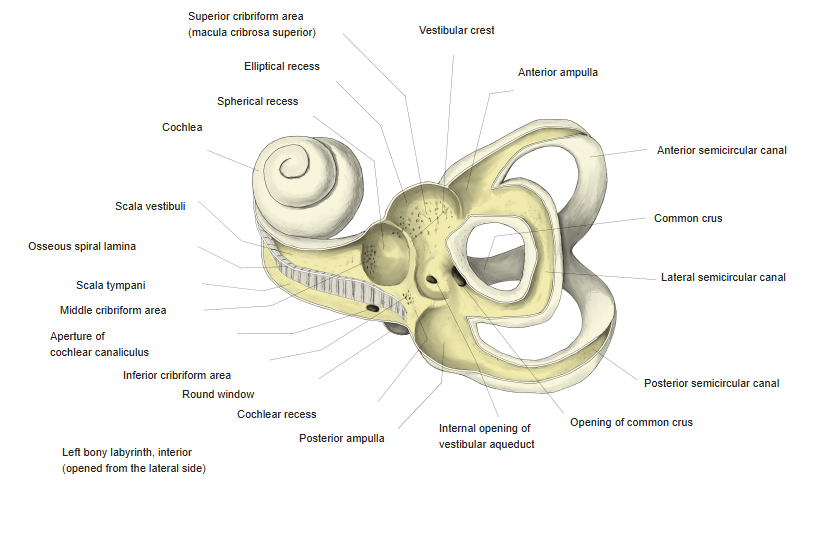
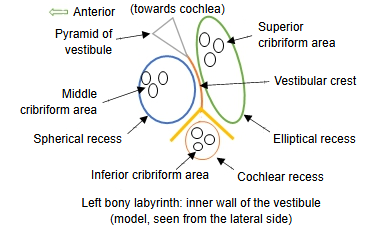
On the medial wall of the vestibule there are three maculae cribrosae, patches pierced by small holes; they are the passages for the nerves that run from the fundus of the internal acoustic meatus to the membranous labyrinth. The one above the pyramid of the vestibule is the superior cribriform area. Through the utriculo-ampullary nerve, the upper branch of the vestibular nerve, it is connected with the superior vestibular area of the internal acoustic meatus.
Reference websites
[Wikipedia]
· Bony labyrinth, Wikipedia.
· Vestibule of the ear, Wikipedia.
Related terms
- Middle cribriform area
- Superior vestibular area
- Maculae cribrosae
- Inferior cribriform area
- Elliptical recess
- Pyramid of vestibule
- Vestibular crest
- Fundus of internal acoustic meatus
- Utriculo ampullar nerve
References and sources
- Further reading: Bony labyrinth, Wikipedia.
- Further reading: Vestibule of the ear, Wikipedia.
- Federative International Programme for Anatomical Terminology (FIPAT). Terminologia Anatomica, 2nd ed. (TA2), 2019.