Plantar aponeurosis (Latin: aponeurosis plantaris)
Also called the plantar fascia
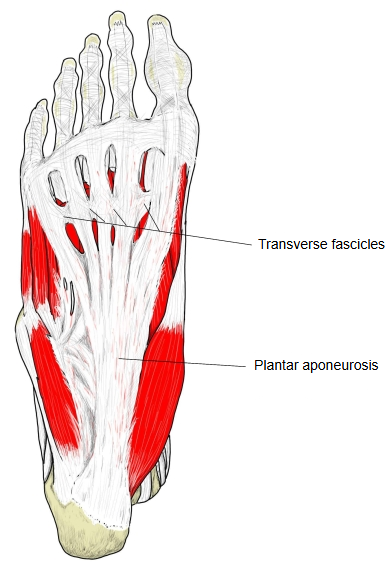
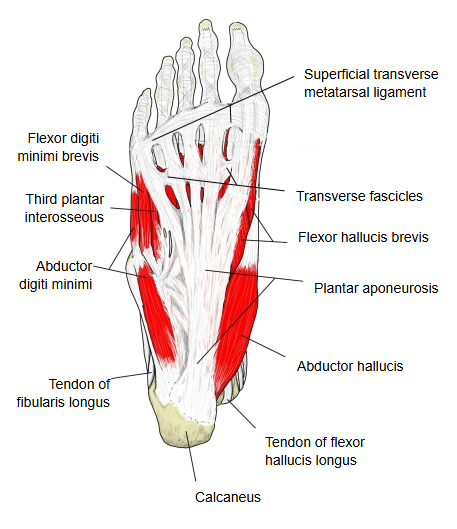
The plantar aponeurosis (plantar fascia) is the thick, fibrous sheet of deep fascia under the skin and fat of the sole of the foot, running from the heel to the toes. Its superficial layer covers the whole sole: the thin medial and lateral parts cover the muscles of the great toe (abductor hallucis) and of the little toe (abductor digiti minimi), and the lateral part is attached to the lateral process of the calcaneal tuberosity, while the thick central part arises mainly from the medial process of the calcaneal tuberosity of the calcaneus. The central part widens and thins as it runs forward, then splits into five slips, one for each toe; the slips end in the fibrous sheaths of the flexor tendons and the tissues around the metatarsophalangeal joints. In its deep layer, transverse fascicles run across the slips near the bases of the proximal phalanges and tie them together.
aponeurosis
- Superficial layer
- Medial and lateral parts : thin; cover the muscles of the great toe and of the little toe. The lateral part is attached to the lateral process of the calcaneal tuberosity.
- Central part : thick; arises mainly from the medial process of the calcaneal tuberosity. As it runs forward it thins and spreads, divides into five slips and ends in the fibrous sheaths of the flexor tendons and at the metatarsophalangeal joints.
- Deep layer : forms transverse fascicles that tie the bases of the proximal phalanges together across the slips.
It covers and gives partial origin to flexor digitorum brevis, and it helps to hold up the longitudinal arch of the foot. When the toes are bent upward, it tightens and raises the arch. Some sources use "plantar fascia" for the whole sheet and "plantar aponeurosis" only for its thick central part; sources differ.
 Sole of the right foot
Reference websites
[Wikipedia]
· Plantar fascia, Wikipedia.
[Websites with illustrations]
· Plantar aponeurosis of the right foot, inferior view (Wikimedia Commons)

· The five bundles of the central part (Wikimedia Commons)

Related terms
- Sole of foot
- Dorsum of foot
- Palmar aponeurosis
- Fascia
- Calcaneal tuberosity
- Calcaneus
- Flexor digitorum brevis
- Abductor hallucis
- Abductor digiti minimi (foot)
References and sources
- Further reading: Plantar fascia, Wikipedia.
- Federative International Programme for Anatomical Terminology (FIPAT). Terminologia Anatomica, 2nd ed. (TA2), 2019.