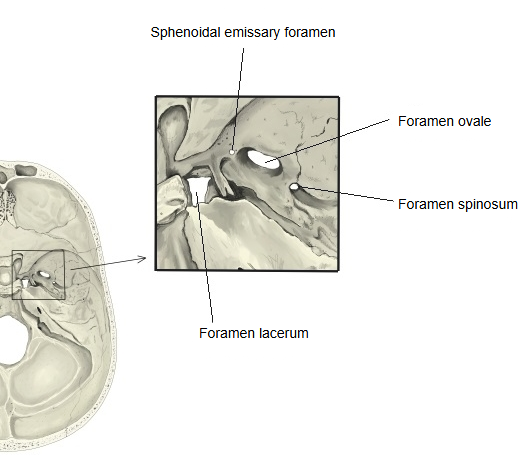
Sphenoidal emissary foramen (Latin: foramen venosum)
Also called the foramen of Vesalius (foramen Vesalii)
· It is not constant: it is often absent, and reported rates vary widely between studies.
· In terms of bones, like the foramen ovale it opens in the greater wing of the sphenoid bone. On the outer skull base it opens near the scaphoid fossa, at the root of the pterygoid process.
· Number: it may be present on one side or both, and occasionally there are two (or more) on one side.
(In that case they are distinguished by adding "anterior" and "posterior" to the name.)
· The vein is one of the emissary veins. Because it has no valves, infection from outside the skull could in principle spread along it to the cavernous sinus.
· The foramen is named after Vesalius, who first described it.
Reference websites
[Wikipedia]
· Sphenoidal emissary foramen, Wikipedia.
Related terms
- Sphenoidal rostrum
- Jugum sphenoidale
- Sphenoidal crest
- Sphenopalatine notch
- Sphenooccipital synchondrosis
- Sphenoparietal suture
- Foramen ovale
- Foramen spinosum
- Foramen lacerum
- Greater wing
- Sphenoid bone
- Cavernous sinus
- Emissary veins
References and sources
- Further reading: Sphenoidal emissary foramen, Wikipedia.
- Federative International Programme for Anatomical Terminology (FIPAT). Terminologia Anatomica, 2nd ed. (TA2), 2019.