Vertebral foramen (Latin: foramen vertebrale)
· The vertebral foramina, lined up one above another, form the vertebral canal, through which the spinal cord passes.
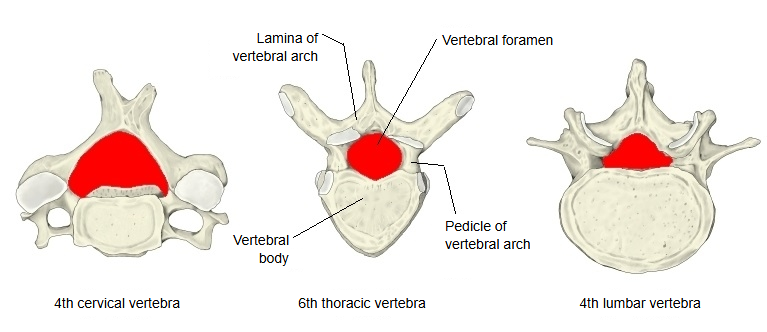
In more detail:
It is bounded by the back of the vertebral body in front, the pedicles at the sides and the laminae behind. The vertebral foramina of all the vertebrae line up to form the vertebral canal, which holds the spinal cord, its meninges and the roots of the spinal nerves. Its shape varies by region: large and triangular in the cervical vertebrae, small and round in the thoracic vertebrae, and triangular in the lumbar vertebrae. The atlas has the largest vertebral foramen, because it has no vertebral body.
Reference websites
[Wikipedia]
· Vertebra, Wikipedia.
· Spinal canal, Wikipedia.
[Websites with illustrations]
· A cervical vertebra (Gray's Anatomy, fig. 84) (Wikimedia Commons)

· A lumbar vertebra from above (Gray's Anatomy, fig. 94) (Wikimedia Commons)

· The vertebral column (TeachMeAnatomy)
Related terms
- Vertebral arch
- Vertebra
- Pedicle of vertebral arch
- Lamina of vertebral arch
- Vertebral canal
- Vertebral body
- Spinous process
- Spinal cord
- Cervical vertebrae
- Thoracic vertebrae
- Lumbar vertebrae
References and sources
- Further reading: Vertebra, Wikipedia.
- Further reading: Spinal canal, Wikipedia.
- Federative International Programme for Anatomical Terminology (FIPAT). Terminologia Anatomica, 2nd ed. (TA2), 2019.