Osteon (Latin: osteonum)
Also called Haversian system
(Haversian
system)
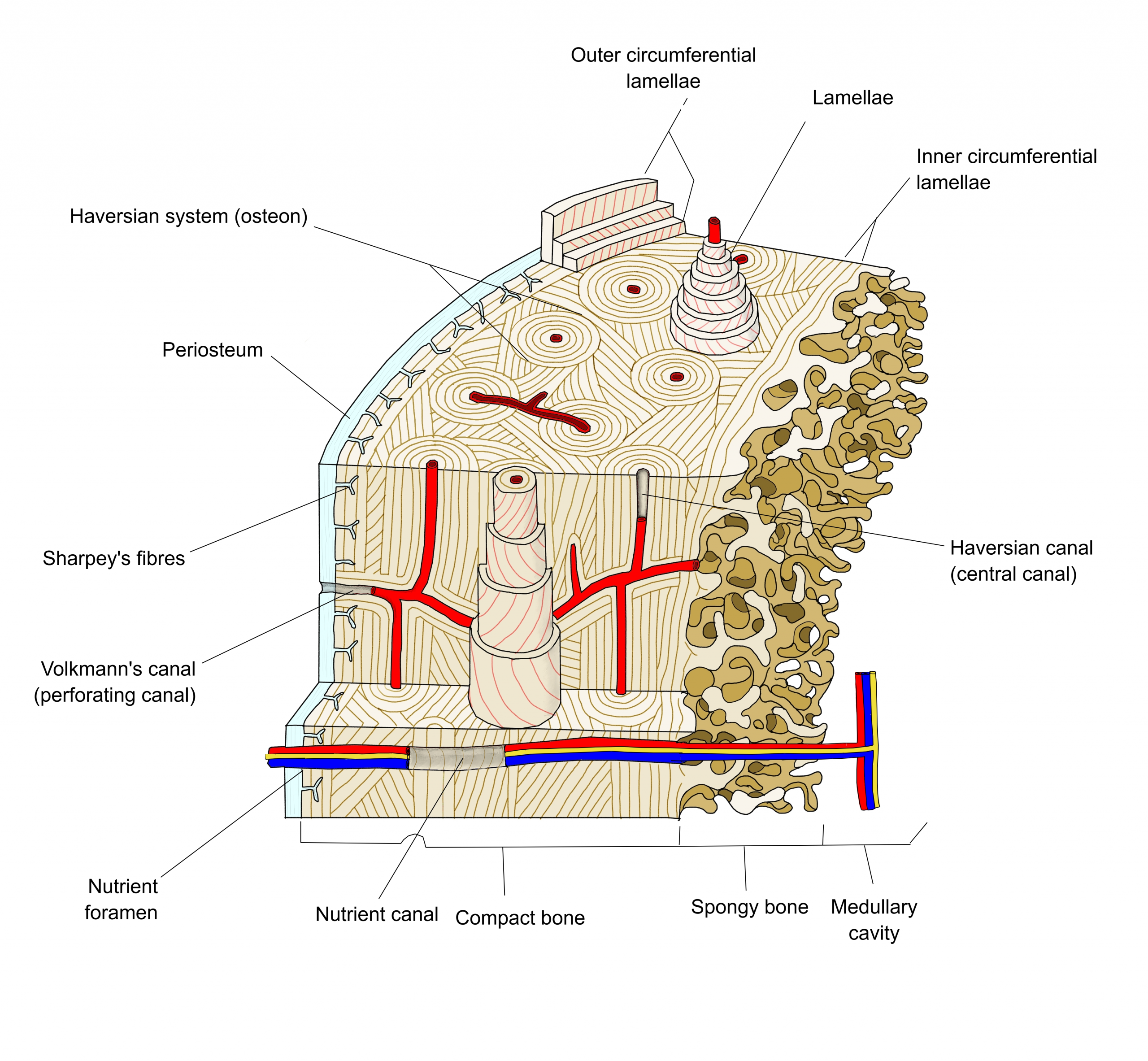
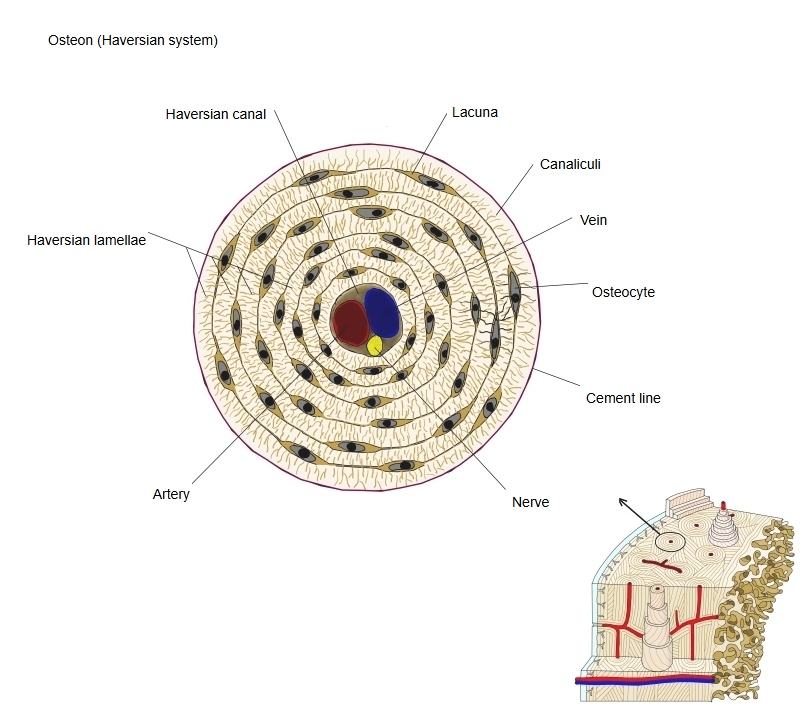
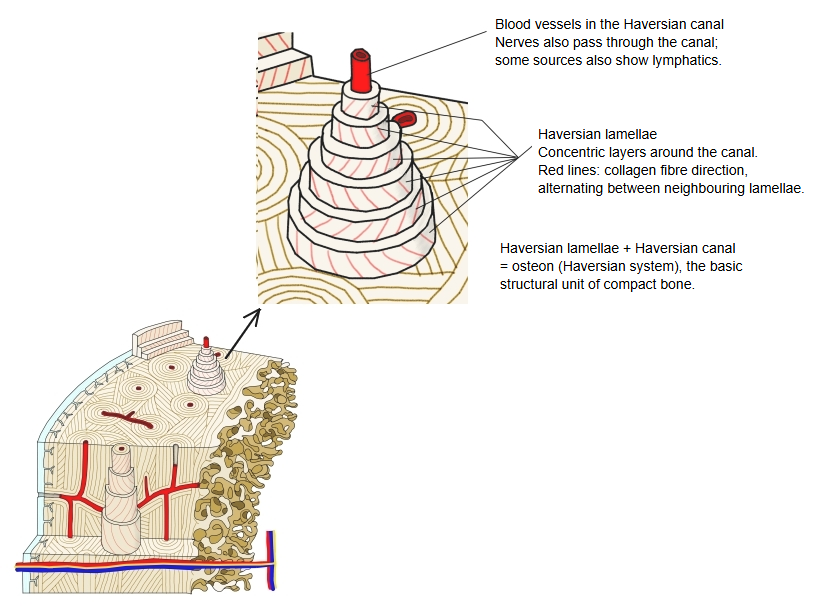
- Haversian lamellae : the set of concentric layers of bone, the bone lamellae, that make up the wall of the osteon.
- Haversian canal : the tunnel-like space in the centre of the Haversian lamellae that carries small blood vessels and nerves.
Osteons are typically about 0.25–0.35 mm across; their length is hard to define, and estimates range from several millimetres to about 1 cm. They run mostly along the long axis of the bone.
Volkmann's (perforating) canals run across the bone and connect the Haversian canals with each other and with the periosteum and the marrow cavity. Fine channels (canaliculi) link the lacunae with each other and with the central canal.
The collagen fibres in neighbouring lamellae run in alternating directions, which makes the bone stronger. As bone is remodelled, old osteons are partly removed and new ones form; the leftover pieces between them are the interstitial lamellae.
The Haversian system is named after the English physician Clopton Havers.
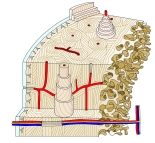 Structure of compact bone
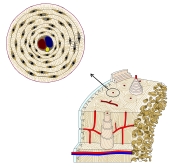 Osteon (cross section)
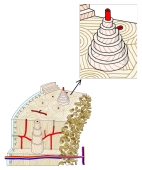 Haversian lamellae
Reference websites
[Wikipedia]
· Osteon, Wikipedia.
· Haversian canal, Wikipedia.
[Websites with illustrations]
· Compact and spongy bone of a long bone (illustration) (Wikimedia Commons)

Related terms
- Interstitial lamellae
- Blood
- Compact bone
- Perforating canal
- Outer circumferential lamellae
- Inner circumferential lamellae
- Periosteum
- Endosteum
- Bone marrow
References and sources
- Further reading: Osteon, Wikipedia.
- Further reading: Haversian canal, Wikipedia.
- Federative International Programme for Anatomical Terminology (FIPAT). Terminologia Anatomica, 2nd ed. (TA2), 2019.