Secretory granule (Latin: granulum secretorium)
Also called the secretory vesicle (dense-core granule)
- Overview
- How it is formed
- Cells with secretory granules
- Contents
- Secretion without granules
- Related terms
Overview
· Not every cell has secretory granules; in fact, cells without them are far more numerous in the body.
The most numerous cells of the human body, the red blood cells, have no secretory granules.
How it is formed
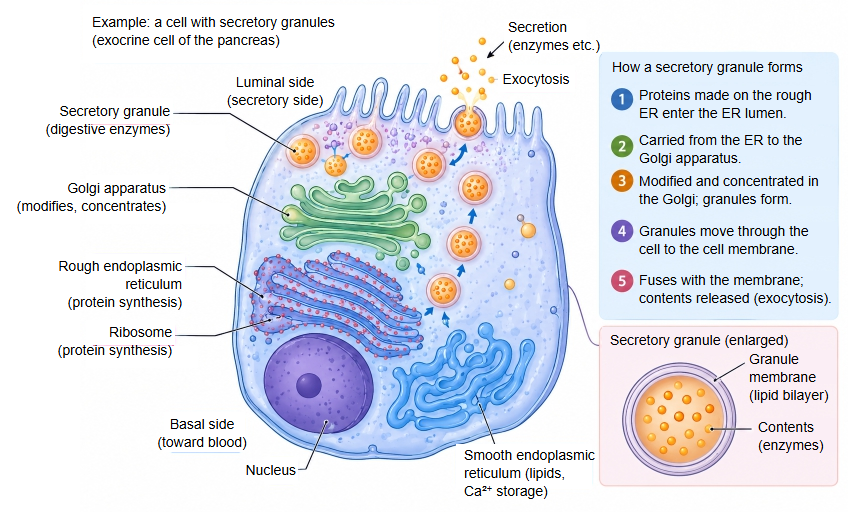
The main steps from the formation of a secretory granule to its release are shown below. Granules are formed by the Golgi apparatus from proteins made on the rough endoplasmic reticulum, and are released by exocytosis: the granule membrane fuses with the plasma membrane and the contents leave the cell.
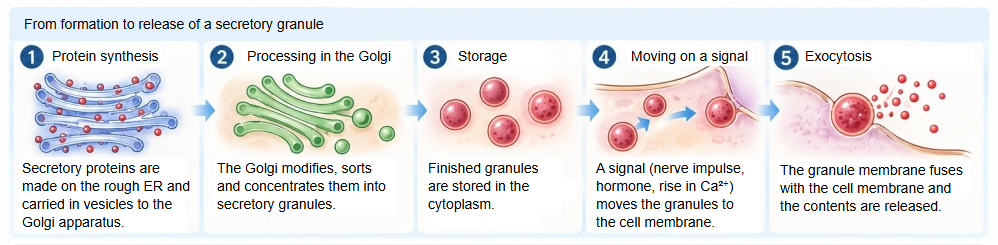
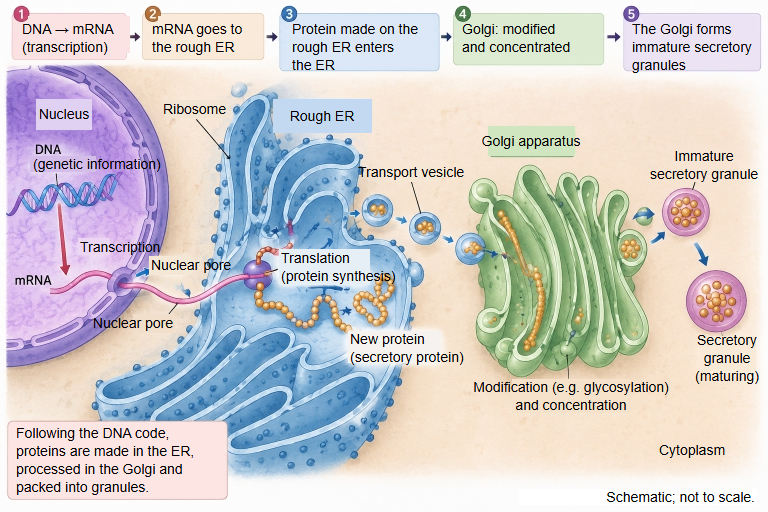
- Synthesis: secretory proteins are made by ribosomes on the rough endoplasmic reticulum and enter its lumen.
- Processing: transport vesicles carry them to the Golgi apparatus, where they are modified (for example by adding sugar chains), sorted and concentrated.
- Packaging: the Golgi buds off immature granules, which mature as their contents become more concentrated.
- Storage: mature granules wait in the cytoplasm, often near the cell surface that faces the lumen.
- Release: a signal, such as a nerve impulse, a hormone or a rise in calcium inside the cell, moves the granules to the cell membrane, where they release their contents by exocytosis.
Cells with secretory granules
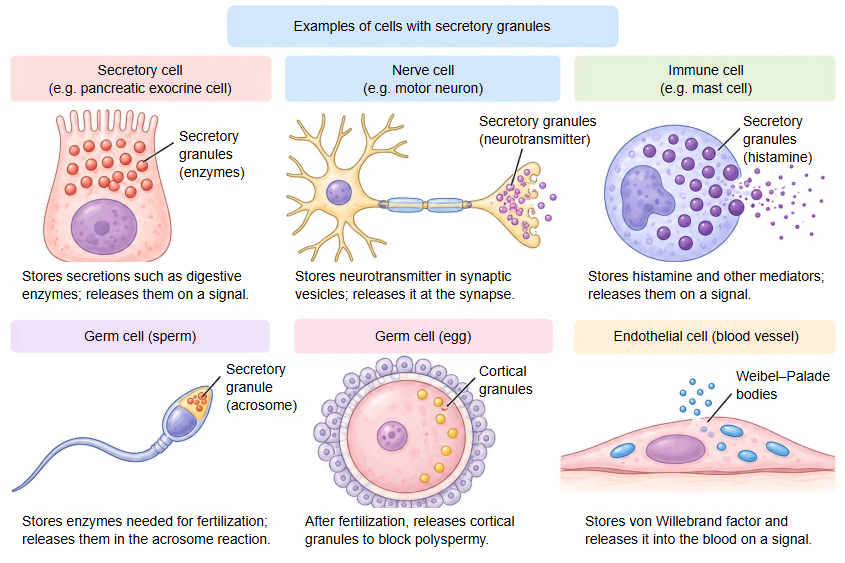
Listed comprehensively, the main cells with secretory granules fall into about 7–8 broad groups, which contain more than 20–30 kinds of cells (the numbers depend on how finely they are grouped).
Typical cells with secretory granules are listed below.
| Group | Cells (examples) | Main products (granule contents) | |
|---|---|---|---|
| 1 | Exocrine gland cells | Acinar cells of the pancreas (the serous cells of the end pieces), serous cells of the salivary glands, chief cells of the stomach | Digestive enzymes (amylase, pepsinogen and others), stored in zymogen granules |
| 2 | Endocrine cells | Alpha and beta cells of the pancreatic islets, cells of the anterior pituitary, enteroendocrine cells of the gut | Peptide hormones (insulin, glucagon, growth hormone and others) |
| 3 | Nerve cells | Nerve endings in the brain and the periphery; neurosecretory cells of the hypothalamus | Neurotransmitters (acetylcholine and others, in synaptic vesicles), neurohormones (oxytocin and others) |
| 4 | Immune cells | Granulocytes (neutrophils, eosinophils, basophils), mast cells, killer T cells, NK cells | Bactericidal enzymes, histamine, cytotoxic proteins (perforin and others) |
| 5 | Blood and vessel cells and fragments | Platelets (and megakaryocytes), endothelial cells of the vessels (Weibel–Palade bodies) | Clotting factors, vasoconstrictor substances, growth factors |
| 6 | Muscle cells (certain sites) | Atrial muscle cells | Atrial natriuretic peptide (ANP, a hormone that lowers blood pressure) |
| 7 | Germ cells | Egg (cortical granules), sperm (acrosome) | Enzymes that block polyspermy; enzymes that dissolve the coats of the egg |
| 8 | Other special epithelial cells | Type II alveolar cells of the lung, melanocytes (pigment cells) of the skin | Pulmonary surfactant (lipids and proteins), melanin pigment |
Contents
Typical substances stored in secretory granules are listed below.
| 1. Hormones (endocrine system) |
| Chemical messengers carried by the blood to distant organs. Peptide and protein hormones: · Insulin / glucagon (pancreas: control of the blood sugar level) · Oxytocin / vasopressin (hypothalamus and posterior pituitary: childbirth, water reabsorption) · Growth hormone (GH) / prolactin (anterior pituitary: growth, milk secretion) · Parathyroid hormone (PTH) (parathyroid glands: control of the calcium level) · Atrial natriuretic peptide (ANP) (heart: control of blood pressure and fluid volume) Sources: ScienceDirect, Diabetes, PMC Amino-acid-derived hormones (catecholamines and others): · Adrenaline / noradrenaline (suprarenal medulla: sympathetic response, rise in blood pressure) |
| 2. Neurotransmitters and neuropeptides (nervous system) |
| Substances that pass signals between nerve cells (across the synaptic cleft). Small-molecule neurotransmitters (stored with hormones in large secretory granules): · Serotonin (brain, enterochromaffin cells of the gut and others) · Dopamine (brain, suprarenal medulla and others) · Acetylcholine (nerve endings and others; mainly in ordinary synaptic vesicles, partly in secretory granules) Sources: ScienceDirect, Diabetes Neuropeptides: · Enkephalins / dynorphins (brain: opioid-like substances involved in pain relief and pleasure) · Substance P (a peptide involved in the transmission of pain) · Cholecystokinin (CCK) (brain and digestive tract: signals for satiety and for the secretion of digestive juices) |
| 3. Exocrine enzymes (digestion and defence) |
| Proteins secreted outside the body (into the lumen of the digestive tract, onto the body surface and so on) that break down or process substances. Digestive enzymes (and their precursors): · Pepsinogen (stomach: turned into pepsin by the gastric acid; digests proteins) · Amylase / trypsinogen / chymotrypsinogen (pancreas: digestion of carbohydrates and proteins) · Salivary amylase (salivary glands: breaks down starch in the saliva) Enzymes for defence and processing: · Renin (kidney: cleaves a precursor peptide to raise the blood pressure; it is released into the blood, so strictly an endocrine product) · Lysozyme (lacrimal glands, salivary glands, white blood cells: an antibacterial enzyme that breaks down bacterial cell walls) |
| 4. Immune and allergy-related substances |
| Stored in the granules of immune cells (mast cells, white blood cells and others); they attack foreign matter and set off inflammation. Chemical mediators: · Histamine (mast cells and basophils: widens vessels and causes allergic and inflammatory reactions) · Serotonin (granules of platelets: vessel constriction, clot formation) Cytotoxic proteins (for attack): · Perforin / granzymes (killer T cells and NK cells: make holes in target cells and make them die) Inflammatory cytokines: · TNF-α (tumour necrosis factor) (partly stored in mast cells and others and released at once) Source: Annals of Allergy, Asthma & Immunology |
| 5. Granule matrix and scaffold proteins |
| Proteins that act as a scaffold to pack hormones and other products densely and stably (in near-crystalline form) inside the granule. They are released together with the contents. Granin family: · Chromogranin A / chromogranin B (widespread in the secretory granules of endocrine cells and nerve cells) · Secretogranins |
Secretion without granules
Are all substances that are made in a cell and secreted from it carried in secretory granules?
No. Storing products in granules lets a cell release a large amount quickly when it is stimulated (regulated secretion), but hormones, enzymes and neurotransmitters made in a cell are not always packed into secretory granules. There are four main routes or exceptions in which no granule is used:
1. 1. Constitutive secretion (released as soon as made): substances secreted this way do not form secretory granules.
Mechanism: after they are made in the rough endoplasmic reticulum and the Golgi apparatus, they are not concentrated into granules but are carried continuously in small membrane vesicles to the cell membrane and released.
Examples: antibodies (immunoglobulins) made by immune cells such as plasma cells, collagen made by fibroblasts, and some hormones that are secreted continuously.
2. 2. Fat-soluble hormones: insulin and other peptide hormones dissolve in water, but hormones that dissolve in fat pass through membranes, so they cannot be kept inside secretory granules at all.
Mechanism: the granule membrane is made of lipids, so fat-soluble substances cross it freely. They are therefore not stored after they are made, but leave the cell directly through the cell membrane.
Examples:
Steroid hormones: hormones of the suprarenal cortex (cortisol and others) and sex hormones (oestrogens, testosterone and others).
Thyroid hormones: derived from an amino acid but fat-soluble; they are not stored in secretory granules (their store is the colloid of the thyroid follicles) and leave the cell through the cell membrane, mainly by way of transporters.
3. 3. Neurotransmitters carried out by transporters: not all neurotransmitters are released by exocytosis.
Mechanism: some neurotransmitters lie free in the cytoplasm, outside any vesicle, and are moved out through dedicated carrier proteins (transporters) in the cell membrane.
Example: reverse transport. When the brain is overexcited, or under certain drugs (amphetamine and others), dopamine and noradrenaline can be released straight out of the cell by transporters running backwards, without vesicles.
4. 4. Gaseous neurotransmitters and signalling molecules: some gas molecules are now known to act as neurotransmitters and signalling substances.
Mechanism: a gas cannot be shut inside a membrane-bound granule. As soon as it is made in the cell, it passes through the cell membrane and spreads to the surrounding cells.
Examples: nitric oxide (NO) and carbon monoxide (CO). They widen blood vessels and carry nerve signals, but use no secretory granules at all.
Related terms
References and sources
- Further reading: Secretory vesicle, Wikipedia.
- Federative International Programme for Anatomical Terminology (FIPAT). Terminologia Anatomica, 2nd ed. (TA2), 2019.