White adipocyte (Latin: adipocytus albus)
Also called white fat cell or unilocular adipocyte
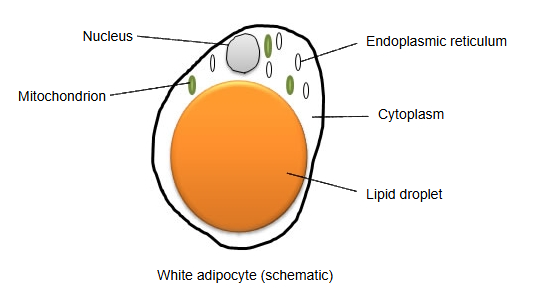
One of the fat cells of the body: it stores fat. In contrast, the fat cell that burns fat to produce heat is called the brown adipocyte.
In more detail
A white adipocyte contains one large lipid droplet (hence 'unilocular adipocyte'); the nucleus, the endoplasmic reticulum, the mitochondria and the rest are pushed to the edge as a thin rim, giving a signet-ring look in sections. The cells are large (often about 70-120 µm across), each surrounded by reticular fibres and close to capillaries.
An adult has about 25-30 billion of them (40-60 billion in obesity). Once their number has increased, it stays roughly the same for life: old cells die and are replaced, but the total hardly falls even after weight loss. Each cell can also swell to 3-4 times its size by storing more fat.
They are found all over the body: those under the skin (subcutaneous tissue) are called subcutaneous fat, and those around the internal organs visceral fat. They also form fat pads such as the buccal fat pad.
Note: the numbers differ between sources; some give an upper limit of 80-100 billion, and some say
that a person may have as many as 300 billion.
Functions
White and brown adipocytes are both fat cells, but they work quite differently. Besides the two functions below, white fat also insulates against heat loss and cushions the organs.
1. Storing energy
Nutrients taken in with food are stored in the form of neutral fat (triglyceride).
2. Secretion of biologically active substances
White adipocytes secrete the following active substances (adipokines and hormones).
| Substance | Action | |
|---|---|---|
| 1 | Adiponectin | A hormone with these actions: it increases sensitivity to insulin, it restrains arteriosclerosis and hypertrophy of the heart muscle, and it reduces inflammation. The more obese a person, the less of it is secreted. |
| 2 | PAI-1 | Plasminogen activator inhibitor-1, a protein that slows the breakdown of blood clots; an excess favours thrombosis and heart disease such as angina. The more obese a person, the more of it is secreted. |
| 3 | TNF-α | Tumour necrosis factor alpha; an excess weakens the action of insulin. The more obese a person, the more of it is secreted. |
| 4 | Leptin | A peptide hormone that regulates appetite and metabolism. |
| 5 | Estrogen | A steroid hormone, also called the follicular hormone or female sex hormone; adipose tissue makes it from other steroid hormones. |
When fat cells increase in number
There are times in life when fat cells increase in number. Overnutrition at these times especially makes them multiply:
· the fetus late in pregnancy; infancy (the first year after birth); puberty.
Related terms
- Brown adipocyte
- Subcutaneous tissue
- Fibrofatty tissue
- Buccal fat pad
- Perirenal fat capsule
- Orbital fat body
- Organelle
References and sources
- Further reading: White adipose tissue, Wikipedia.
- Further reading: Adipocyte, Wikipedia.
- Federative International Programme for Anatomical Terminology (FIPAT). Terminologia Anatomica, 2nd ed. (TA2), 2019.