Cells of Hensen
Also called Hensen's cells
· They are columnar cells that are wide at the top; their most typical feature is the presence of lipid droplets in the cytoplasm.
· Cells of irregular shape and varying height are packed together in a single layer and form a raised ridge.
See the description further down the page.
of
Corti
- Hair cells
- Inner hair cells : in a single row on the inner side of the inner pillar cells, with stereocilia on their free surface.
- Outer hair cells : in several rows on the outer side of the outer pillar cells; several times as many as the inner hair cells.
- Supporting cells
- Inner pillar cells : outside the inner hair cells; with the outer pillar cells they form the tunnel of Corti.
- Outer pillar cells : inside the outer hair cells; with the inner pillar cells they form the tunnel of Corti.
- Inner phalangeal cells : on the inner side of the inner pillar cells; they support the inner hair cells.
- Outer phalangeal cells : = cells of Deiters. Outside the outer pillar cells; they support the outer hair cells in several rows. Related terms: space of Nuel, phalangeal process, reticular membrane, Retzius fibre.
- Cells of Hensen : several rows of cells outside the outer phalangeal cells, forming the outer slope of the organ of Corti.
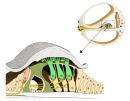 Organ of Corti
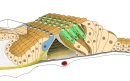 Organ of Corti (tectorial membrane removed)
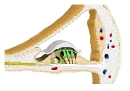 Cochlear duct
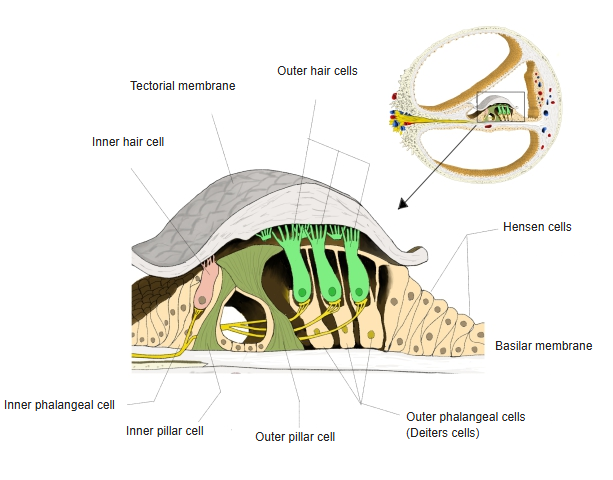
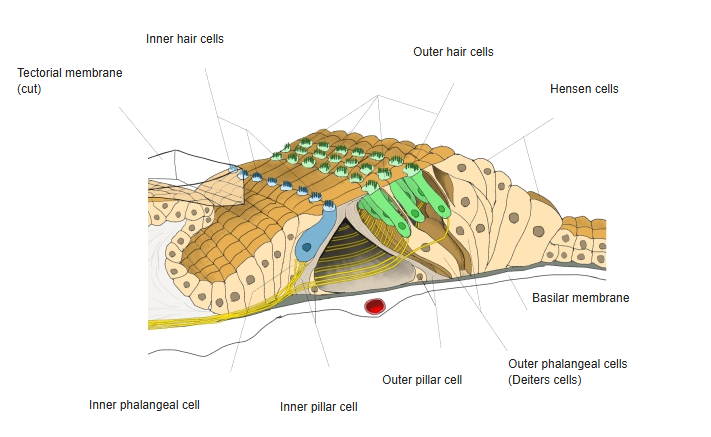
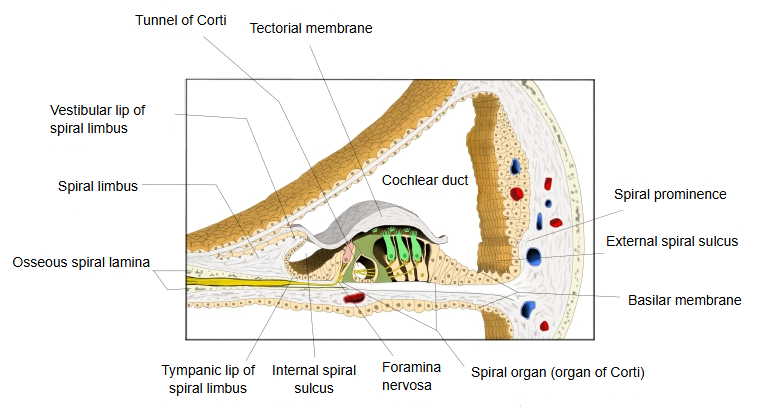
The cells of Hensen are a large group of epithelial cells that stand on the basilar membrane outside the cells of Deiters (outer phalangeal cells) and the outer hair cells, and form the outer slope of the organ of Corti, which falls towards the outer side of the cochlear duct. The cells form a single layer, but they differ in shape and height and the tall cells may lean over the lower ones, so the layer can look stratified; under the pressure within the epithelium some cells may even lie completely on top of others, as is always seen on the inner slope of the organ. Further outwards the cells become lower and continue into the cells of Claudius.
Lipid droplets in the cytoplasm are most obvious in the upper turns of the cochlea. The cells are joined to each other and to other supporting cells by many gap junctions. They give mechanical support to the organ of Corti and help to keep its ionic environment stable, including the removal of potassium ions released by the hair cells. In birds and other non-mammals, supporting cells like these can replace lost hair cells; mammals lack this ability. The cells are named after the German anatomist and physiologist Victor Hensen (1835–1924).
Reference websites
[Wikipedia]
· Hensen's cell, Wikipedia.
Related terms
- Spiral organ (organ of Corti)
- Organ of Corti
- Outer phalangeal cell
- Basilar membrane
- Reticular membrane
- Tunnel of Corti
- Cochlear duct
References and sources
- Further reading: Hensen's cell, Wikipedia.
- Federative International Programme for Anatomical Terminology (FIPAT). Terminologia Anatomica, 2nd ed. (TA2), 2019.