Cells of Deiters
Also called Deiters' cells
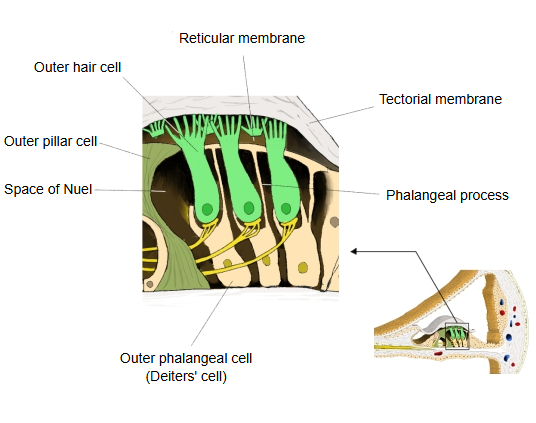
Cells of Deiters are one of the supporting cells of the organ of Corti; they hold the outer hair cells, which stand in several rows.
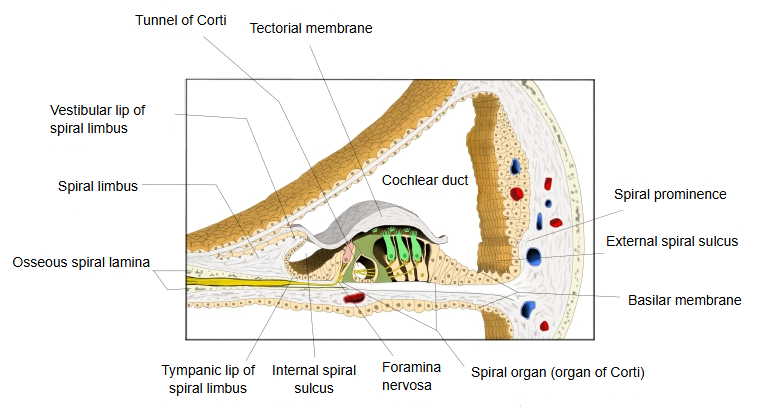
Cells of Deiters = outer phalangeal cells, named after the German anatomist Otto DeitersOrgan of Corti: the part of the cochlear duct of the cochlea that is essential for hearing (spiral organ)
Organ
of
Corti
of
Corti
- Hair cells
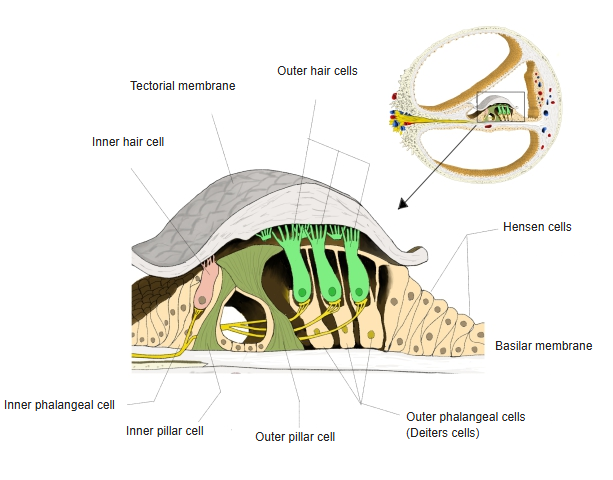
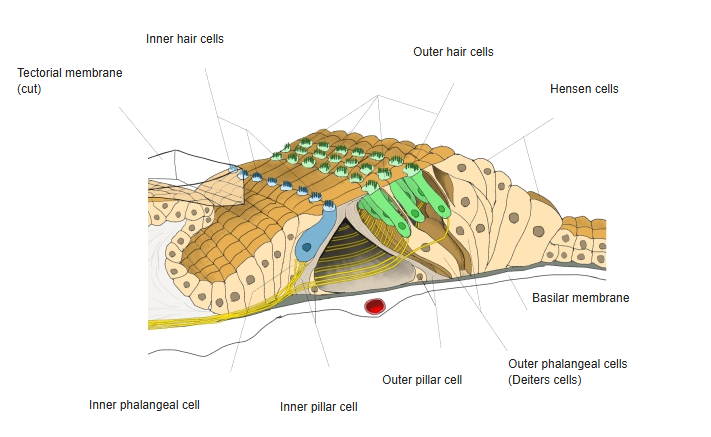
- Inner hair cells : in a single row on the inner side of the inner pillar cells, with stereocilia on their free surface.
- Outer hair cells : in several rows on the outer side of the outer pillar cells; several times as many as the inner hair cells.
- Supporting cells
- Inner pillar cells : outside the inner hair cells; with the outer pillar cells they form the tunnel of Corti.
- Outer pillar cells : inside the outer hair cells; with the inner pillar cells they form the tunnel of Corti.
- Inner phalangeal cells : on the inner side of the inner pillar cells; they support the inner hair cells.
- Outer phalangeal cells : = cells of Deiters. Outside the outer pillar cells; they support the outer hair cells in several rows. Related terms: space of Nuel, phalangeal process, reticular membrane, Retzius fibre.
- Cells of Hensen : several rows of cells outside the outer phalangeal cells, forming the outer slope of the organ of Corti.
Features
· The gap between the cells of Deiters (= outer phalangeal cells), the outer pillar cells and the outer hair cells is called the space of Nuel.
· Each cell starts on the basilar membrane with a hexagonal foot plate.
· Its upper half becomes extremely thin and is called the phalangeal process; at the top it joins the reticular membrane. Below this, the outer hair cell sits in a cup on the upper surface of the cell body.
· In the thickened middle part of the cell body the cytoplasm is markedly granular and contains the nucleus.
· A single thin thread (the Retzius fibre, a modified part of the cytoplasm) runs through the whole length of the cell.
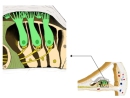 Outer hair cells and the space of Nuel
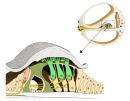 Spiral organ (section)
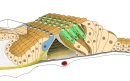 Spiral organ (3D view)
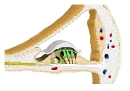 Cochlear duct (section)
Reference websites
[Wikipedia]
· Deiters' cells, Wikipedia.