Osteoblast (Latin: osteoblastus)
Overview
Where it is found
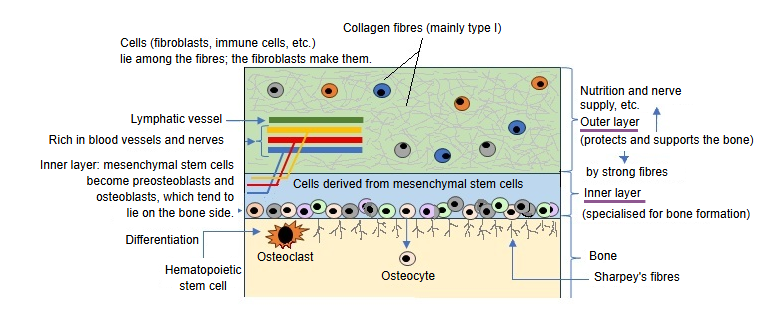
1. 1. Periosteum: it has two layers, an outer fibrous layer and an inner cellular layer; osteoblasts and the other cells lie in the thin inner layer next to the bone.
2. 2. Endosteum: a very thin membrane that lines the medullary cavity, the canals for vessels and nerves (Haversian canals and Volkmann's canals) and the trabeculae of spongy bone.
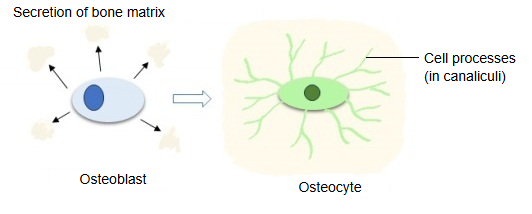
3. 3. Bone surface: osteoblasts are not found inside the bone substance; they sit on bone surfaces, especially where remodelling is active, and some of them go on to become osteocytes; others flatten into bone-lining cells or die.
· Together with osteoclasts (derived from haematopoietic stem cells through the monocyte-macrophage line), osteoblasts play a central part in bone remodelling (the continual removal and rebuilding of bone).
From mesenchymal stem cell to osteocyte
The figure below is a schematic of the structure of the periosteum. In the periosteum, the pre-osteoblasts lie in rows in the inner layer, close to the bone.
Receptors
The actions of oestrogen on osteoblasts are, in brief:
1. 1. Promotes bone formation
It stimulates the proliferation and differentiation of osteoblasts and their secretion of bone matrix, which helps to maintain bone mass.
2. 2. Suppresses bone resorption (indirectly)
It shifts the balance of RANKL and OPG made by osteoblasts (less RANKL, more OPG), which restrains the activity of osteoclasts and so reduces bone resorption.
3. 3. Bone loss after the menopause
After the menopause, oestrogen falls; osteoblast activity drops while osteoclast activity rises, which leads to osteoporosis.
Because of this large clinical effect, the oestrogen receptors receive particular attention.
Receptors of osteoblasts
| Substance | Receptor | Main effects | |
|---|---|---|---|
| 1 | Oestrogen | ERα, ERβ (oestrogen receptors) | promotes bone formation; restrains osteoclasts |
| 2 | Parathyroid hormone (PTH) | PTH1R (PTH receptor type 1) | regulates both bone formation and bone resorption |
| 3 | Active vitamin D (1,25(OH)2D3) | VDR (vitamin D receptor) | regulates calcium balance (calcium absorption); increases the expression of bone matrix proteins |
| 4 | Thyroid hormone (T3) | TRα, TRβ (thyroid hormone receptors) | speeds up bone turnover |
| 5 | Growth hormone / IGF-1 | IGF-1 receptor (IGF-1R) | promotes osteoblast proliferation and differentiation |
| 6 | Glucocorticoids | GR (glucocorticoid receptor) | inhibit osteoblast proliferation; reduce bone formation |
Osteoblasts and osteocytes compared
| Feature | Osteoblast | Osteocyte | |
|---|---|---|---|
| 1 | Shape | cuboidal to polygonal | flattened to oval body with long, slender processes |
| 2 | Size | larger | smaller than the osteoblast |
| 3 | Position | on bone surfaces (periosteum, endosteum) | embedded in the bone matrix, each in its own lacuna, throughout the bone |
| 4 | Function | secretes bone matrix (osteoid); forms bone | senses loading and regulates remodelling; transport of nutrients and waste |
| 5 | Origin | mesenchymal stem cell → osteoblast | osteoblast → osteocyte |
| 6 | Oestrogen receptors | present (ERα, ERβ) | present (ERα, ERβ) |
| 7 | Cell processes | few | many branched processes in the canaliculi, linked with other osteocytes and the cells on the bone surface |
| 8 | Role in bone formation | leading | maintains the matrix and regulates remodelling |
| 9 | Movement | can move along the bone surface and line up | fixed; does not move within the matrix |
Video
Related terms
- Stem cell
- Mesenchymal stem cell
- Osteocyte
- Osteoclast
- Periosteum
- Endosteum
- Bone matrix
- Osteon
- Cell layer of periosteum
- Osteoblastic niche
References and sources
- Further reading: Osteoblast, Wikipedia.
- Further reading: Bone remodeling, Wikipedia.
- Federative International Programme for Anatomical Terminology (FIPAT). Terminologia Anatomica, 2nd ed. (TA2), 2019.