Cytoplasm (Latin: cytoplasma)
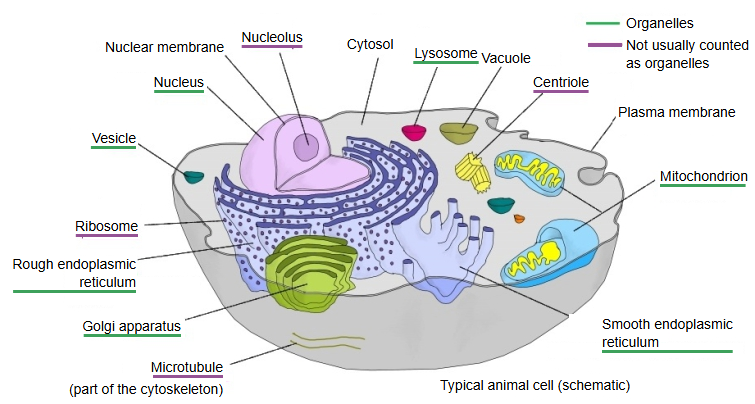
The cytoplasm is one of the components of a cell: everything in the cell except the cell membrane on the outside and the nucleus.
Structure
of the
cell
of the
cell
- Cell membrane : phospholipid bilayer, membrane proteins, sugar chains
- Cytoplasm
- Cytosol : water, electrolytes, metabolic enzymes, free amino acids, metabolic intermediates
- Organelles : mitochondria, endoplasmic reticulum, centrosome, Golgi apparatus, lysosomes, peroxisomes, vesicles (some sources do not count vesicles as organelles)
- Cytoskeleton : microtubules, actin filaments, intermediate filaments
- Nucleus : nuclear envelope, nucleoplasm, chromatin, nucleolus; the nucleus is also counted among the organelles
Most of the cell's metabolism, including protein synthesis on the ribosomes and the first steps of sugar breakdown (glycolysis), takes place in the cytoplasm.
The material inside the nucleus is called nucleoplasm, not cytoplasm. Sources differ on whether small vesicles and some other structures are counted as organelles.
Related terms
- Golgi apparatus
- Cytoskeleton
- Endoplasmic reticulum
- Organelle
- Cell nucleus
- Plasma membrane
- Nucleoplasm
- Microtubule
- Nuclear envelope
References and sources
- Further reading: Cytoplasm, Wikipedia.
- Federative International Programme for Anatomical Terminology (FIPAT). Terminologia Anatomica, 2nd ed. (TA2), 2019.