Adipose tissue (Latin: Textus adiposus)
Also called the fat tissue or the body fat
Overview
The diagram below follows a standard Japanese anatomy textbook, which counts adipose tissue as one type of connective tissue proper;
other sources describe it a little differently, for example:
Adipose tissue is a loose connective tissue made up of adipocytes; some texts call it a specialised loose connective tissue.
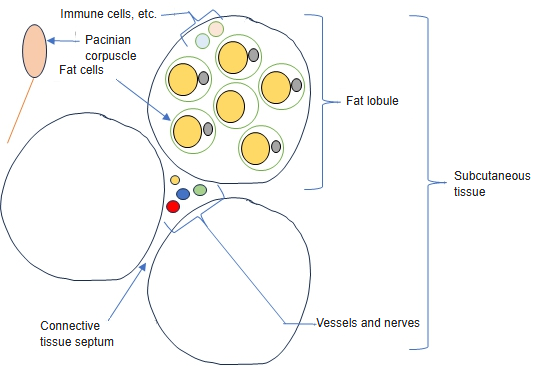
Unlike typical connective tissue, it has little extracellular matrix: the adipocytes are packed together in lobules, each wrapped by a network of small blood vessels, and the lobules are separated by thin septa of connective tissue that carry the vessels and nerves. Besides adipocytes it contains preadipocytes, fibroblasts, vessel cells and immune cells such as macrophages.
tissue
- Connective tissue proper
- Loose connective tissue : the most widespread (subcutaneous tissue, mucosa, around vessels and elsewhere); few fibres. Together with dense connective tissue it is called fibrous connective tissue.
- Dense connective tissue : contains many fibres and is very strong; the dermis, ligaments, tendons.
- Adipose tissue : made up of adipocytes; found throughout the body, especially well developed under the skin.
- Reticular tissue : reticular cells and reticular fibres form a network; the spleen, lymph nodes, bone marrow, the thymus.
- Specialised connective tissue
- Blood : plasma (a liquid matrix) and blood cells (red blood cells, white blood cells, platelets).
- Lymph : the fluid in the lymph vessels; similar in make-up to plasma, with lymphocytes.
- Bone : inorganic matter (about 70%, mainly calcium phosphate) and organic matter (collagen and others). With cartilage it forms the supporting tissues in the narrow sense.
- Cartilage : hyaline, fibrous and elastic cartilage; main components collagen fibres and proteoglycans.
Note: embryonic connective tissue (the immature connective tissue of the embryo: mesenchyme and mucous connective tissue) is sometimes counted as a further group of connective tissue.
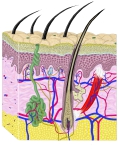 Skin
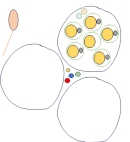 Subcutaneous tissue (schematic)
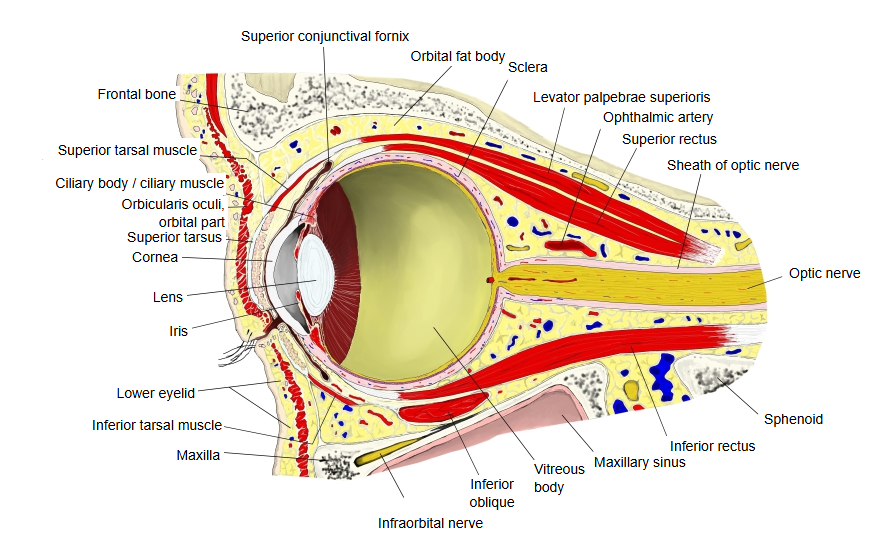
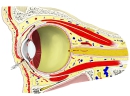 Orbit (sagittal section)
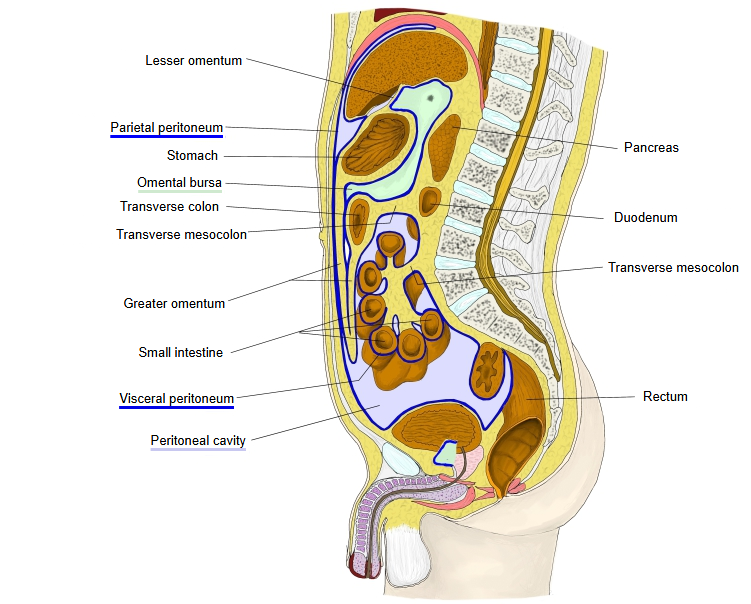
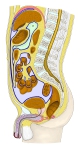 Abdominal cavity (sagittal section)
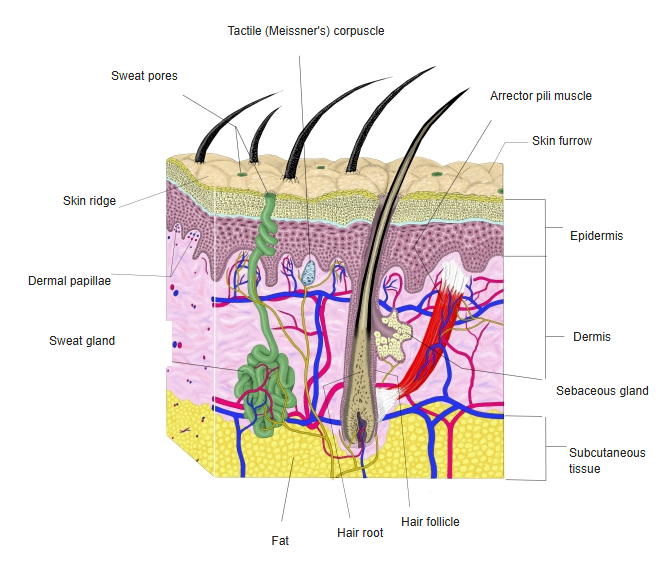
Functions
The main functions of adipose tissue are:
[Energy store]
Fat from food is stored in the adipocytes as triglyceride (neutral fat: fatty acids + glycerol) and released as fuel, for example during exercise.
[Cushioning and insulation]
It softens impacts from outside and, as insulation against heat and cold, helps to keep the body temperature steady. Brown adipose tissue, made of brown adipocytes, also produces heat.
[Endocrine organ]
Adipose tissue secretes hormones and other signalling substances (adipokines), such as:
adiponectin, resistin, angiotensinogen (the precursor of angiotensin), PAI-1 (involved in blood clotting), TNF-α, IL-6, leptin, VEGF and bFGF.
Reference websites
[Wikipedia]
· Adipose tissue, Wikipedia.
· Adipokine, Wikipedia.
[Websites with illustrations]
· Fat depots of the body and white, beige and brown adipocytes (Experimental & Molecular Medicine (Springer Nature))
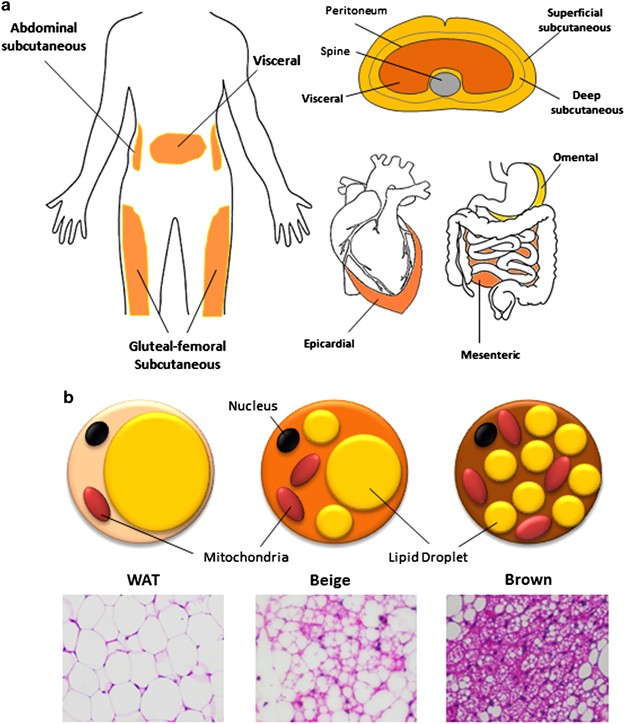
· Adipose tissue (illustration) (Wikimedia Commons)

Related terms
- Dense connective tissue
- Adipocyte
- White adipocyte
- Brown adipocyte
- Subcutaneous tissue
- Connective tissue proper
- Orbital fat body
- Buccal fat pad
- Fibrofatty tissue
References and sources
- Further reading: Adipose tissue, Wikipedia.
- Federative International Programme for Anatomical Terminology (FIPAT). Terminologia Anatomica, 2nd ed. (TA2), 2019.