Coronary ligament of liver (Latin: ligamentum coronarium)
Also called the coronary ligament
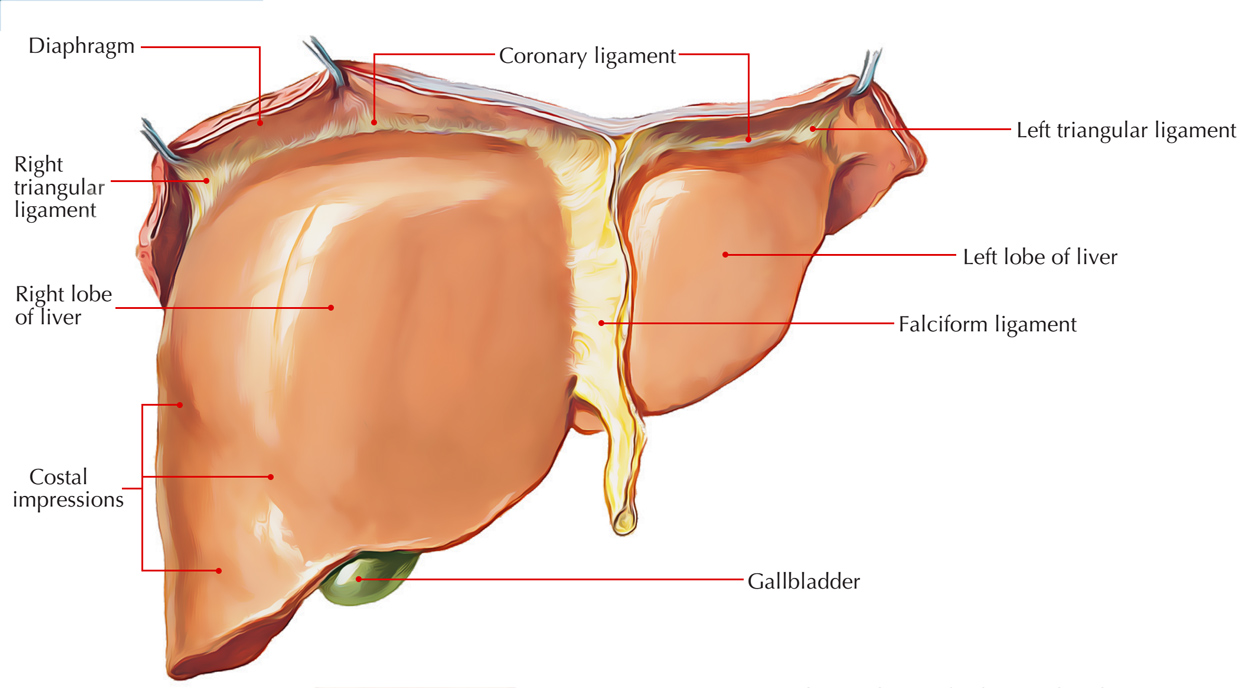
· The anterior (upper) layer and the posterior (lower) layer are separated by the bare area of the liver, which has no peritoneal covering and touches the diaphragm directly. At the right and left ends the two layers meet to form the right and left triangular ligaments (triangular ligaments). The anterior layer is continuous in front with the falciform ligament; the posterior layer runs on to the lesser omentum and the peritoneum over the right kidney.
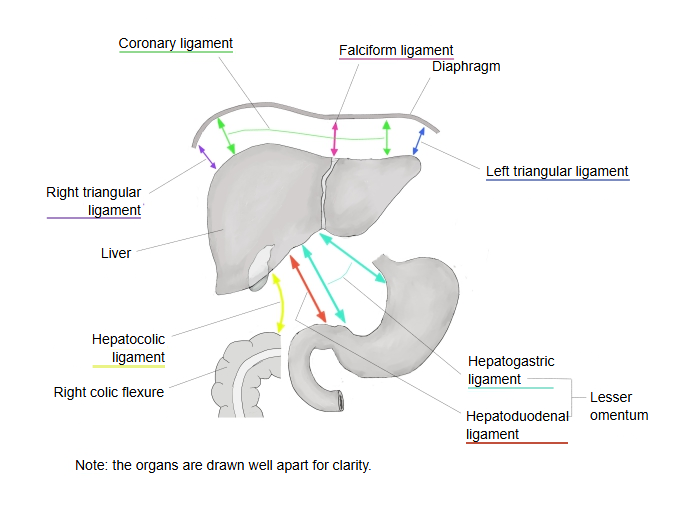
- Falciform ligament : from its attachment on the underside of the diaphragm it runs down the front of the liver to the inferior border, and from there to the umbilicus.
- Coronary ligament : two layers of peritoneum, in front and behind, joining the diaphragmatic surface of the liver to the underside of the diaphragm.
- Left and right triangular ligaments : the left and right ends of the coronary ligament.
- Lesser omentum
- Hepatogastric ligament : joins the liver (at the porta hepatis) to the lesser curvature of the stomach; forms most of the lesser omentum.
- Hepatoduodenal ligament : joins the liver and the duodenum; the thick right edge of the lesser omentum.
Some textbooks also show the hepatocolic ligament as a part of the ventral mesogastrium in their illustrations.
Reference websites
[Wikipedia]
· Coronary ligament, Wikipedia.
[Websites with illustrations]
· Coronary ligament of liver (Kenhub)

· Anterior part of the coronary ligament (Kenhub)

· Liver and its ligaments (Earth's Lab)
Related terms
- Bare area
- Triangular ligaments
- Right triangular ligament
- Left triangular ligament
- Ventral mesogastrium
- Liver
- Peritoneum
References and sources
- Further reading: Coronary ligament, Wikipedia.
- Federative International Programme for Anatomical Terminology (FIPAT). Terminologia Anatomica, 2nd ed. (TA2), 2019.