Areola (Latin: areola mammae)
Also called Mammary areola
· In pregnancy and after childbirth the pigmentation becomes stronger and the areola turns dark brown.
· The areolar glands grow markedly during pregnancy.
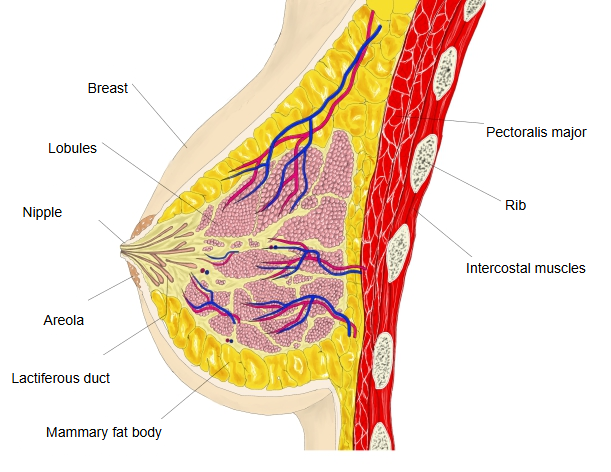
· The nipple and areola have no fat beneath the skin. They consist of dense connective tissue carrying blood vessels and lactiferous ducts, with well-developed sebaceous glands and smooth muscle.
· The areolar glands are a type of apocrine gland; there are about 12 of them, set roughly in a ring.
- Surface
- Skin : covers almost the whole surface of the breast.
- Nipple : (female) a cylindrical projection slightly below the centre of the breast; milk comes out here through the openings of the lactiferous ducts.
- Areola : the ring-shaped area around the nipple; the small bumps of the areolar glands are seen on it.
- Inside
- Body of the breast
- Mammary fat body : takes up most of the breast; it contains bundles of connective tissue fibres.
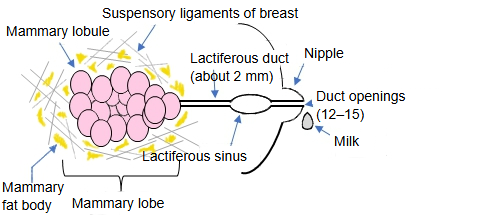
- Mammary gland : lobes of the mammary gland: groups of lobules, about 15–20 arranged radially around the nipple; lactiferous ducts: carry the milk made in the lobules to the nipple.
- Suspensory ligaments : (Cooper's ligaments) stretched between the fascia and the skin; they keep the shape of the breast.
- Others : arteries: branches of the internal thoracic, lateral thoracic and posterior intercostal arteries; nerves: branches of the intercostal and supraclavicular nerves, and others.
- Body of the breast
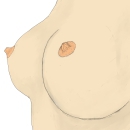 Breast
 Nipple and areola
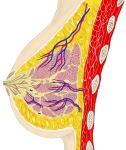 Breast (sagittal section)
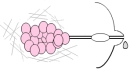 One lobe and its duct
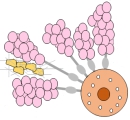 Lobes around the nipple
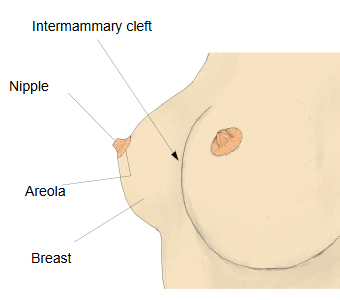
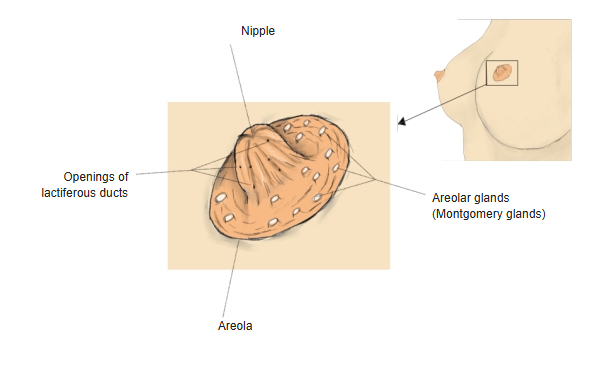
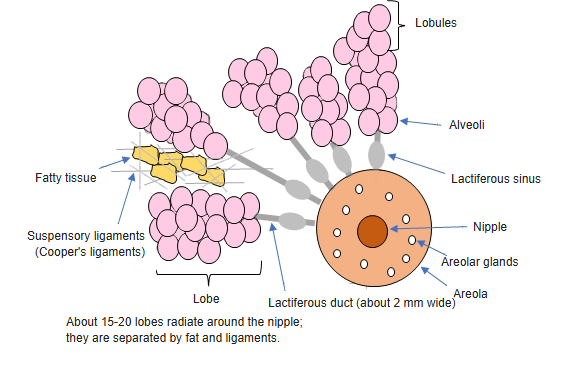
The areola is the round, pigmented area around the nipple. Small raised bumps, the areolar tubercles, are scattered over it, formed by the areolar glands beneath the skin. The areolar glands are a type of apocrine gland; there are about 12 of them, set roughly in a ring. In pregnancy the areola darkens and the areolar glands develop and enlarge. Beneath the areola the veins form the areolar venous plexus.
Related terms
- Mammary fat body
- Areolar glands
- Apocrine gland
- Openings of lactiferous ducts
- Lactiferous duct
- Breast
- Mammary gland
- Areolar venous plexus
References and sources
- Further reading: Areola, Wikipedia.
- Further reading: Areolar glands, Wikipedia.
- Federative International Programme for Anatomical Terminology (FIPAT). Terminologia Anatomica, 2nd ed. (TA2), 2019.