Lysosome (Latin: lysosoma)
· Sizes differ between sources: most lysosomes measure about 0.1–1 µm, but diameters of up to a few micrometres are also given.
Types of enzymes
· Protein breakdown: proteases such as cathepsins B, D and L.
· Nucleic-acid breakdown: nucleases such as DNase II and acid RNase.
· Lipid breakdown: acid lipase and phospholipases such as phospholipase A2.
· Breakdown of sugar chains: glycosidases such as beta-galactosidase, alpha-mannosidase and hexosaminidase, among others.
How the lysosomal enzymes reach the lysosome
The breakdown takes place inside the lysosome.
What is broken down
· Old or damaged proteins.
· Worn-out organelles such as mitochondria (autophagy).
· Bacteria and viruses taken in by the cell (phagocytosis).
· Other material brought in from outside the cell (products of endocytosis), often by way of endosomes.
After breakdown
Some of the remains are expelled from the cell; the rest is broken down to amino acids, sugars, fatty acids and other small molecules, which return to the cytoplasm and are reused.
of the
cell
- Cell membrane : phospholipid bilayer, membrane proteins, sugar chains
- Cytoplasm
- Cytosol : water, electrolytes, metabolic enzymes, free amino acids, metabolic intermediates
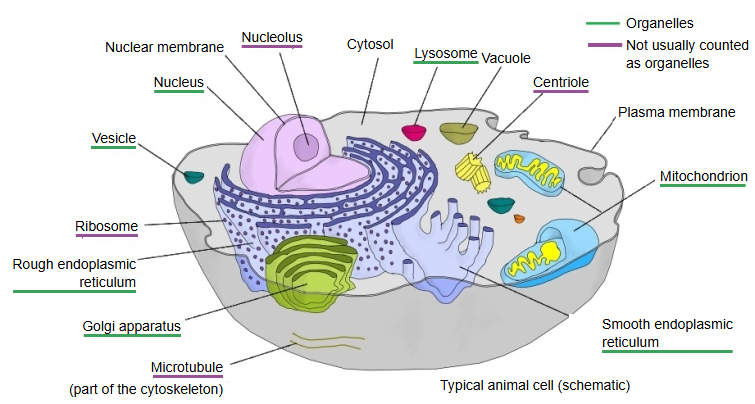
- Organelles : mitochondria, endoplasmic reticulum, centrosome, Golgi apparatus, lysosomes, peroxisomes, vesicles (some sources do not count vesicles as organelles)
- Cytoskeleton : microtubules, actin filaments, intermediate filaments
- Nucleus : nuclear envelope, nucleoplasm, chromatin, nucleolus; the nucleus is also counted among the organelles
Reference websites
[Wikipedia]
· Lysosome, Wikipedia.
[Websites with illustrations]
· Lysosome (glossary with illustration) (National Human Genome Research Institute)
· Lysosomes (images) (Wikimedia Commons)
Related terms
References and sources
- Further reading: Lysosome, Wikipedia.
- Federative International Programme for Anatomical Terminology (FIPAT). Terminologia Anatomica, 2nd ed. (TA2), 2019.