Eosinophil
Also called the eosinophilic granulocyte or eosinocyte
One of the three types of granulocytes, the white blood cells that protect the body against invaders such as bacteria, viruses and parasites. Its large granules stain red-orange with the dye eosin, which gives it its name.
blood
cells
- Granulocytes : neutrophils, eosinophils, basophils.
- Monocytes : become macrophages in the tissues.
- Lymphocytes
- B cells : become plasma cells.
- NK cells
- T cells
More details
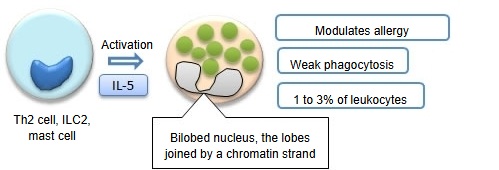
Eosinophils are slightly larger than neutrophils, about 12–17 µm across, and make up about 1–3% of the white blood cells. The nucleus usually has two lobes joined by a thin strand of chromatin, and the cytoplasm is packed with granules. Their development in the bone marrow and their activation depend largely on interleukin 5 (IL-5), which is made mainly by Th2 cells (a kind of helper T cell) and group 2 innate lymphoid cells (ILC2s); mast cells also make it.
Their numbers rise in allergic diseases such as asthma and in parasitic infections, and usually fall in acute infection. They spend only a short time in the blood and live mainly in the tissues.
Function
They kill parasites, such as worms, with the toxic proteins of their granules, and take part in allergic inflammation. They can engulf particles, but their phagocytic activity is weak.
Secretions
Substances that eosinophils secrete include the following.
| 1 | Reactive oxygen species | Superoxide, hydrogen peroxide and hypobromous acid (made by eosinophil peroxidase). |
| 2 | Granule proteins | · Major basic protein (MBP): makes mast cells and basophils release their granules. · Eosinophil cationic protein (ECP) · Eosinophil peroxidase (EPX, EPO) · Eosinophil-derived neurotoxin (EDN) These proteins are toxic to parasites and also to the body's own tissues; ECP and EDN are ribonucleases with antiviral activity. |
| 3 | Lipid mediators | Eicosanoids: leukotrienes (LTC4, LTD4, LTE4) and prostaglandins (PGE2). |
| 4 | Cytokines and growth factors | · Interleukins: IL-1, IL-2, IL-4, IL-5, IL-6, IL-8, IL-9, IL-13 · Tumour necrosis factor alpha (TNF-α) · Growth factors: transforming growth factor beta (TGF-β), vascular endothelial growth factor (VEGF), platelet-derived growth factor (PDGF) |
Receptors
The main receptors of eosinophils are as follows.
| 1 | Fc receptors | FcγR, FcαR, FcεR |
| 2 | Complement receptors | C3a, C5a |
| 3 | Integrins | Mac-1, LFA-1, VLA-4 |
| 4 | Cytokine receptors | IL-3, IL-5, GM-CSF |
| 5 | Chemokine receptors | CCR1, CCR3 |
| 6 | Eicosanoid receptors | CysLT1, BLT (leukotriene B4 receptor), CRTH2 |
| 7 | Histamine receptors | H1, H2, H4 |
| 8 | Others | PAF receptor, Fas, HLA-DR, fMLP receptor and others |
⇒ Light micrograph of an eosinophil in a blood smear (Wikimedia Commons)

Reference websites
[Wikipedia]
· Eosinophil, Wikipedia.
· Interleukin 5, Wikipedia.
[Websites with illustrations]
· Eosinophil (drawing) (Wikimedia Commons)

Related terms
References and sources
- Further reading: Eosinophil, Wikipedia.
- Federative International Programme for Anatomical Terminology (FIPAT). Terminologia Anatomica, 2nd ed. (TA2), 2019.