Protein
- Nutritional aspects
- Protein in the body
- Classification of proteins
- Reference websites
- (Wikipedia)
- Related terms
Nutritional aspects
| The three major nutrients | |
|---|---|
| Protein | A large molecule made of many amino acids linked in chains. Meat and fish are rich in it. It is the material of muscle, bone and other tissues. |
| Carbohydrate | Sugars (saccharides, including starch) and dietary fibre; an important source of energy in the body. |
| Fat (lipid) | Gives more than twice as many calories per gram as the other two nutrients. Found in oils and meat; used in the body mainly as a source of energy and stored as adipose tissue. |
· After water, protein is the most abundant substance in the body.
Carbohydrates and fats are made of carbon, hydrogen and oxygen; proteins contain nitrogen as well (and most also contain sulfur).
| Element | Carbohydrate, fat | Protein |
|---|---|---|
| Carbon (C) | Yes | Yes |
| Hydrogen (H) | Yes | Yes |
| Oxygen (O) | Yes | Yes |
| Nitrogen (N) | No | Yes |
Foods rich in protein
Protein is found in large amounts in fish, meat, eggs, milk and dairy products such as cheese, and soybeans and other legumes; most vegetables and fruits contain little.
Protein in the body
· Every day the body makes much more protein than it takes in with food. The difference is covered by recycling: proteins that are no longer needed or are damaged are broken down into amino acids, which are used again. One of the processes that does this inside the cells is autophagy ("self-eating").
Use of protein
· Protein can also be a source of energy in the body, but when more is taken in than is needed, the excess is converted and stored as fat.
In the composition of the body, water takes the largest share, and after water comes protein.
| Component | Notes |
|---|---|
| Water | The largest component, about 60% of the body weight of an adult man; the proportion is higher in newborns. Includes the blood, the lymph and tissue fluid (see body fluid). |
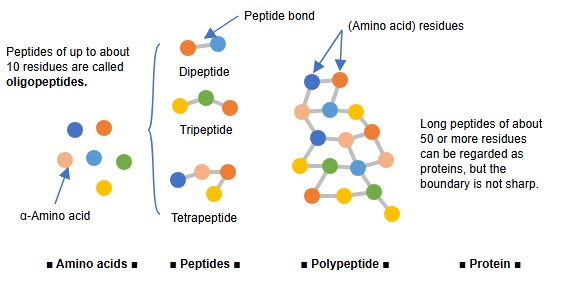
| Protein | The second largest component. Found in all organs and tissues, including the brain, heart, intestine, skeletal muscle, bone, skin and blood. Body proteins are made from about 20 kinds of amino acids. |
| Fat | Varies widely from person to person. |
| Others | Minerals, carbohydrate and other substances. |
Classification of proteins
Proteins can be classified as follows.
1. By composition
| Class | Description | Examples | |
|---|---|---|---|
| Simple proteins | Made of amino acids only | Albumin, globulins | |
| Conjugated proteins | Protein + a non-protein part | Hemoglobin (with heme) | |
| 1 | Glycoproteins | Sugar chains attached | IgG, mucin |
| 2 | Lipoproteins | Lipids attached | HDL, LDL |
| 3 | Chromoproteins | A pigment attached | Hemoglobin |
| 4 | Nucleoproteins | Combined with nucleic acid | Histone-DNA complexes (chromatin), ribosomes |
| 5 | Metalloproteins | Contain metal ions | Ferritin, zinc-finger proteins |
| 6 | Phosphoproteins | Phosphate groups attached | Casein |
2. By shape
| Class | Description | Examples | |
|---|---|---|---|
| 1 | Fibrous proteins | Long, extended structure; give structural support; hardly soluble in water | Keratin (hair), collagen |
| 2 | Globular proteins | Round, compact structure; many have working functions such as those of enzymes | Hemoglobin, enzymes, antibodies |
| 3 | Membrane proteins | Embedded in the cell membrane; involved in transport and signalling | Ion channels, receptors |
3. By function
| Class | Function | Examples | |
|---|---|---|---|
| 1 | Enzymes | Catalyse chemical reactions | Amylase, DNA polymerase |
| 2 | Transport proteins | Carry substances | Hemoglobin, transferrin |
| 3 | Structural proteins | Support the structure of cells and tissues | Actin, collagen |
| 4 | Storage proteins | Store nutrients and other substances | Ferritin (stores iron), casein |
| 5 | Receptor proteins | Receive signals | Insulin receptor |
| 6 | Motor proteins | Movement and contraction | Myosin, kinesin |
| 7 | Regulatory proteins | Regulate gene expression and other processes | Transcription factors, protein hormones |
| 8 | Immune proteins | Immune responses | Antibodies (such as IgG) |
4. By origin
| Class | Description | Examples | |
|---|---|---|---|
| 1 | Animal proteins | From animals | Ovalbumin (egg white), myoglobin |
| 2 | Plant proteins | From plants | Gliadin (wheat), lectins |
5. By chemical properties
| Class | Description | Examples | |
|---|---|---|---|
| 1 | Acidic proteins | Rich in acidic amino acids | Pepsin, albumin |
| 2 | Basic proteins | Rich in basic amino acids | Histones |
| 3 | Neutral proteins | Acidic and basic amino acids roughly balanced | — |
Reference websites
[Wikipedia]
· Protein, Wikipedia.
Related terms
References and sources
- Further reading: Protein, Wikipedia.
- Federative International Programme for Anatomical Terminology (FIPAT). Terminologia Anatomica, 2nd ed. (TA2), 2019.