Epicondyle (Latin: epicondylus)
An epicondyle is a projection on or above a condyle.
It takes no part in a jointIt gives attachment to muscles and ligaments
The difference from a condyle is function. A condyle carries an articular surface; an epicondyle lies beside that surface and anchors the soft tissues around the joint. A tubercle or tuberosity also serves for attachment, but those names say nothing about a condyle and can be used anywhere on a bone.
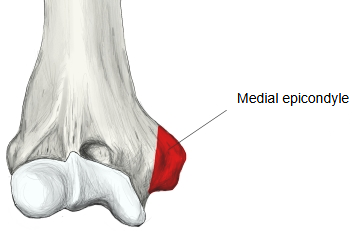
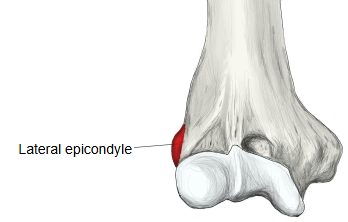
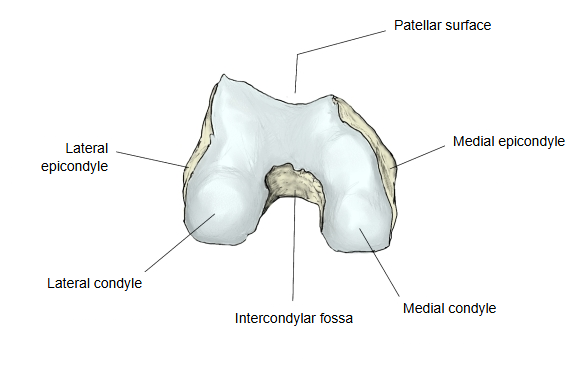
The best-known examples are at the lower end of the humerus, where the medial epicondyle gives origin to the flexor muscles of the forearm and the lateral epicondyle to the extensor muscles. On the femur the medial and lateral epicondyles give attachment to the collateral ligaments of the knee joint.
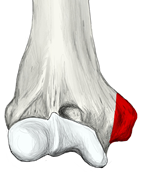 Medial epicondyle of humerus
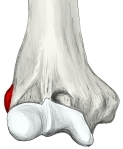 Lateral epicondyle of humerus
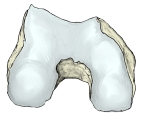 Right femur (inferior)
Related terms
- Articular surface
- Condyle
- Tubercle
- Tuberosity
- Medial epicondyle
- Lateral epicondyle
- Medial epicondyle of femur
- Lateral epicondyle of femur
References and sources
- Further reading: Epicondyle, Wikipedia.
- Federative International Programme for Anatomical Terminology (FIPAT). Terminologia Anatomica, 2nd ed. (TA2), 2019.