Coracoid process (Latin: processus coracoideus)
Attached structures
Muscles: coracobrachialis (origin), biceps brachii (short head; origin), pectoralis minor (insertion).
Ligaments: coracohumeral ligament, coracoclavicular ligament, coracoacromial ligament, superior transverse scapular ligament (attached near the root of the process).
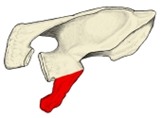 Right scapula (from above)
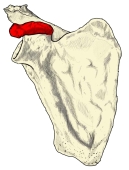 Coracoid process (red)
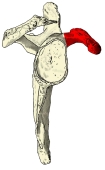 Right scapula (lateral)
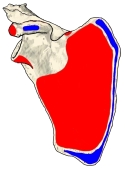 Muscle attachments (anterior)
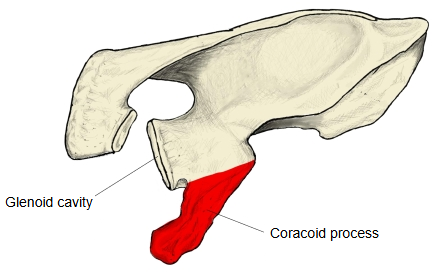
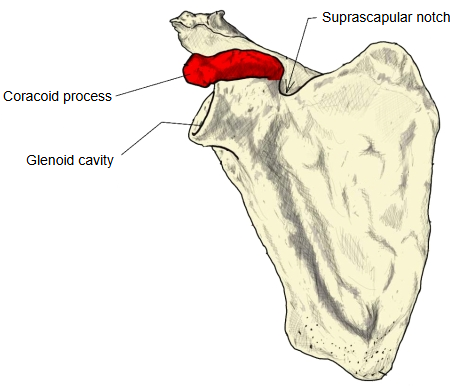
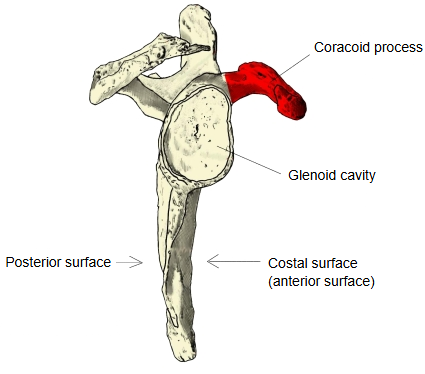
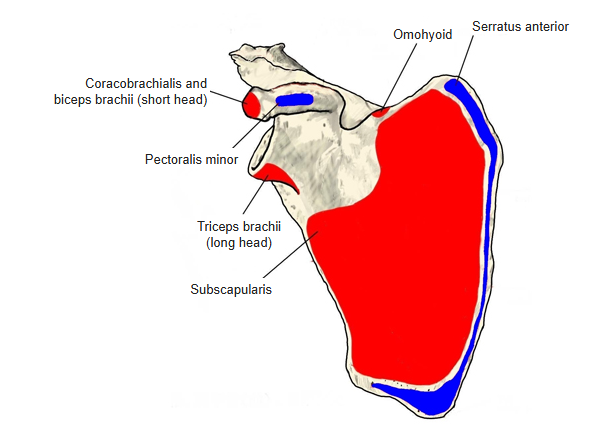
Between the suprascapular notch and the glenoid cavity, the coracoid process projects forwards and laterally, bent like a crow's beak. Coracobrachialis and the short head of biceps brachii arise from it, and pectoralis minor is inserted on it. The name comes from the Greek korax, crow (or something bent like a crow's beak).
It is a thick, curved process attached by a broad base to the upper part of the neck of the scapula. It runs first upwards and medially, then becomes smaller and bends sharply to point forwards and laterally. Subscapularis passes across the smooth front of its ascending part. On the root of the process are a rough impression for the conoid ligament and a ridge for the trapezoid ligament, the two parts of the coracoclavicular ligament; the coracoacromial ligament is attached to its lateral border, and the conjoined tendon of coracobrachialis and the short head of biceps arises from its tip. Its tip can be felt below the clavicle, in the deltopectoral groove between deltoid and pectoralis major. With the acromion and the coracoacromial ligament it forms the arch that roofs the shoulder joint (glenohumeral joint).
Where it is found
Related terms
- Acromion
- Glenoid cavity
- Suprascapular notch
- Neck of scapula
- Supraglenoid tubercle
- Lateral angle of scapula
References and sources
- Further reading: Coracoid process, Wikipedia.
- Federative International Programme for Anatomical Terminology (FIPAT). Terminologia Anatomica, 2nd ed. (TA2), 2019.