Quadriceps femoris (Latin: musculus quadriceps femoris)
Also called: quadriceps
The collective name for the four muscles on the front of the thigh: rectus femoris, vastus lateralis, vastus medialis and vastus intermedius. It is one of the largest and strongest muscle groups in the body.
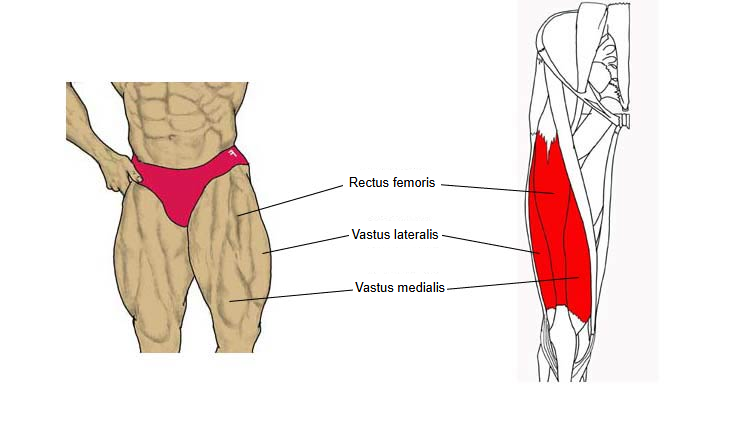
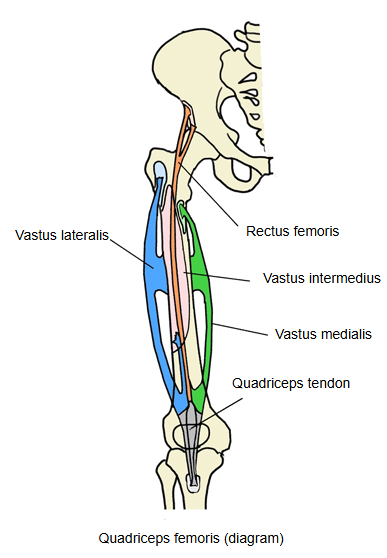
More detail: the four muscles arise from different places, but they end together: they attach to the patella as one tendon, the quadriceps tendon, and the pull continues through the patellar ligament to the tibial tuberosity. Rectus femoris arises from the hip bone above the acetabulum, so it crosses both the hip and the knee; the three vasti arise from the femur. The group extends the knee (rectus femoris also helps to flex the hip) and is supplied by the femoral nerve (L2 to L4). The patella is a sesamoid bone in the quadriceps tendon and increases the leverage of the muscle on the knee. Sources differ on whether the small articularis genus should be counted as part of the group.
Where it is found
Related terms
- Base of patella
- Superior border of patella
- Lateral border of patella
- Patellar ligament
- Tibial tuberosity
- Patella
- Femur
References and sources
- Further reading: Quadriceps femoris muscle, Wikipedia.
- Federative International Programme for Anatomical Terminology (FIPAT). Terminologia Anatomica, 2nd ed. (TA2), 2019.