Mechanical axis of the lower limb
Also called Mikulicz line or the load-bearing axis
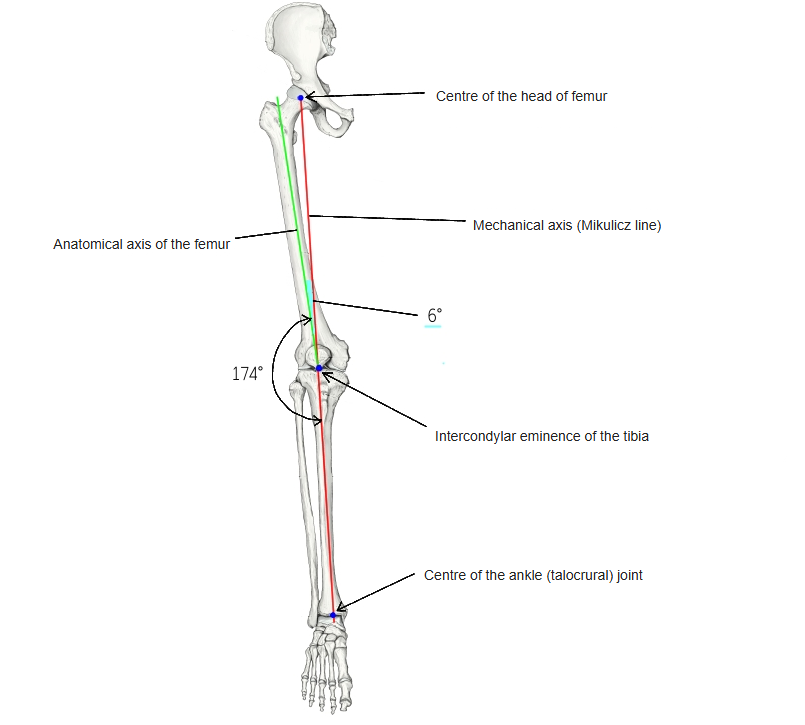
The mechanical axis of the lower limb can be described as follows.
In a limb with normal alignment, the large joints of the lower limb (the hip joint, the knee joint and the ankle (talocrural) joint) lie on one straight line, and this line is the load-bearing axis running down the lower limb: the mechanical axis (Mikulicz's line). It runs from the centre of the head of the femur down through the intercondylar eminence of the upper articular surface of the tibia to the centre of the ankle joint. In the shaft of the tibia the anatomical (shaft) axis and the mechanical axis coincide, but in the shaft of the femur the anatomical axis is angled about 6° to the mechanical axis. The anatomical axes of the femur and tibia therefore do not form one straight line: in the coronal (frontal) plane they meet at the level of the knee at an angle of about 174°, open laterally (the femorotibial angle). If the mechanical axis passes medial to the centre of the knee, the limb is in varus (bow-legged); if lateral, in valgus (knock-kneed). Sources differ slightly on the normal values.
Where it is found
Related terms
References and sources
- Further reading: Genu varum, Wikipedia.
- Further reading: Genu valgum, Wikipedia.
- Federative International Programme for Anatomical Terminology (FIPAT). Terminologia Anatomica, 2nd ed. (TA2), 2019.