Vertebral column (Latin: columna vertebralis)
Also called the spine or backbone
Vertebral column: Overview | Features of the vertebrae | Related terms | Ligaments and membranes | Joints
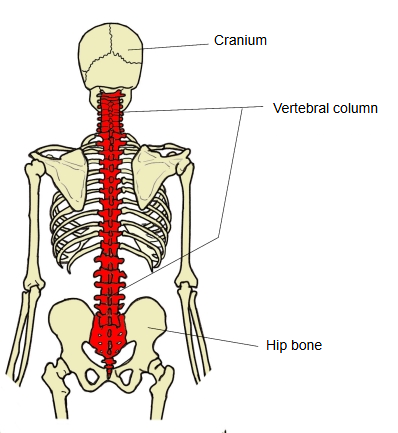
The vertebral column is what is commonly called the spine or backbone: a flexible column of usually 33 (32–35) vertebrae and the intervertebral discs between them, running from the skull to the pelvis and forming the central axis of the skeleton.
· It supports the head and trunk, protects the spinal cord in the vertebral canal, and allows the trunk to bend and twist.
Regions and numbers
The vertebrae have different names and numbers in each region. In the fetus and the newborn all vertebrae are separate; in the adult the sacral vertebrae fuse into one sacrum and the coccygeal vertebrae into one coccyx. From the axis down to the sacrum, the vertebral bodies are joined by intervertebral discs; the vertebral arches are joined by the facet joints and by ligaments such as the ligamenta flava. Long ligaments run the whole length of the column: the anterior longitudinal ligament in front of the bodies and the posterior longitudinal ligament behind them.
| Name | Number | Illustration | |
|---|---|---|---|
| 1 | Cervical vertebrae (neck) | 7 | 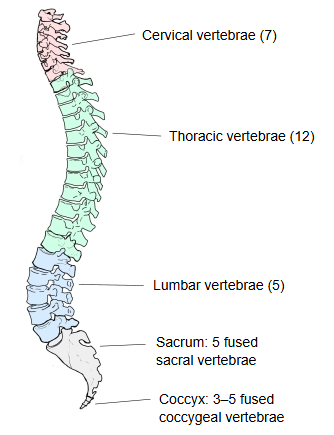 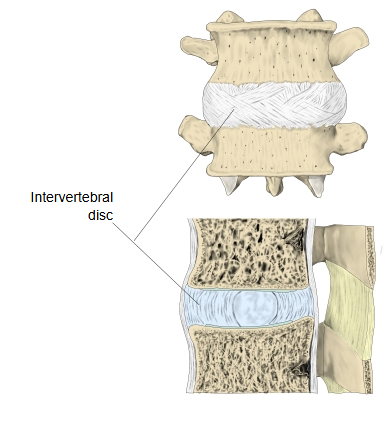 |
| 2 | Thoracic vertebrae (chest; each carries a pair of ribs) | 12 | |
| 3 | Lumbar vertebrae (lower back) | 5 | |
| 4 | Sacral vertebrae (fused into the sacrum) | 5 | |
| 5 | Coccygeal vertebrae (fused into the coccyx) | 3–5 (usually 4) |
Curvatures
Seen from the side, the adult vertebral column has four curves.
· Cervical and lumbar lordosis: convex forwards; they develop after birth, as the child holds up the head and then stands.
· Thoracic and sacral kyphosis: convex backwards; these are present before birth.
The curves make the column springier and help keep the body's weight over the feet.
Sites with illustrations and photographs
· Vertebral column: structure, regions and function (TeachMeAnatomy)
· Vertebral column: anterior, left lateral and posterior views (illustration)
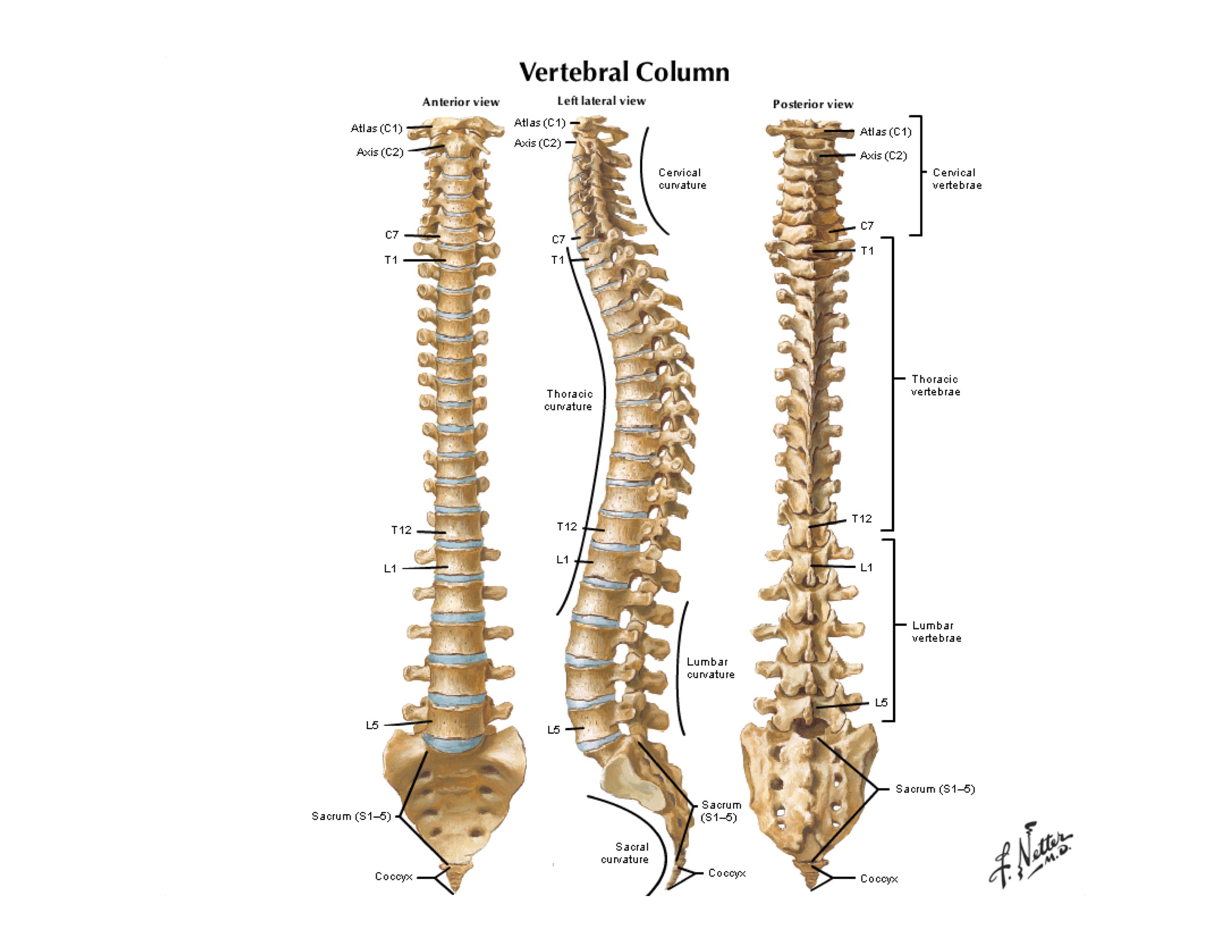
· Vertebral column, coloured by region (Gray's Anatomy) (Wikimedia Commons)

· Vertebral column (illustration) (Wikimedia Commons)

Where it is found
Related terms
- Vertebral body
- Spinous process
- Cervical vertebrae
- Thoracic vertebrae
- Lumbar vertebrae
- Sacrum
- Coccyx
- Coccygeal vertebrae
References and sources
- Further reading: Vertebral column, Wikipedia.
- Federative International Programme for Anatomical Terminology (FIPAT). Terminologia Anatomica, 2nd ed. (TA2), 2019.