Medullary cone (Latin: conus medullaris)
Also called the conus medullaris
What is the medullary cone?
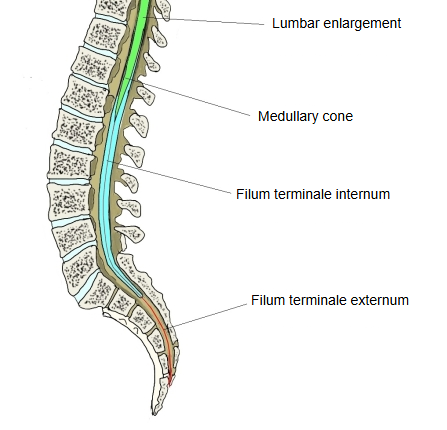
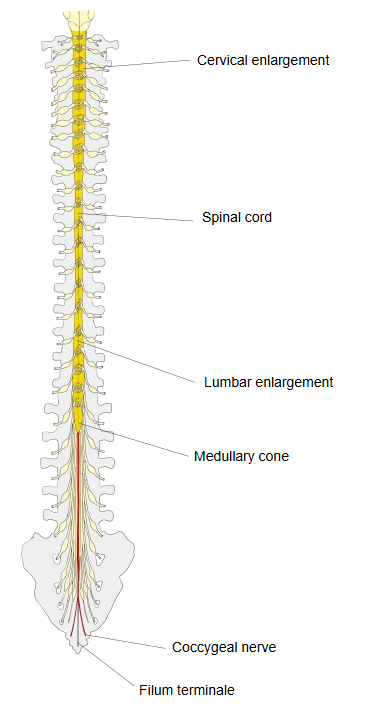
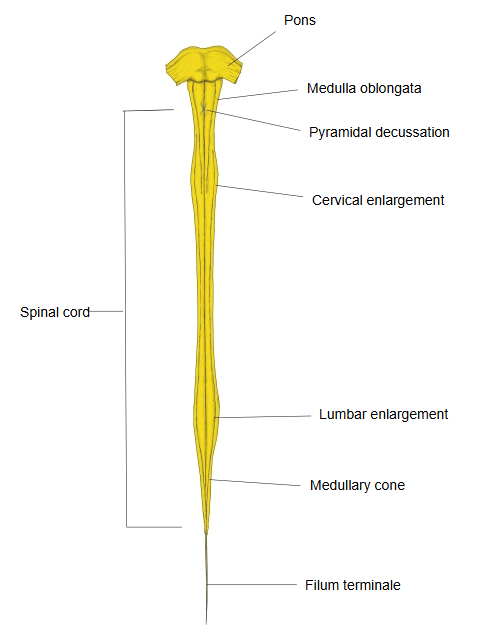
The medullary cone is the pointed lower end of the spinal cord at the level of the first or second lumbar vertebra; below it the cord continues as the filum terminale. The roots of the lower lumbar, sacral and coccygeal spinal nerves leave the cone and run down inside the dural sac as the cauda equina. Because the cord ends at about L1–L2, a needle for lumbar puncture is placed lower, usually between L3 and L5, where only nerve roots lie. The cone contains the lowest sacral and coccygeal segments of the cord, which serve the bladder, bowel and the skin around the anus.
Blood supply: mainly from the three longitudinal arterial trunks of the spinal cord, the anterior spinal artery and the right and left posterior spinal arteries. Smaller radicular branches reach it from the aorta (lumbar arteries) and from the iliolumbar, lateral sacral and median sacral arteries; these contribute more to the supply of the cauda equina.
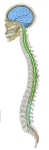 Brain and spinal cord (lateral view)
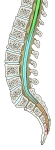 Lower end of the spinal cord
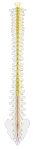 Spinal cord (posterior view)
 Spinal cord (isolated)
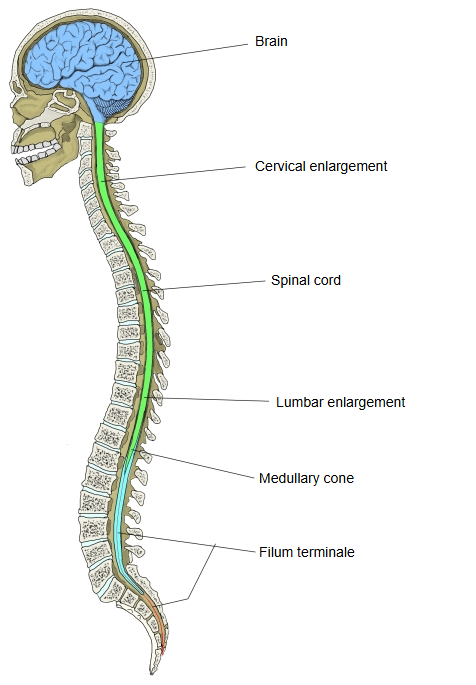
Reference websites
[Wikipedia]
· Conus medullaris, Wikipedia.
[Websites with illustrations]
· Lumbar spine, median section: medullary cone, dural sac and lumbar puncture (SlideServe)

Related terms
- Filum terminale
- Vertebral canal
- Vertebral cavity
- Groove for spinal nerve
- Vertebral region
- Erector spinae
- Spinal cord
- Pial part of filum terminale
- Spinal nerves
- Dura mater
- Subarachnoid space
- Lumbar vertebrae
- Coccyx
References and sources
- Further reading: Conus medullaris, Wikipedia.
- Federative International Programme for Anatomical Terminology (FIPAT). Terminologia Anatomica, 2nd ed. (TA2), 2019.