Axon hillock (Latin: colliculus axonis)
· In a pseudounipolar neuron the site where action potentials arise lies near the tip of the peripheral process, unlike in other neurons (bipolar and multipolar neurons); the impulses pass by the cell body. Pseudounipolar neurons therefore have no axon hillock in this sense.
Note: some sources say that action potentials start not in the axon hillock but in the initial segment: the part of the axon next to the hillock, where voltage-gated sodium channels are densely packed.
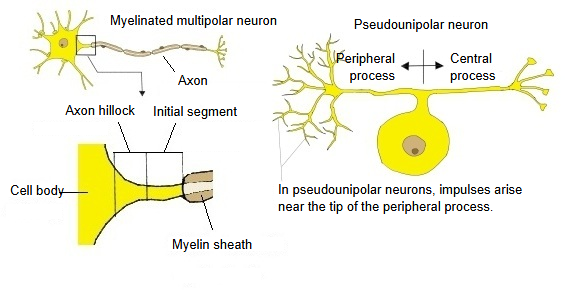
Cell body, axon and trigger zone
Is the axon hillock part of the cell body or of the axon?
Strictly, it is an intermediate region, neither the cell body nor the functional beginning of the axon. There is no clear anatomical boundary: it is a transition zone between the cell body and the axon. Unlike the rest of the cell body, it lacks the coarse Nissl bodies.
Many neuroanatomy and physiology textbooks say that the axon begins at the axon hillock.
Others regard the hillock itself as not yet part of the axon, so the boundary is continuous and vague, both in function and in structure.
Do action potentials start in the axon hillock or in the initial segment?
The main site where action potentials actually start is the initial segment; the axon hillock is the structural transition zone just before it. Strictly, therefore, the initial segment is the place where action potentials are generated. The initial segment ends where the myelin sheath begins.
Why are the two often confused?
The axon hillock was once thought to be the place where impulses (spikes) start, so older textbooks and some other sources still describe it in that way.
Electrophysiological and molecular studies have since shown that action potentials begin in the initial segment, where voltage-gated sodium channels are gathered at high density.
Reference websites
[Wikipedia]
· Axon hillock, Wikipedia.
· Axon initial segment, Wikipedia.
[Websites with illustrations]
· Axon hillock (diagram) (Wikimedia Commons)

· Axon hillock (illustration) (Neuroscientifically Challenged)
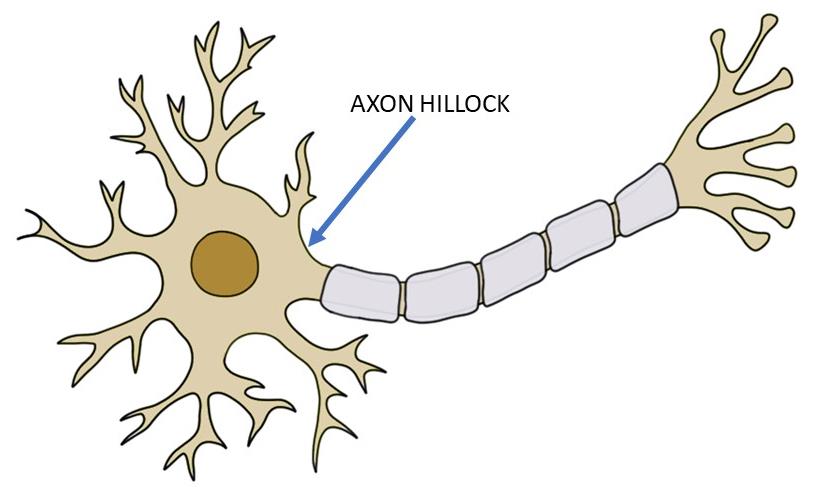
· Neuron structure with the axon hillock (stock illustration) (Adobe Stock)

· Sodium channel clusters at the axon hillock, initial segment and node of Ranvier (figure) (Elsevier)

Related terms
- Axon
- Axon terminal
- Node of Ranvier
- Unmyelinated nerve fibre
- Peripheral process
- Nervous tissue
- Interneuron
References and sources
- Further reading: Axon hillock, Wikipedia.
- Further reading: Axon initial segment, Wikipedia.
- Federative International Programme for Anatomical Terminology (FIPAT). Terminologia Anatomica, 2nd ed. (TA2), 2019.