Greater sciatic foramen (Latin: foramen ischiadicum majus)
In the pelvis, the greater sciatic notch and the lesser sciatic notch are closed off by the crossing sacrotuberous ligament and sacrospinous ligament, and become the greater sciatic foramen and the lesser sciatic foramen. The greater sciatic foramen is further divided by the piriformis, which passes through it, into an upper suprapiriform foramen and a lower infrapiriform foramen.
sciatic
foramen
- Suprapiriform foramen : the gap above the piriformis
- Piriformis : the muscle that passes through the foramen
- Infrapiriform foramen : the gap below the piriformis
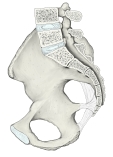 Pelvis (medial view)
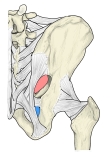 Pelvis (posterior view)
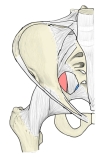 Pelvis (oblique view)
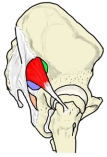 Piriformis in the greater sciatic foramen
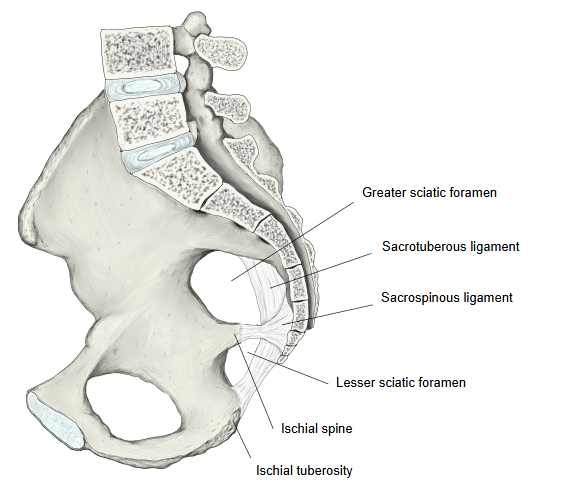
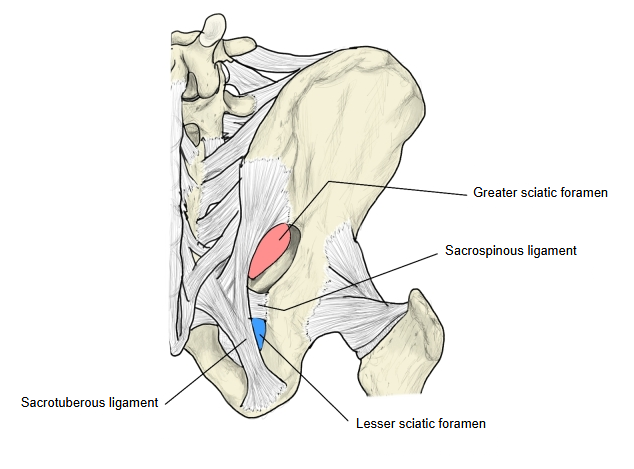
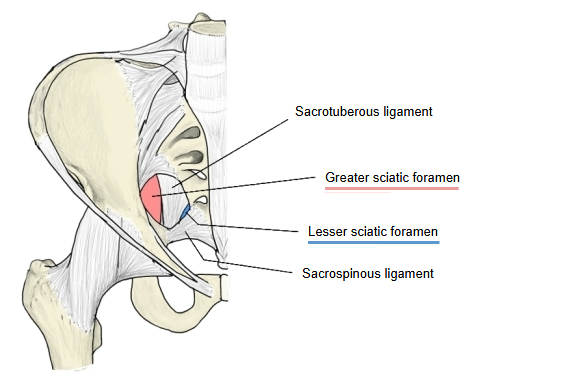
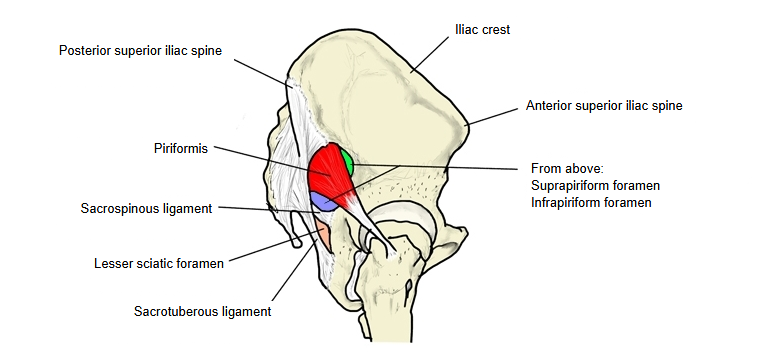
The greater sciatic notch of the hip bone is closed below by the sacrotuberous and sacrospinous ligaments and so becomes the greater sciatic foramen, the main route from the pelvis to the gluteal region. The piriformis leaves the pelvis through it and fills most of it, dividing it into the suprapiriform and infrapiriform foramina. The superior gluteal artery, veins and nerve pass through the suprapiriform foramen; the sciatic nerve, the inferior gluteal vessels and nerve, the internal pudendal vessels, the pudendal nerve and the posterior femoral cutaneous nerve pass through the infrapiriform foramen. Because the sciatic nerve passes below (or sometimes through) the piriformis here, tightness or variation of the muscle can compress the nerve; this is often called piriformis syndrome.
Structure: the foramen is bounded in front and above by the greater sciatic notch of the ilium, behind by the sacrotuberous ligament, below by the sacrospinous ligament and the ischial spine, and above by the anterior sacroiliac ligament. Below the sacrospinous ligament lies the smaller lesser sciatic foramen, which leads from the gluteal region into the perineum.
Function: the piriformis, which leaves the pelvis through the foramen, takes up most of its space; vessels and nerves pass out to the gluteal region above and below it.
Structures passing through
Note: some textbooks do not mention nos. 6 and 7 of the nerves (the nerve to obturator internus and the nerve to quadratus femoris).
The internal pudendal vessels and the pudendal nerve cross the ischial spine and re-enter through the lesser sciatic foramen to reach the perineum, in the pudendal canal. The names suprapiriform and infrapiriform foramen are common in some anatomical traditions; many English texts simply describe structures passing above or below the piriformis. In some people the common fibular part of the sciatic nerve passes through or above the muscle.
Reference websites
[Wikipedia]
· Greater sciatic foramen, Wikipedia.
[Websites with illustrations]
· Ligaments of the pelvis and the sciatic foramina (Pinterest)

· Articulations of the pelvis, posterior view (Gray's Anatomy, fig. 320) (Wikimedia Commons)

Where it is found
Related terms
- Sacrotuberous ligament
- Sacrospinous ligament
- Piriformis
- Ischial spine
- Sciatic nerve
- Pudendal canal
- Hip bone
References and sources
- Further reading: Greater sciatic foramen, Wikipedia.
- Federative International Programme for Anatomical Terminology (FIPAT). Terminologia Anatomica, 2nd ed. (TA2), 2019.