Inferior ramus of ischium (Latin: ramus inferior ossis ischii)
Also called the ascending ramus of ischium
· Muscles attached to it: on the inner side the obturator internus and the deep transverse perineal; on the outer side part of the gracilis, the adductor magnus and the obturator externus.
- Body of ischium : the upper part, forming part of the acetabulum.
- Ramus of ischium
- Superior ramus : the part continuing down from the body.
- Inferior ramus : the part continuing into the inferior pubic ramus.
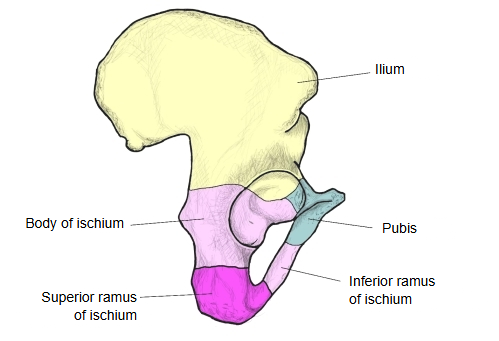
[Question]
Not all sources divide the ramus into superior and inferior parts: many describe the ischium only as a body and a ramus.
On that description the ischium lies at the back and lower part of the hip bone and surrounds the obturator foramen from behind and below. The back and lower part of the acetabulum and the thick, three-sided part below it form the body; the thin, flattened bar running forwards, medially and upwards from the body is the ramus.
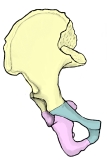 Parts of the hip bone
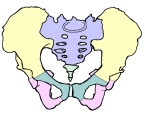 Bones of the pelvis
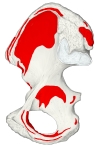 Muscle attachments (medial)
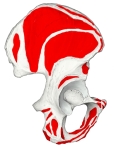 Muscle attachments (lateral)
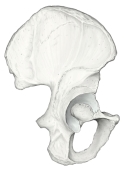 Hip bone (lateral view)
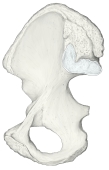 Hip bone (medial view)
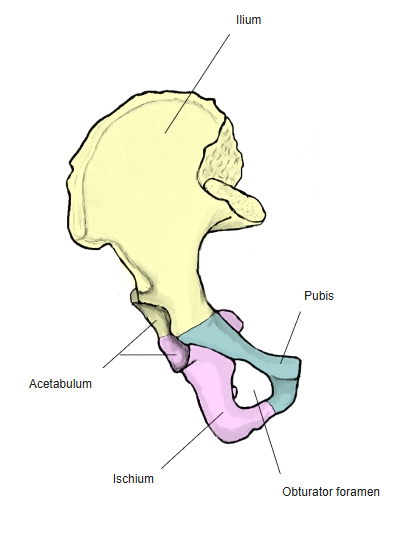
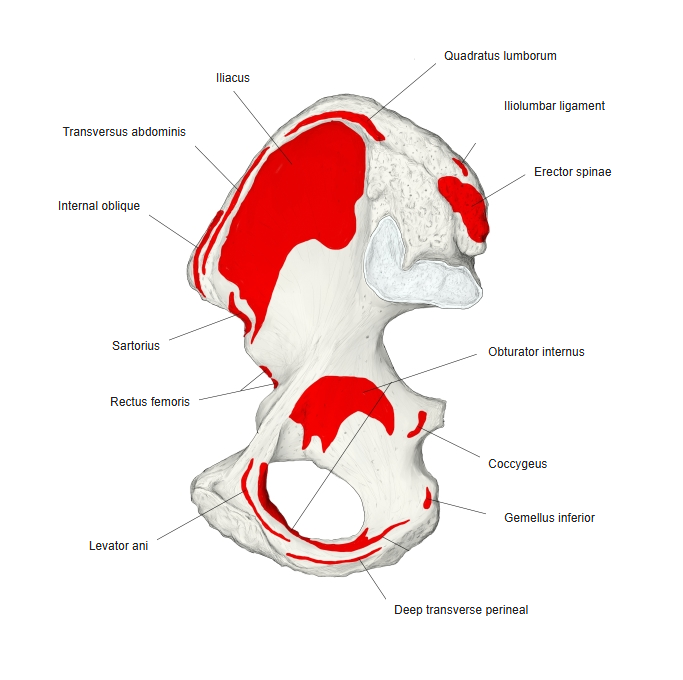
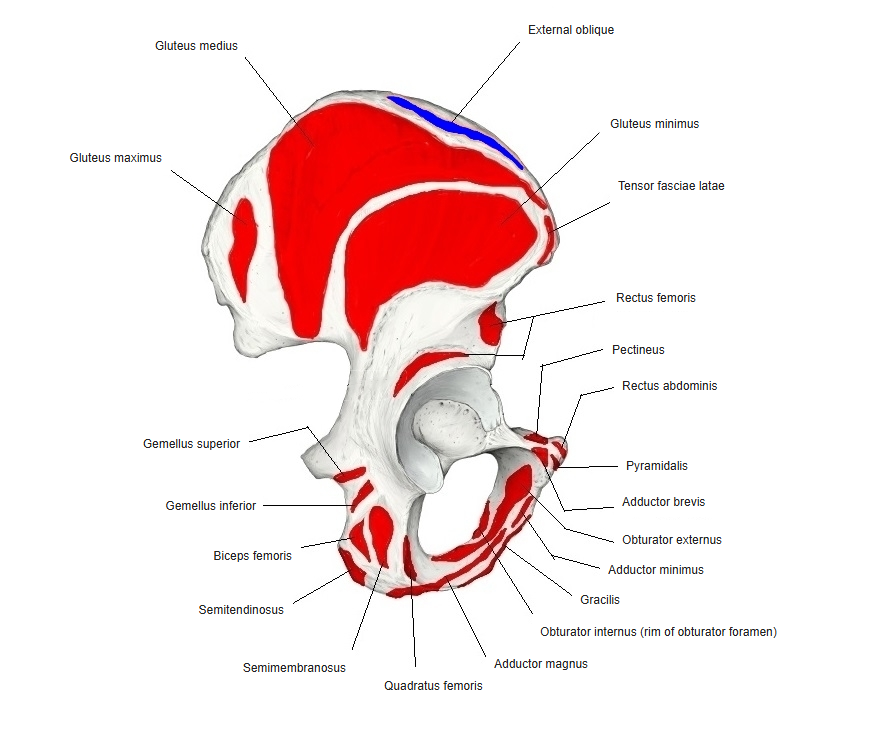
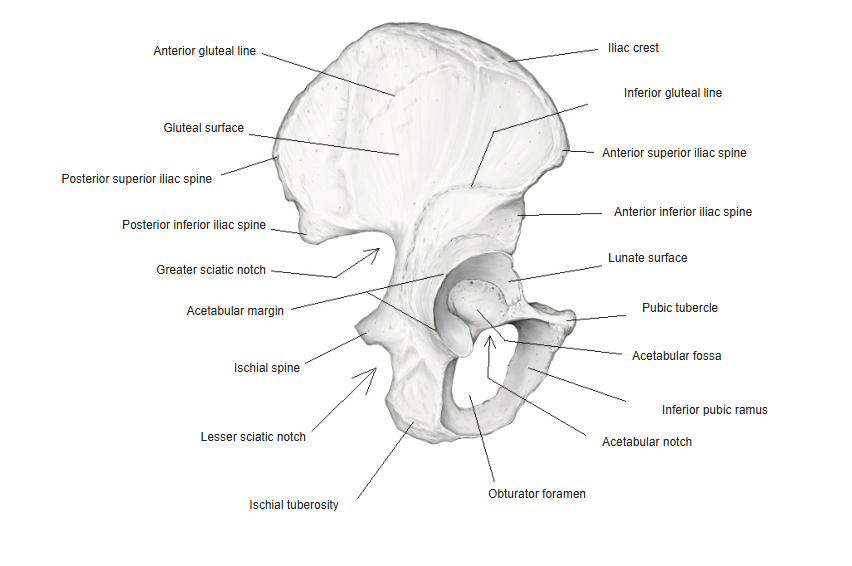
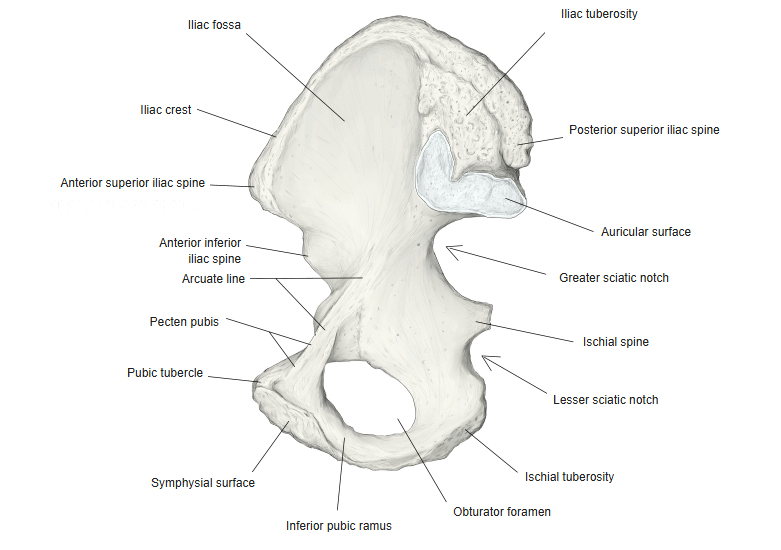
The inferior ramus is the thin, flattened part of the ischium that rises from the superior ramus and joins the inferior pubic ramus; in the adult the junction may be marked by a raised line. Its outer surface is rough for the origin of the obturator externus and some fibres of the adductor magnus; its inner surface forms part of the front wall of the pelvis. Its thick medial border forms part of the pelvic outlet and gives attachment to the membranous layer of the superficial perineal fascia and to the perineal membrane, to the superficial transverse perineal muscle, and further forwards to the crus of the penis or clitoris and the ischiocavernosus. Its thin, sharp lateral border forms part of the margin of the obturator foramen.
· Together with the inferior pubic ramus it forms the ischiopubic ramus, the side of the pubic arch.
· Sources differ: Terminologia Anatomica divides the ischium only into a body (which includes the ischial tuberosity) and a ramus; the division of the ramus into superior and inferior rami is older usage (for example Gray's Anatomy, 1918). On that older division, the superior ramus is the lower part of the body in current terms, and the inferior ramus is the ramus.
Reference websites
[Wikipedia]
· Ischium, Wikipedia.
[Websites with illustrations]
· Right hip bone, external surface (Gray's Anatomy, fig. 235) (Wikimedia Commons)

· Right hip bone, internal surface (Gray's Anatomy, fig. 236) (Wikimedia Commons)

· Ischium: anatomy, structure and main parts (Kenhub)
Related terms
References and sources
- Further reading: Ischium, Wikipedia.
- Federative International Programme for Anatomical Terminology (FIPAT). Terminologia Anatomica, 2nd ed. (TA2), 2019.