Cortical collecting duct (Latin: ductus colligens corticalis)
Overview
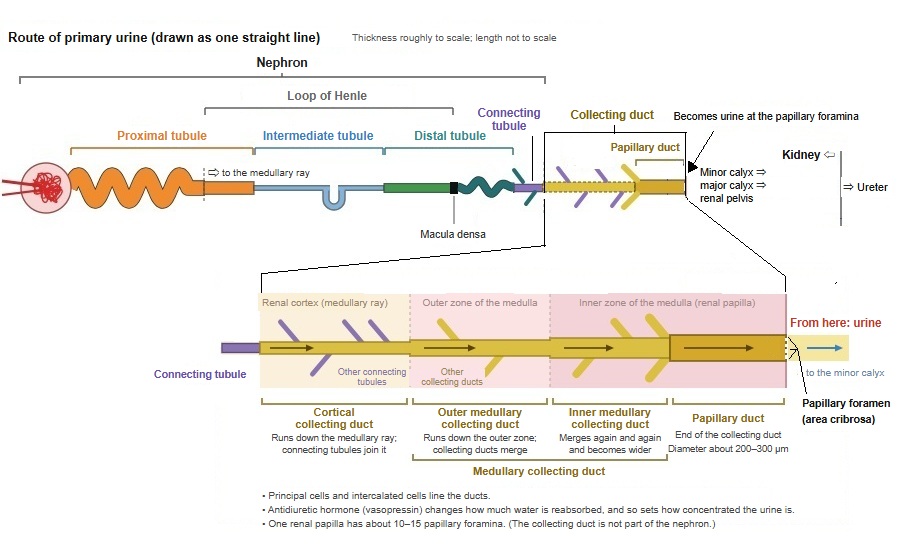
The cortical collecting duct is the part of the collecting duct that runs in the renal cortex; it runs downward, becoming thicker as connecting tubules join it.
Collecting duct: a straight duct into which primary urine flows from several connecting tubulesConnecting tubule: a short tube joining a distal tubule to the collecting duct
- Cortical collecting duct : runs down in the medullary rays of the renal cortex.
- Medullary collecting duct : runs down through the renal medulla (outer and inner zones), joining with others and becoming wider.
- Papillary duct : discharges primary urine from the papillary foramina at the tip of the renal papilla into the minor calyx, where it becomes urine.
Note: the papillary duct is sometimes counted as part of the medullary collecting duct, as the wide final part of the inner medullary collecting duct.
- Renal cortex
- Renal corpuscle : glomerulus and Bowman's capsule.
- Proximal tubule : takes back water and nutrients from the primary urine.
- Distal tubule : adjusts electrolytes and water.
- Cortical collecting duct : collects primary urine from several connecting tubules.
- Renal medulla
- Renal pyramid : the cone-shaped tissue that forms the medulla; it contains:
- Loop of Henle : part of the countercurrent system that lets the kidney concentrate urine.
- Medullary collecting duct : carries primary urine to the renal papilla.
- Papillary duct : opens at the tip of the papilla; its contents leave into a minor calyx as urine.
- Renal pyramid : the cone-shaped tissue that forms the medulla; it contains:
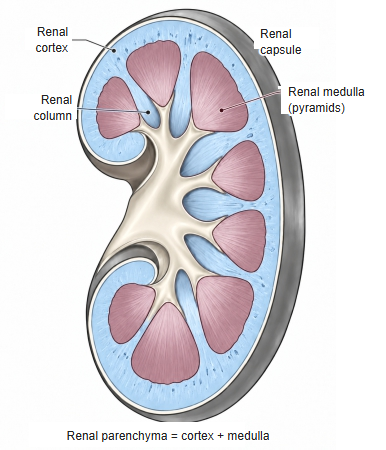
renal medulla (click to enlarge)
Reference websites
[Wikipedia]
· Collecting duct system, Wikipedia.
[Websites with illustrations]
· Histology atlas: urinary system (McGill University)
· Tubules histology (kidneypathology.com)
· Kidney (slide) (Histology Guide)
Related terms
- Proximal tubule
- Straight tubule
- Distal tubule
- Medullary collecting duct
- Papillary duct
- Kidney
- Renal parenchyma
- Renal pelvis
- Ureter
- Urinary system
References and sources
- Further reading: Collecting duct system, Wikipedia.
- Federative International Programme for Anatomical Terminology (FIPAT). Terminologia Anatomica, 2nd ed. (TA2), 2019.