Tympanic opening of auditory tube (Latin: ostium tympanicum tubae auditivae)
Also called Tympanic opening of pharyngotympanic tube or the tympanic ostium of Eustachian tube
· It is a small oval opening a few millimetres across: about 5 mm high and 3 mm wide in some accounts (sources differ).
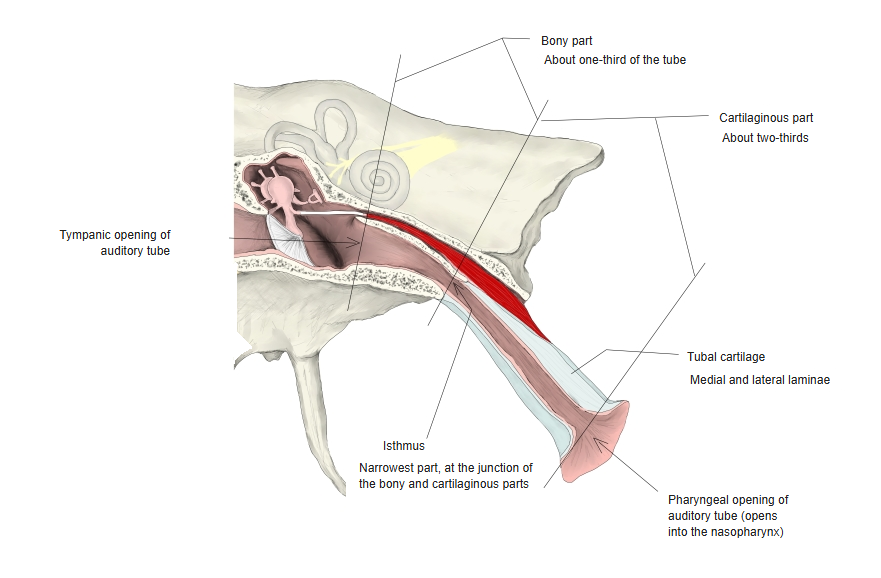
It lies high on the anterior (carotid) wall of the tympanic cavity, just below the canal for tensor tympani. From here the bony part of the tube (about the lateral one-third) runs forwards and medially in the petrous part of the temporal bone, then continues as the cartilaginous part (about two-thirds) to the pharyngeal opening in the nasopharynx. The adult tube is about 35 to 40 mm long. Unlike the pharyngeal opening, the tympanic opening stays open; the narrowest point of the tube (the isthmus) lies where the bony and cartilaginous parts meet. Air passing through the tube keeps the pressure in the middle ear equal to the outside air; the same route lets infection spread from the nasopharynx to the middle ear.
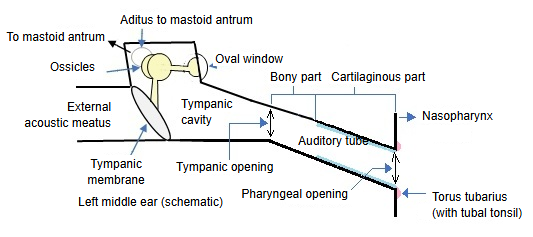
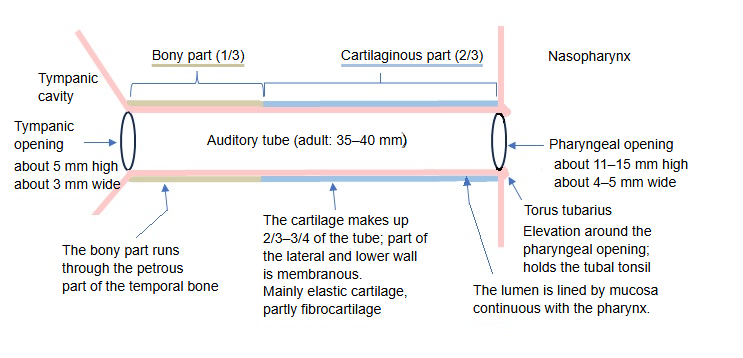
 Left auditory tube
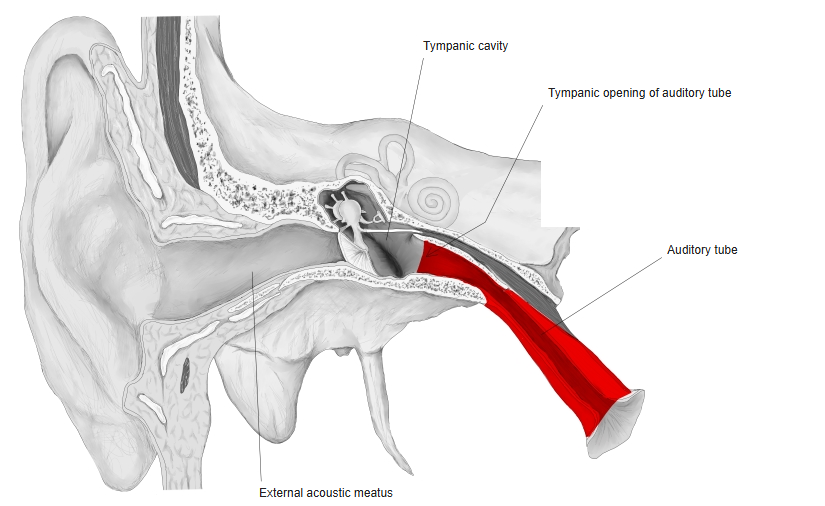
 Right ear (coronal section, anterior view)
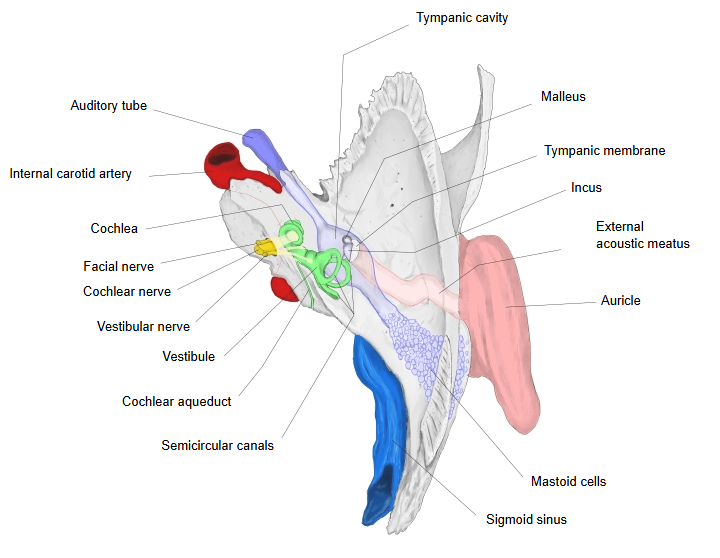
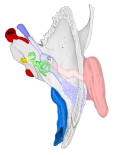 Right temporal bone (superior view)
Related terms
- Salpingopharyngeal fold
- Sulcus for auditory tube
- Canal for auditory tube
- Tubal tonsil
- Torus tubarius
- Auditory tube
- Middle ear
- Tympanic cavity
- Pharyngeal opening of auditory tube
- Musculotubal canal
- Tympanic membrane
References and sources
- Further reading: Eustachian tube, Wikipedia.
- Further reading: Tympanic cavity, Wikipedia.
- Federative International Programme for Anatomical Terminology (FIPAT). Terminologia Anatomica, 2nd ed. (TA2), 2019.