Oblique thyroarytenoid (Latin: musculus thyroarytenoideus obliquus)
- Overview
- Illustrations
- Origin / insertion
- Action
- Nerve / blood supply
- Reference websites
- (Wikipedia, websites with illustrations)
- Related terms
Overview
- Superficial muscles of the neck
- Suprahyoid and infrahyoid muscles
- Deep muscles of the neck
- Muscles of the pharynx
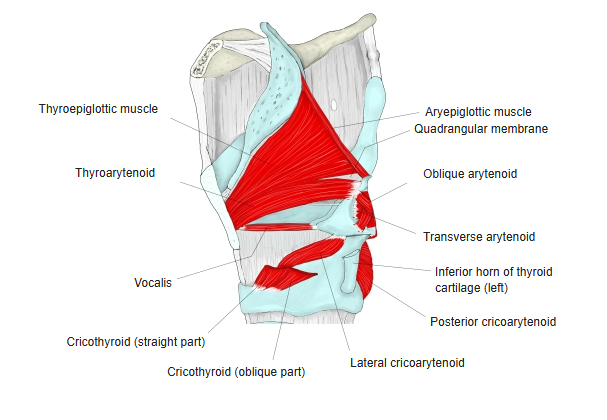
- Intrinsic laryngeal muscles (9) : cricothyroid, posterior cricoarytenoid, lateral cricoarytenoid, thyroarytenoid, vocalis, transverse arytenoid, oblique arytenoid, aryepiglotticus, thyroepiglotticus; variant: oblique thyroarytenoid
· An occasional variant related to the thyroarytenoid: a thin band lying on its lateral surface.
· Name: standard lists of the intrinsic laryngeal muscles (TA2, most textbooks) do not include it. Older accounts of muscle variation call a band in this position the superior thyroarytenoid (musculus thyroarytenoideus superior); a dissection study of 2018 (Lee et al.) named it the oblique thyroarytenoid (musculus thyroarytenoideus obliquus).
· That study found it fairly often, but sources give no agreed incidence. It is still debated whether it is a muscle of its own or an accessory belly of the thyroarytenoid.
The intrinsic laryngeal muscles at a glance (attachments simplified):
| Muscle | Origin | Insertion | Main action |
|---|---|---|---|
| Cricothyroid | front and side of the arch of the cricoid cartilage | lower border and inferior horn of the thyroid cartilage | tilts the thyroid cartilage forward: lengthens and tenses the vocal folds |
| Posterior cricoarytenoid | back of the lamina of the cricoid cartilage | back of the muscular process of the arytenoid cartilage | abducts the vocal folds: the only muscle that opens the rima glottidis |
| Lateral cricoarytenoid | upper border of the arch of the cricoid cartilage | front of the muscular process of the arytenoid cartilage | adducts the vocal folds |
| Thyroarytenoid | inner surface of the thyroid cartilage near the angle; cricothyroid ligament | anterolateral surface and muscular process of the arytenoid cartilage | shortens and relaxes the vocal folds; helps to close the glottis |
| Vocalis (deep part) | inner surface of the thyroid cartilage near the angle | vocal process and oblong fovea of the arytenoid cartilage | fine-tunes the tension of the vocal fold |
| Thyroepiglotticus (part) | with the thyroarytenoid | aryepiglottic fold and margin of the epiglottis | widens the laryngeal inlet |
| Transverse arytenoid | back and lateral border of one arytenoid cartilage | the same parts of the other arytenoid cartilage | draws the arytenoid cartilages together |
| Oblique arytenoid | back of the muscular process of one arytenoid cartilage | apex of the other arytenoid cartilage | draws the arytenoid cartilages together; narrows the laryngeal inlet |
| Aryepiglotticus (part) | continuation of the oblique arytenoid at the apex of the arytenoid cartilage | side of the epiglottis, through the aryepiglottic fold | narrows the laryngeal inlet |
| Oblique thyroarytenoid (occasional variant) | anterosuperior part of the inner surface of the thyroid lamina (sources differ) | base of the muscular process of the arytenoid cartilage | probably helps to close and relax the vocal folds |
Illustrations
More figures: Multi-muscle illustrations: Neck · Muscles of the neck (list) · Larynx
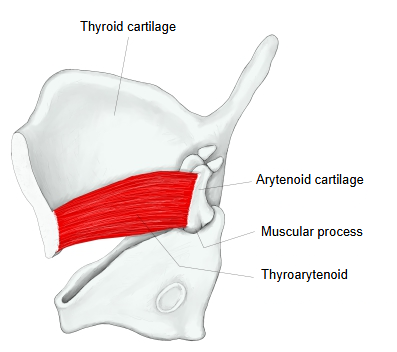
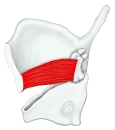 Thyroarytenoid
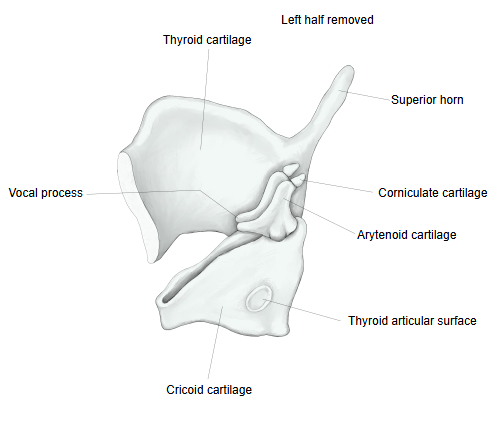
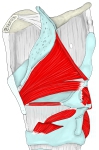 Intrinsic laryngeal muscles (lateral view)
Origin / insertion
[Origin] : the anterosuperior part of the inner surface of the thyroid cartilage (thyroid lamina), near the angle.
From there it runs obliquely backward and downward over the lateral surface of the thyroarytenoid.
[Insertion] : the base of the muscular process of the arytenoid cartilage (its inferolateral part).
Sources differ: some texts describe the same band the other way round, arising from the muscular process of the arytenoid cartilage and ending at the upper border of the thyroid cartilage; in a few specimens the origin or insertion is placed a little differently.
Action
Not settled. From its position it probably acts with the thyroarytenoid: it draws the arytenoid cartilage forward and turns it inward, so it helps to close the rima glottidis and to shorten and relax the vocal folds.
Nerve / blood supply
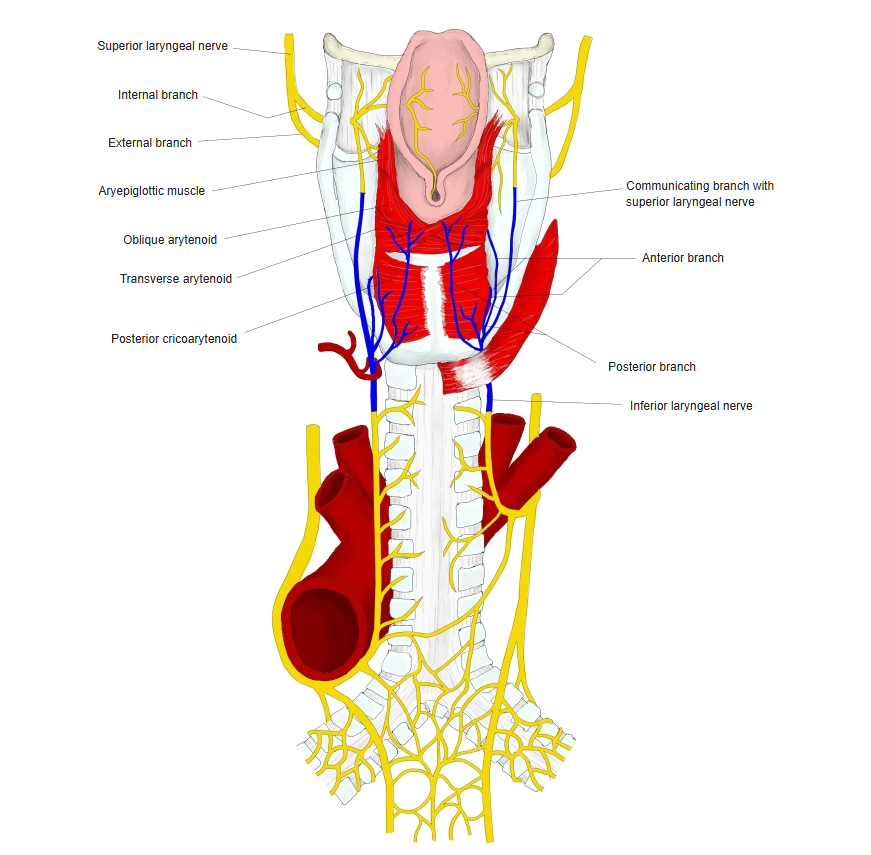
· Nerve : recurrent laryngeal nerve (its end part is called the inferior laryngeal nerve), as for the thyroarytenoid.
· Arteries : laryngeal branches of the superior laryngeal artery and the inferior laryngeal artery, as for the thyroarytenoid.
· Veins : the superior laryngeal vein and the inferior laryngeal veins, to the thyroid veins.
 Laryngeal nerves (posterior view)
Reference websites
[Wikipedia]
· Thyroarytenoid muscle, Wikipedia.
[Websites with illustrations]
· Oblique thyroarytenoid muscle in humans: an independent muscle or an accessory belly? (The Laryngoscope)
Related terms
- Intrinsic laryngeal muscles
- Thyroid cartilage
- Arytenoid cartilage
- Muscular process of arytenoid cartilage
- Thyroarytenoid
- Vocalis
- Lateral cricoarytenoid
- Recurrent laryngeal nerve
References and sources
- FIPAT. Terminologia Anatomica, 2nd ed. (TA2), 2019: musculus thyroarytenoideus (the oblique thyroarytenoid is not listed).
- Lee et al. Oblique thyroarytenoid muscle in humans: an independent muscle or an accessory belly? Laryngoscope 2018; 128(7): 1634–1638. doi:10.1002/lary.27090.
- Bergman RA, et al. Illustrated Encyclopedia of Human Anatomic Variation: Thyroarytenoideus (superior thyroarytenoideus).
- Thyroarytenoid muscle, Wikipedia.