Tragicus (Latin: musculus tragicus)
Also called the muscle of tragus
- Overview
- Illustrations
- Origin / insertion
- Action
- Nerve / blood supply
- Reference websites
- (Wikipedia, websites with illustrations)
- Related terms
Overview
- Facial muscles (24)
- Muscles of mastication (4)
- Extra-ocular muscles (7)
- Muscles of the auditory ossicles (2)
- Muscles of the tongue (7)
- Muscles of the soft palate and fauces (5)
· A short, flattened vertical band on the lateral surface of the tragus. A few of its fibres may continue upward to the spine of the helix (the inconstant pyramidal muscle of the auricle).
· Like the other intrinsic auricular muscles it is small and weak; in most people it changes the shape of the auricle very little. These muscles develop from the second pharyngeal arch, which is why the facial nerve supplies them.
Illustrations
More figures: Multi-muscle illustrations: Head · Muscles of the head (list) · Auricle
 Left auricular cartilage (lateral surface)
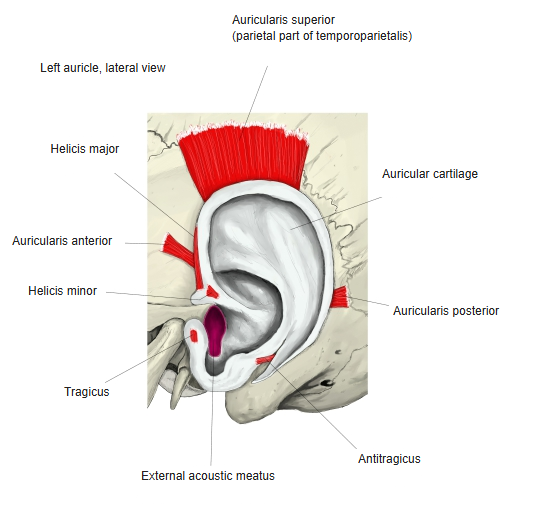
Origin / insertion
[Origin] : the lower part of the lateral surface of the tragus cartilage.
[Insertion] : the upper part (apex) of the tragus.
Action
May pull the tragus slightly and so change the shape of the auricle a little; in some people this may widen the opening of the external acoustic meatus.
Nerve / blood supply
· Nerve : facial nerve (cranial nerve VII), temporal branches. Some texts add the posterior auricular nerve.
· Arteries : small branches of the posterior auricular artery and the anterior auricular branches of the superficial temporal artery.
· Veins : the posterior auricular vein and the anterior auricular veins.
Reference websites
[Wikipedia]
· Tragicus, Wikipedia.
[Websites with illustrations]
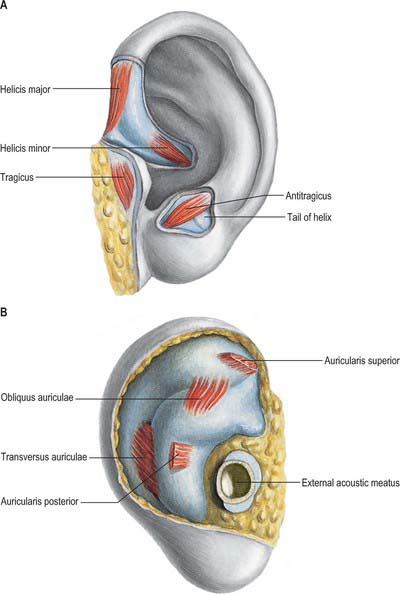
· Intrinsic muscles of the auricle (image) (Clinical Gate)
Related terms
- Auricular muscles
- Intrinsic auricular muscles
- Auricular cartilage
- Tragus
- External acoustic meatus
- Antitragicus
- Auricle
References and sources
- FIPAT. Terminologia Anatomica, 2nd ed. (TA2), 2019: musculus tragicus.
- Tragicus, Wikipedia.