Hepatogastric ligament (Latin: ligamentum hepatogastricum)
Also called gastrohepatic ligament
- Overview
- Structures passing through it
- Reference websites
- (Wikipedia, websites with illustrations)
- Where it is found
- Related terms
Overview
· It is the larger, left part of the lesser omentum. On the right it continues into the hepatoduodenal ligament, the thick free edge of the lesser omentum.
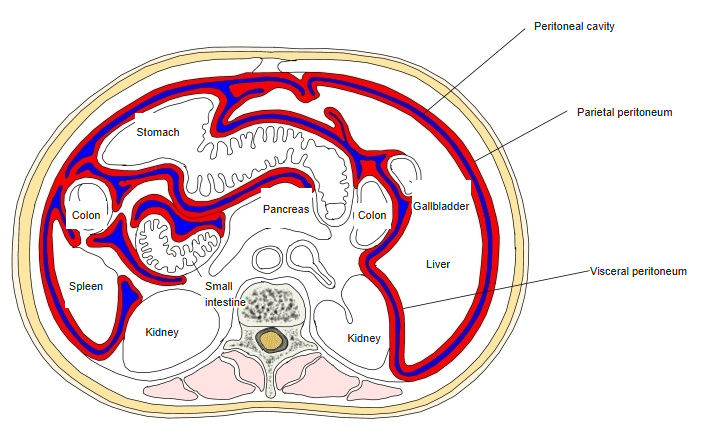
· It forms part of the front wall of the lesser sac (omental bursa): the greater sac lies in front of it and the lesser sac behind.
· It develops from the ventral mesogastrium, the fold of peritoneum that joined the embryonic stomach to the front of the body wall and in which the liver grows.
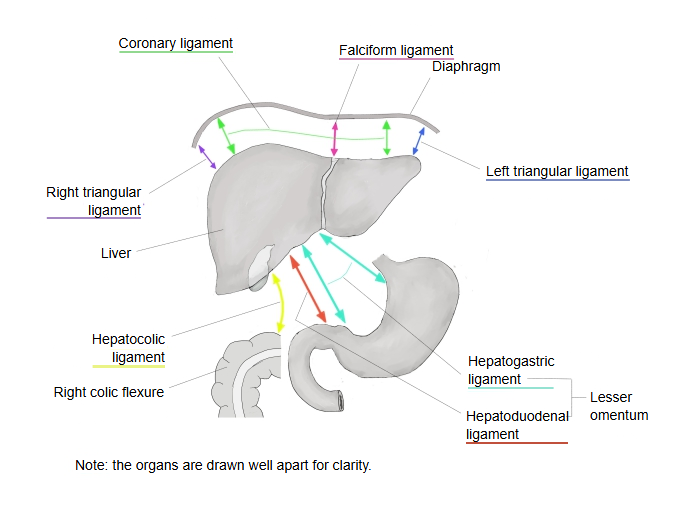
- Falciform ligament : from its attachment on the underside of the diaphragm it runs down the front of the liver to the inferior border, and from there to the umbilicus.
- Coronary ligament : two layers of peritoneum, in front and behind, joining the diaphragmatic surface of the liver to the underside of the diaphragm.
- Left and right triangular ligaments : the left and right ends of the coronary ligament.
- Lesser omentum
- Hepatogastric ligament : joins the liver (at the porta hepatis) to the lesser curvature of the stomach; forms most of the lesser omentum.
- Hepatoduodenal ligament : joins the liver and the duodenum; the thick right edge of the lesser omentum.
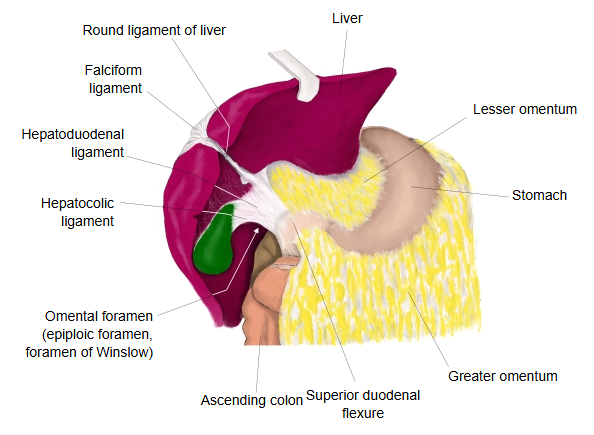
Some textbooks also show the hepatocolic ligament as a part of the ventral mesogastrium in their illustrations. Figure of the whole peritoneum
ligament
- Dense part (pars condensa) : the upper part, attached near the esophagus and the cardia; it is thicker.
- Thin part (pars flaccida) : the part attached along the lesser curvature of the stomach; it is thin and often almost transparent.
· Above, it is attached to the floor of the fissure for the ligamentum venosum on the visceral surface of the liver, close to the porta hepatis.
· Below, it is attached along the lesser curvature of the stomach and the right side of the abdominal esophagus.
· Because the thin part is often almost transparent, surgeons may open it to reach the lesser sac.
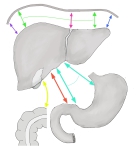 Ligaments of the liver (schematic)
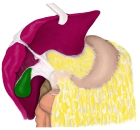 Lesser omentum and omental foramen
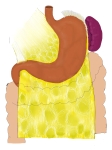 Lesser and greater omenta (anterior)
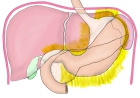 Peritoneal folds around the stomach
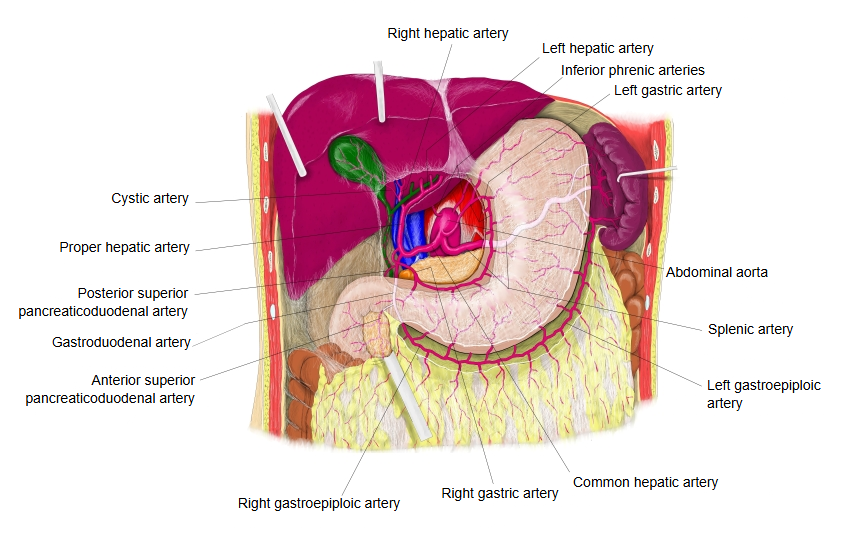
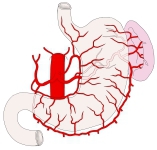 Arteries of the stomach
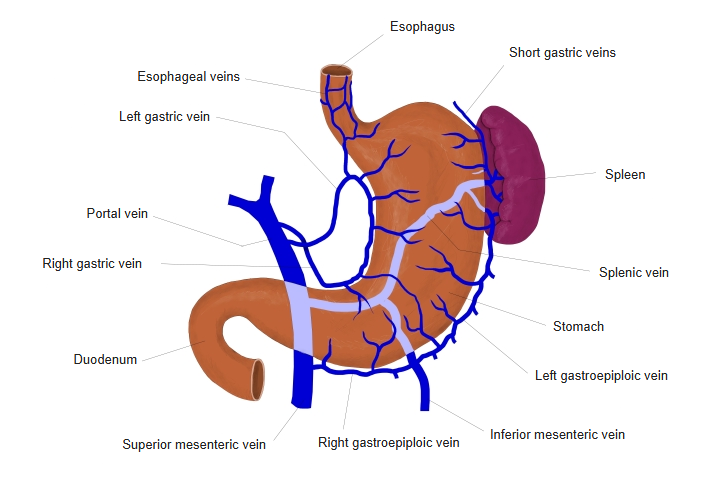
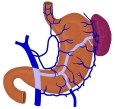 Veins of the stomach
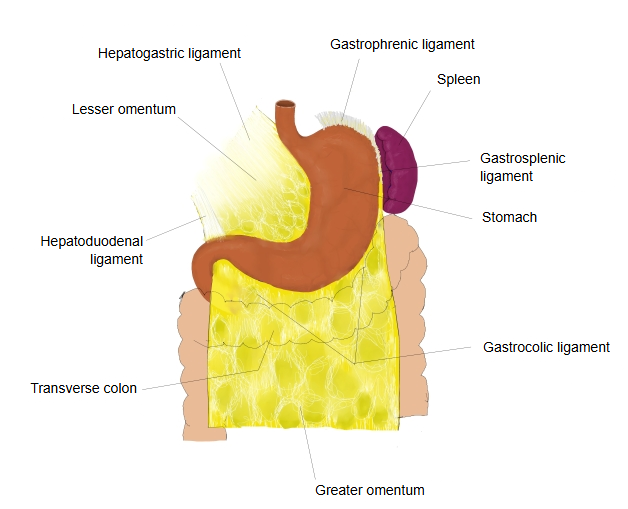
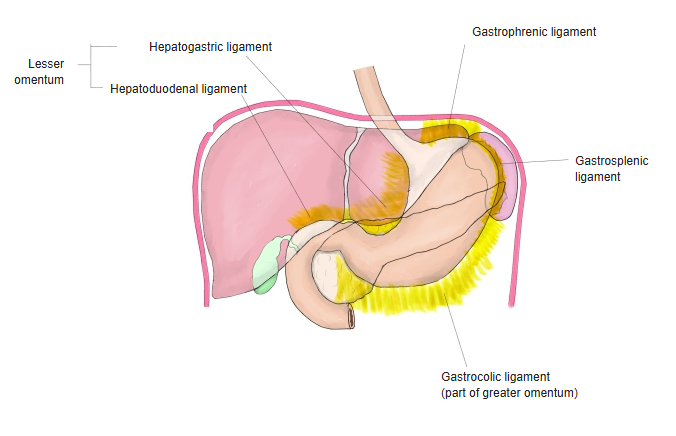
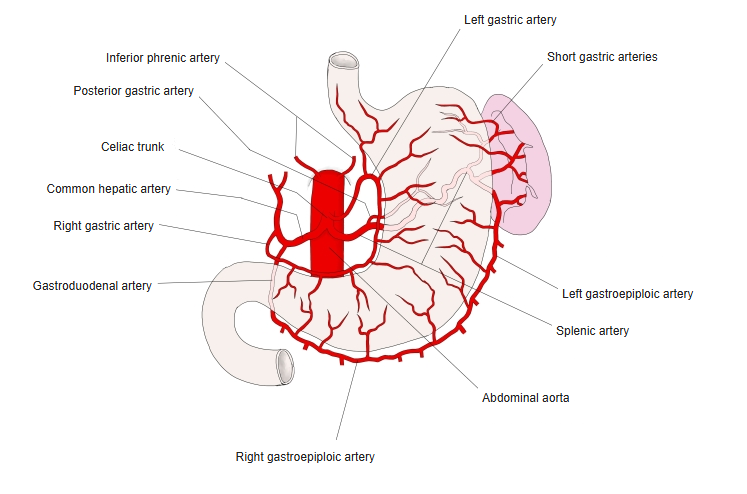
Structures passing through it
The following structures pass through the hepatogastric ligament.
Arteries The following two arteries join (anastomose) with each other.
1. 1. Left gastric artery: a branch of the celiac trunk. After it leaves the celiac trunk it runs up and to the left to the cardia of the stomach, and then runs down and to the right in the hepatogastric ligament along the lesser curvature.
2. 2. Right gastric artery: usually a branch of the proper hepatic artery. It is already in the hepatogastric ligament where it arises (just above the pylorus); it runs to the pylorus, reaches the lesser curvature and then runs to the left along it.
The right gastric artery may also arise from the common hepatic or the gastroduodenal artery; sources differ on how often. In some people an accessory or replaced left hepatic artery from the left gastric artery also crosses the ligament to reach the liver.
 Arteries of the stomach
 Arteries around the stomach
Veins
The veins accompany the arteries (the left gastric vein and the right gastric vein) and drain into the portal vein.
Nerves
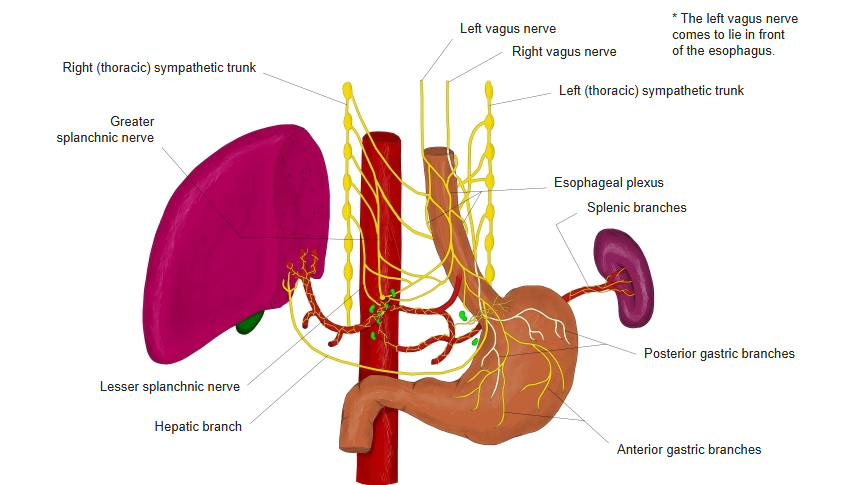
The following nerves run along the lesser curvature of the stomach.
1. 1. Parasympathetic: the vagus nerve. The anterior vagal trunk gives the anterior gastric branches and the hepatic branch (on its way to the liver); the posterior vagal trunk gives the posterior gastric branches (anterior and posterior gastric branches).
2. 2. Sympathetic: the left gastric plexus, part of the gastric plexus derived from the celiac plexus.
Around the left gastric artery, sympathetic fibres from the celiac ganglion form a network-like plexus that runs with the artery.
Lymph vessels / lymph nodes
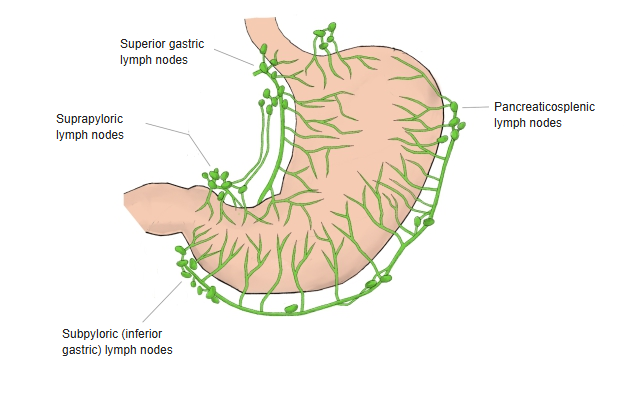
1. 1. Left gastric lymph nodes (along the course of the left gastric artery)
2. 2. Right gastric lymph nodes (along the course of the right gastric artery)
3. 3. Lymph nodes of the cardia (around the entrance of the stomach, in front of and behind it)
4. 4. Lymph vessels: they form a network joining the nodes and finally drain to the celiac lymph nodes around the origin of the celiac trunk.
Reference websites
[Wikipedia]
· Hepatogastric ligament, Wikipedia.
· Lesser omentum, Wikipedia.
[Websites with illustrations]
· Lesser omentum and its ligaments (illustration) (image on cloudfront.net)

· Lesser omentum (illustration) (Pinterest)

Where it is found
Related terms
- Hepatoduodenal ligament
- Lesser curvature
- Fissure for ligamentum venosum
- Porta hepatis
- Lesser omentum
- Left gastric artery
- Stomach
References and sources
- Further reading: Hepatogastric ligament, Wikipedia.
- Further reading: Lesser omentum, Wikipedia.
- Federative International Programme for Anatomical Terminology (FIPAT). Terminologia Anatomica, 2nd ed. (TA2), 2019.