Rima glottidis (Latin: rima glottidis)
Also called Glottic opening or the glottic chink
· Its width changes all the time: it opens and closes. The total area of the opening seen from above or below is called the glottal area.
· Just above it, the gap between the two vestibular folds is the wider rima vestibuli.
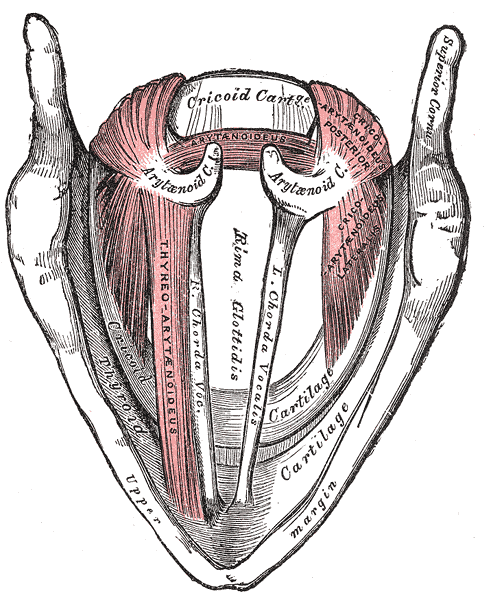
It is the narrowest part of the laryngeal cavity in adults. It has two parts: the longer front intermembranous part, about three-fifths of its length, between the vocal folds (vocal ligaments), and the shorter back intercartilaginous part, between the vocal processes and bases of the arytenoid cartilages.
Shape: in quiet breathing a narrow triangle with its point in front; in deep breathing widely open, almost diamond-shaped; in speech a narrow slit as the vocal folds come together; in swallowing, coughing and straining closed tightly.
and
recesses
of the
larynx
- Inside the larynx
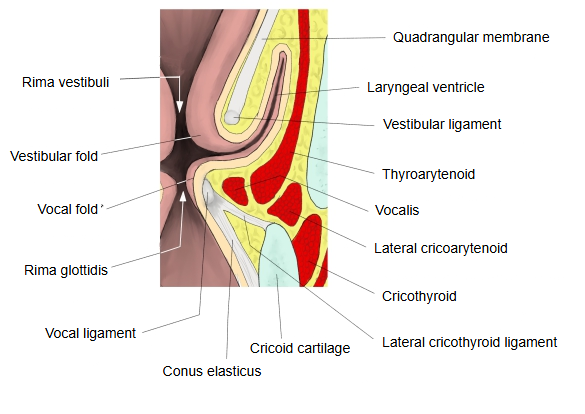
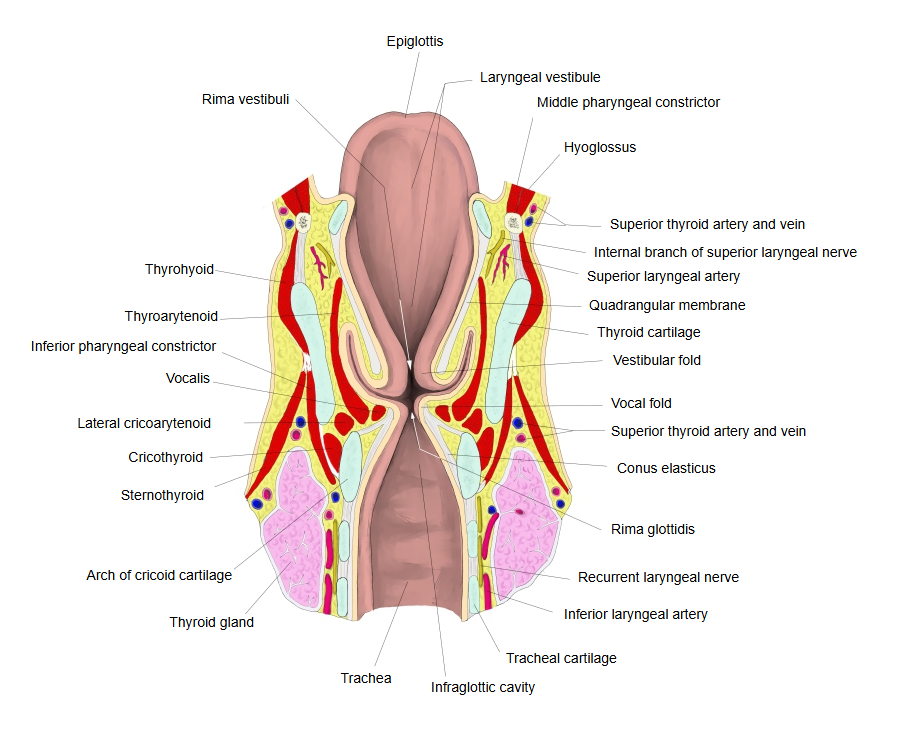
- Vestibular fold : between the thyroid and arytenoid cartilages; based on the vestibular ligament and the quadrangular membrane. = ventricular fold, false vocal cord.
- Vocal fold : between the thyroid and arytenoid cartilages; based on the vocal ligament and the conus elasticus. Produces the voice.
- Laryngeal inlet
- Aryepiglottic fold : between the epiglottis and the arytenoid cartilage; forms the sides of the laryngeal inlet; shows two small swellings (cuneiform and corniculate tubercles).
- In front
- Median glosso-epiglottic fold : between the middle of the root of the tongue and the epiglottic cartilage; the only unpaired fold.
- Lateral glosso-epiglottic fold : on the front of the epiglottis, at the outer side of the epiglottic vallecula.
- Others
- Fold of the superior laryngeal nerve : a ridge in the wall of the piriform recess raised by the superior laryngeal nerve (internal branch) as it runs from above and outside downwards and inwards.
- Pharyngo-epiglottic fold : runs from the side wall of the pharynx to the outer side of the epiglottic cartilage; in the laryngeal part of the pharynx.
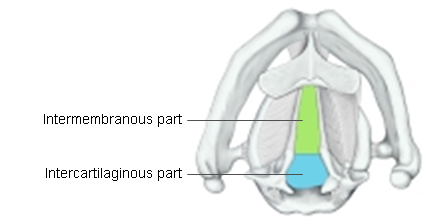
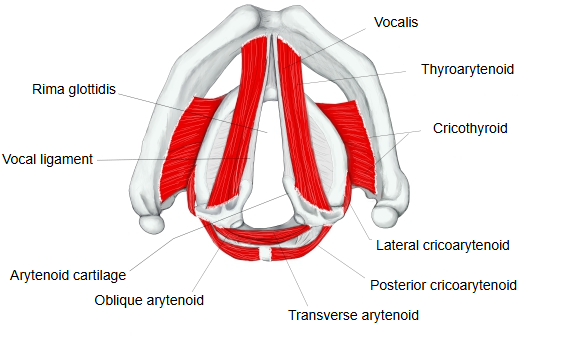
Muscles that close the rima glottidis: the lateral cricoarytenoid and the oblique and transverse arytenoids; the thyroarytenoid also helps.
Muscle that opens the rima glottidis: the posterior cricoarytenoid, the only muscle that widens it.
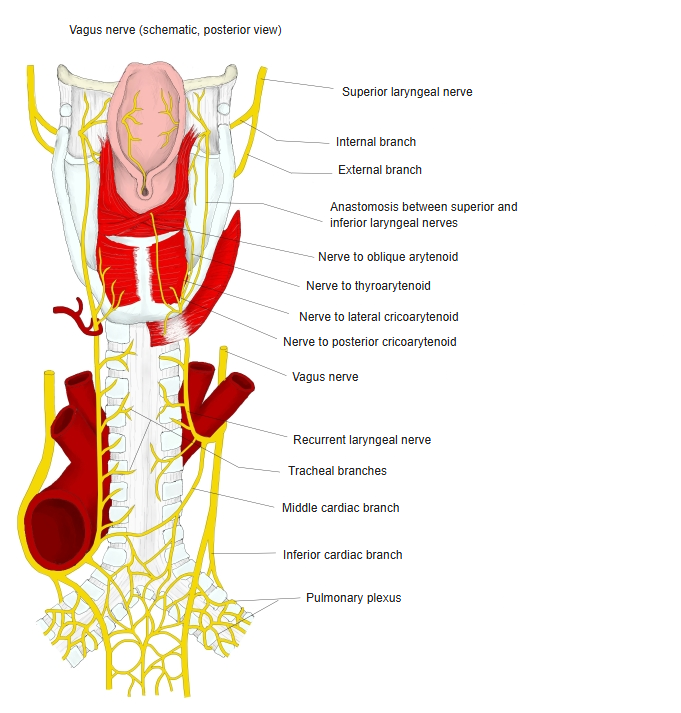
Muscle that tenses the vocal folds: the cricothyroid, which raises the pitch. Unlike the others it is supplied by the external branch of the superior laryngeal nerve.
The rima glottidis is the narrowest part of the larynx; it is longer in men (about 23 mm) than in women (about 17-18 mm).
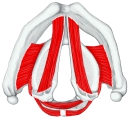 Muscles of the larynx from above
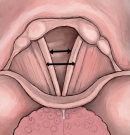 Rima vestibuli and rima glottidis (from above)
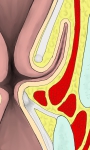 Vestibular and vocal folds (coronal section)
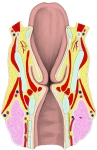 Larynx (coronal section)
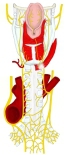 Vagus nerve and laryngeal nerves
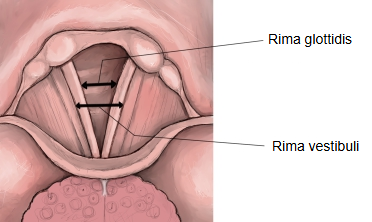
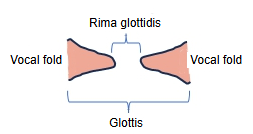
Glottis and rima glottidis: the difference
· The two words are easily confused:
The glottis is the left and right vocal folds together with the space between them; that space alone is the rima glottidis. Sources differ on whether the part between the arytenoid cartilages is included; most English texts include it.
Reference websites
[Wikipedia]
· Rima glottidis, Wikipedia.
· Glottis, Wikipedia.
[Websites with illustrations]
· The interior of the larynx from above (Gray's Anatomy) (Wikimedia Commons)
· Coronal section of the larynx (Gray's Anatomy) (Wikimedia Commons)

Where it is found
Related terms
References and sources
- Further reading: Rima glottidis, Wikipedia.
- Federative International Programme for Anatomical Terminology (FIPAT). Terminologia Anatomica, 2nd ed. (TA2), 2019.