Pharyngeal opening of auditory tube (Latin: ostium pharyngeum tubae auditivae)
Also called Pharyngeal opening of pharyngotympanic tube or the pharyngeal ostium of Eustachian tube
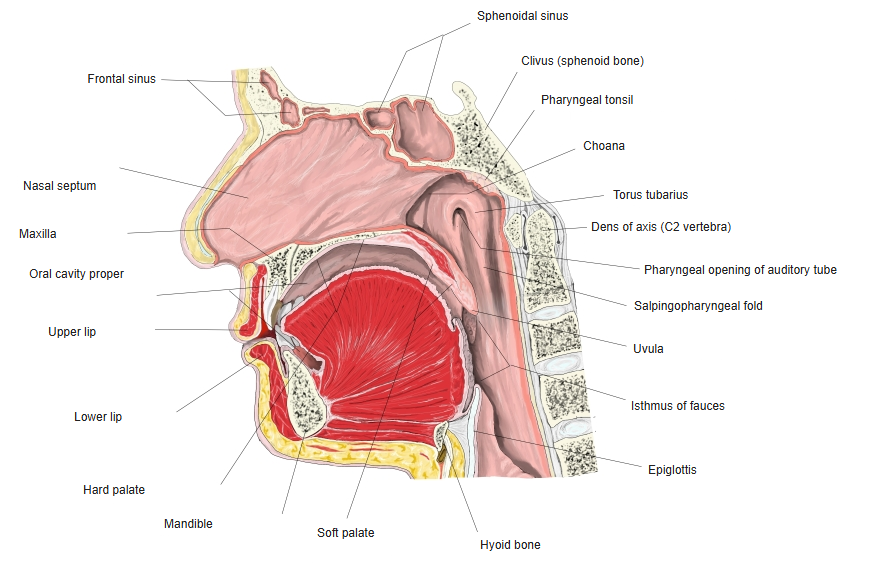
· There is one on each side, in the lateral wall of the nasal part of the pharynx; through the auditory tube the pharynx connects with the middle ear (tympanic cavity).
· It lies about 1 cm behind the posterior end of the inferior nasal concha, roughly at the level of the inferior nasal meatus.
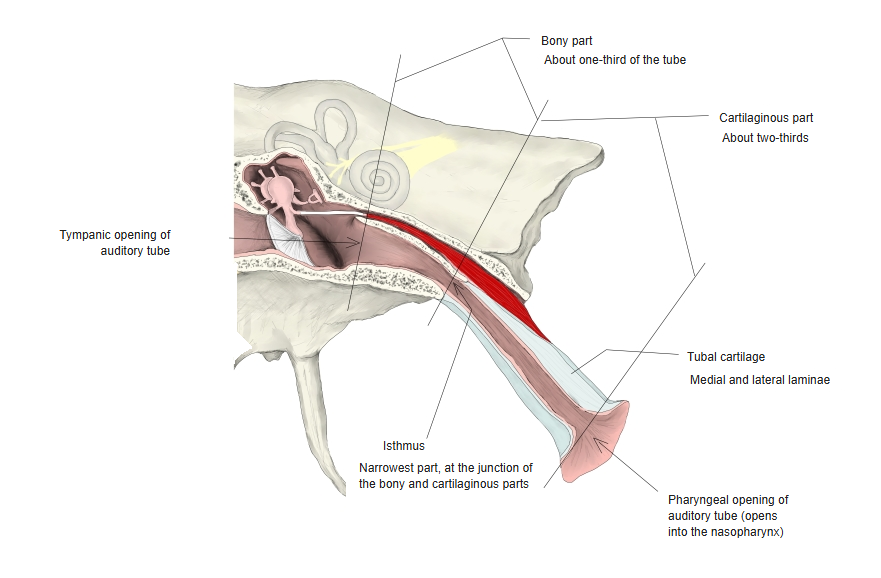
· It is a funnel- or triangle-shaped slit, framed above and behind by the torus tubarius (the end of the tubal cartilage), with the torus levatorius below it and the salpingopharyngeal fold running down from its posterior lip. The pharyngeal recess lies behind it.
· The tube is about 3.5 to 4 cm long: the lateral third is bony and the medial two-thirds cartilaginous. It is normally closed and is opened in swallowing and yawning, mainly by the tensor veli palatini; this equalises the air pressure on both sides of the eardrum.
· In children the tube is shorter and more horizontal, and an enlarged pharyngeal tonsil (adenoids) can block this opening, so middle-ear infections are more common.
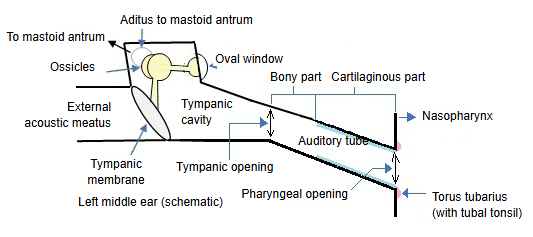
 Left auditory tube
 Nose, mouth and pharynx (median section, left side)
Reference websites
[Wikipedia]
· Eustachian tube, Wikipedia.
· Pharynx, Wikipedia.
[Websites with illustrations]
· Nasopharynx (Kenhub)
· The middle ear (auditory tube) (TeachMeAnatomy)
Where it is found
Related terms
- Auditory tube
- Middle ear
- Nasopharynx
- Pharyngeal recess
- Torus levatorius
- Pharyngeal tonsil
- Tensor veli palatini
References and sources
- Further reading: Eustachian tube, Wikipedia.
- Further reading: Pharynx, Wikipedia.
- Federative International Programme for Anatomical Terminology (FIPAT). Terminologia Anatomica, 2nd ed. (TA2), 2019.