Nutrient canal (Latin: canalis nutricius)
What is the nutrient canal?
compact bone
- Nutrient canal : leads the arteries, veins and nerves from the nutrient foramen to the medullary cavity.
- Volkmann's canal : (perforating canal) runs across the compact bone, roughly at right angles to the Haversian canals.
- Haversian canal : (central canal) runs lengthwise through the centre of the Haversian lamellae of each osteon; roughly at right angles to Volkmann's canals.
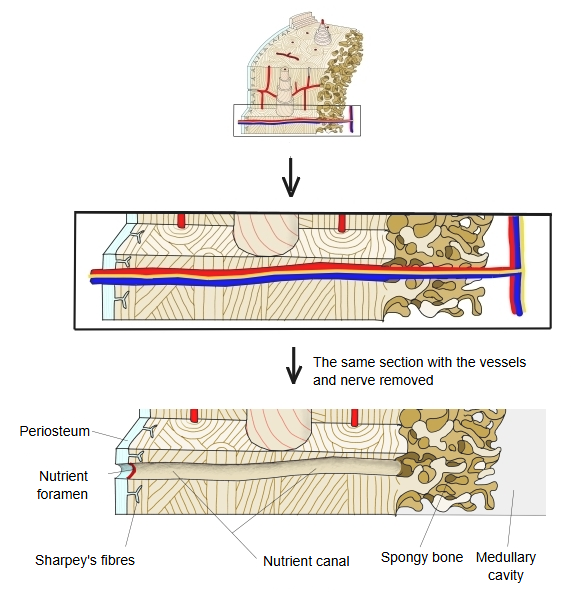
The nutrient foramen and nutrient canal pass through the bone substance to the medullary cavity, the space that holds the bone marrow. The nutrient artery that enters here mainly supplies the marrow, but its branches also supply the deep layers of the compact bone next to the cavity. The veins that leave through the canal carry carbon dioxide and waste products away from the marrow and bone, and also bring the newly formed red blood cells and white blood cells of the marrow into the circulation.
Nerves enter the bone and the periosteum with the nutrient vessels. Most of the fibres that enter the bone with the arteries are vasomotor nerves that control blood flow; the bone tissue itself has few sensory fibres, whereas the periosteum has many sensory nerves and is very sensitive to injury.
All bones have larger or smaller openings for the vessels that nourish them, the nutrient foramina. They are largest in the shafts of the large long bones, where they lead into a nutrient canal that usually runs obliquely to the medullary cavity; the nutrient arteries and veins pass through it. Nutrient canals are found in long bones (in the shaft) and in irregular bones (in other places).
Related terms
References and sources
- Further reading: Nutrient canal, Wikipedia.
- Further reading: Nutrient foramen, Wikipedia.
- Federative International Programme for Anatomical Terminology (FIPAT). Terminologia Anatomica, 2nd ed. (TA2), 2019.