Pharyngeal plexus (Latin: plexus pharyngeus)
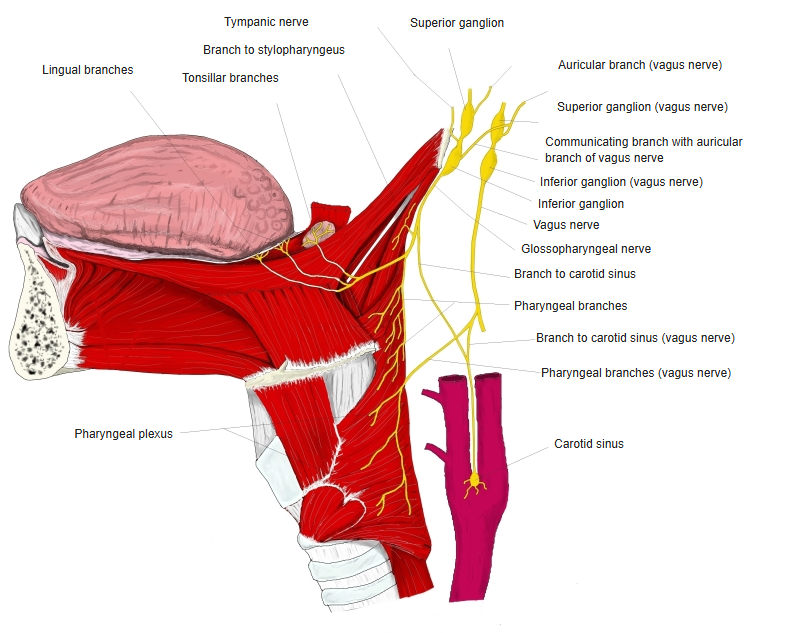
The pharyngeal plexus is a network of nerves in the wall of the pharynx, formed by nerve fibres of the glossopharyngeal nerve, the vagus nerve and the superior cervical ganglion.
Network of nerves: it lies on the outer surface of the pharynx, mainly over the middle constrictorGlossopharyngeal and vagus nerves: both are mixed cranial nerves and reach the plexus through their pharyngeal branchesSuperior cervical ganglion: one of the ganglia of the sympathetic trunk; it sends the laryngopharyngeal branches
So the pharyngeal plexus carries motor and sensory nerve fibres from the glossopharyngeal and vagus nerves, and sympathetic nerve fibres from the superior cervical ganglion. The motor fibres come from the vagus nerve, while the glossopharyngeal nerve mainly brings sensory fibres from the mucosa (sources differ on whether it also adds motor fibres). The sympathetic fibres go mainly to blood vessels and glands.
Pharyngeal
plexus
plexus
- Formed by : the pharyngeal branches of the glossopharyngeal nerve, the pharyngeal branches of the vagus nerve, and the laryngopharyngeal branches of the superior cervical ganglion (sympathetic; one from the sympathetic trunk).
- Supplies
- 1. Muscles of the pharynx : all except stylopharyngeus (supplied by its own branch of the glossopharyngeal nerve): the superior, middle and inferior constrictors, palatopharyngeus and salpingopharyngeus.
- 2. Muscles of the soft palate : all except tensor veli palatini (supplied by the mandibular nerve through the nerve to medial pterygoid): levator veli palatini, musculus uvulae, palatoglossus and palatopharyngeus (which belongs to both groups).
· The muscles listed above are the main ones supplied by fibres from the pharyngeal plexus; the list may not be complete. The plexus also supplies the mucous membrane of the pharynx.
Related terms
- Pharyngeal branches of vagus nerve
- Pharyngeal branches of glossopharyngeal nerve
- Laryngopharyngeal branches
- Superior cervical ganglion
- Vagus nerve
- Glossopharyngeal nerve
- Pharynx
References and sources
- Further reading: Pharyngeal plexus of vagus nerve, Wikipedia.
- Federative International Programme for Anatomical Terminology (FIPAT). Terminologia Anatomica, 2nd ed. (TA2), 2019.