Posterior superior alveolar canal
Also called the posterior alveolar canal
The posterior superior alveolar canal is one of the three alveolar canals of the maxilla: the hindmost one.
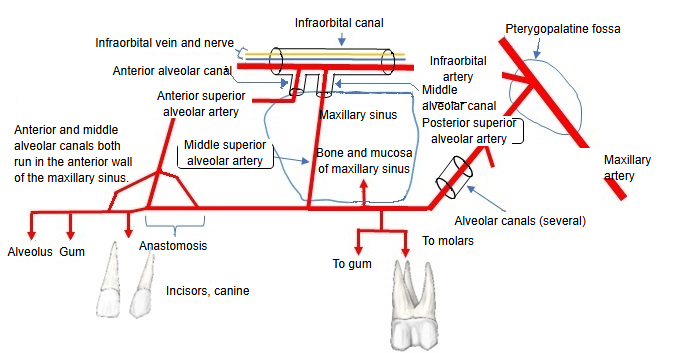
Small bony canals that carry nerves and vessels to the teeth (dental alveoli), the gums and the maxillary sinus
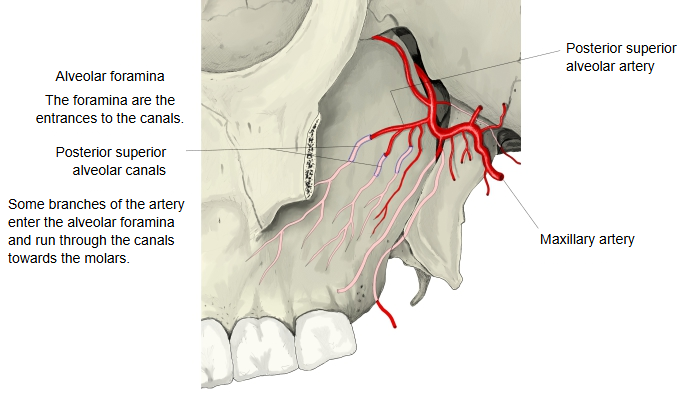
Its entrance is an alveolar foramen that opens on the maxillary tuberosity, facing the infratemporal fossa. Several such canals run forwards and down in the posterior wall of the maxillary sinus and lead the nerves and vessels towards the roots of the molar teeth.
Usually two or threeThe posterior superior alveolar branches of the maxillary nerve (posterior superior branches), the posterior superior alveolar artery and the posterior superior alveolar veins
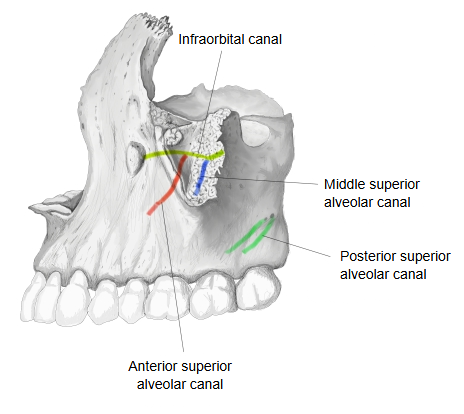
- Anterior superior alveolar canal : branches from the infraorbital canal (the continuation of the infraorbital groove) and runs in the anterior wall of the body of the maxilla. Contents: the anterior superior alveolar nerve (from the infraorbital nerve), artery and veins.
- Middle superior alveolar canal : branches from the infraorbital canal and descends in the lateral wall of the maxillary sinus; inconstant, and many details are unclear. Contents: the middle superior alveolar nerve, artery and vein.
- Posterior superior alveolar canal : begins at the alveolar foramina (two or three) on the maxillary tuberosity. Contents: the posterior superior alveolar branches of the maxillary nerve, the posterior superior alveolar artery and veins.
Note: some sources use the name "alveolar canals" only for the posterior canals.
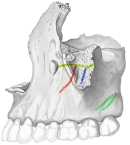 Alveolar canals of the maxilla
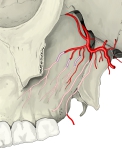 Canals and artery
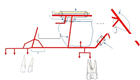 Arteries of the upper teeth (diagram)
Reference websites
[Wikipedia]
· Maxilla, Wikipedia.
[Websites with illustrations]
· Maxilla with the alveolar foramina (figure) (IMAIOS e-Anatomy)
· Superior alveolar canals (figure) (Pinterest (image))

Related terms
- Maxillary tuberosity
- Maxillary sinus
- Infraorbital canal
- Body of maxilla
- Alveolar process
- Infratemporal fossa
- Posterior superior alveolar artery
References and sources
- Further reading: Maxilla, Wikipedia.
- Federative International Programme for Anatomical Terminology (FIPAT). Terminologia Anatomica, 2nd ed. (TA2), 2019.