Ethmoidal process (Latin: processus ethmoidalis conchae nasalis inferioris)
Also called the ethmoidal process of inferior nasal concha
The ethmoidal process is one of the three processes on the upper border of the inferior nasal concha; its tip meets the uncinate process.
The lacrimal, maxillary and ethmoidal processes; the ethmoidal process is the hindmostInferior nasal concha: one of the bones of the facial skeletonUncinate process: a hooked plate that projects downwards from the ethmoidal labyrinth of the ethmoid bone
Three
processes
processes
- Front: Lacrimal process : meets the lower end of the lacrimal bone.
- Middle: Maxillary process : hooks down over the lower edge of the maxillary hiatus.
- Back: Ethmoidal process : meets the tip of the uncinate process of the ethmoid bone.
 Inferior nasal concha (lateral surface)
 Lateral wall of nasal cavity
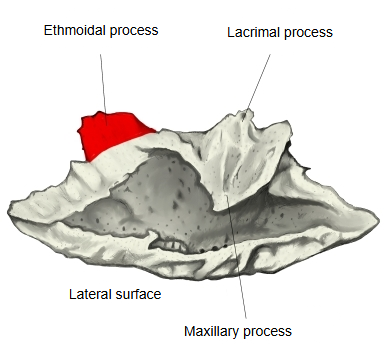
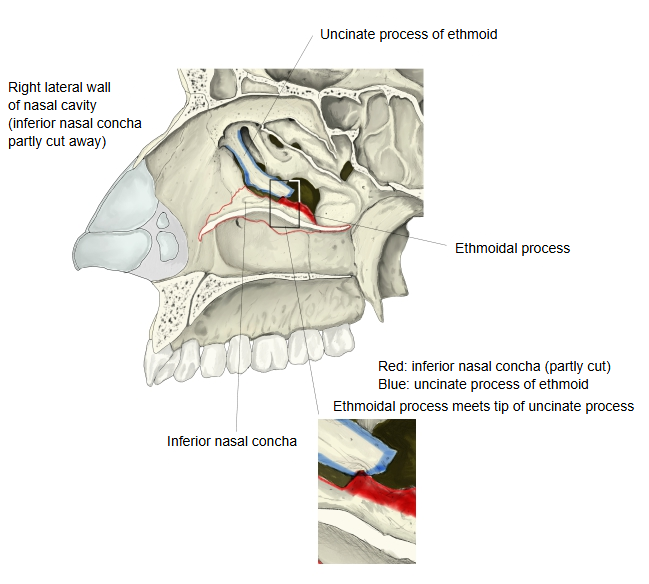
The ethmoidal process rises from the back part of the upper border of the inferior nasal concha and joins the lower end of the uncinate process of the ethmoid bone. Together they help close the back and lower part of the maxillary hiatus, the large opening into the maxillary sinus. Behind the process, the upper border of the inferior nasal concha rests on the conchal crest of the palatine bone. The size of the process varies, as does the curve of the inferior nasal concha as a whole.
Related terms
- Ethmoidal spine
- Ethmoidal notch
- Inferior nasal concha
- Uncinate process
- Lacrimal process
- Maxillary hiatus
- Maxillary sinus
- Conchal crest
- Ethmoid bone
References and sources
- Further reading: Inferior nasal concha, Wikipedia.
- Federative International Programme for Anatomical Terminology (FIPAT). Terminologia Anatomica, 2nd ed. (TA2), 2019.