Vertebra (Latin: vertebra (plural vertebrae))
- Overview
- General structure of a vertebra
- Reference websites
- (Wikipedia, websites with illustrations)
- Related terms
Overview
column
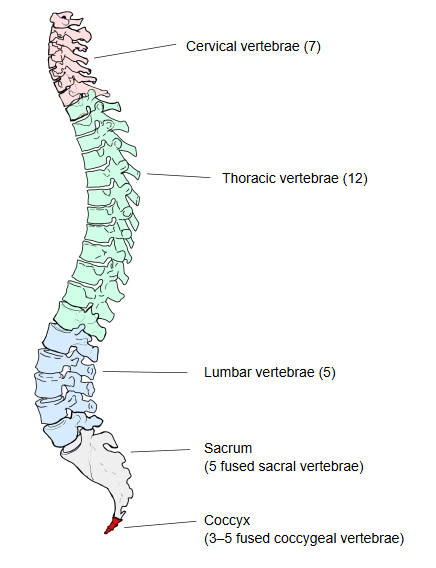
- Cervical vertebrae : 1st to 7th cervical vertebrae (C1–C7), 7 in all
- Thoracic vertebrae : 1st to 12th thoracic vertebrae (T1–T12), 12 in all
- Lumbar vertebrae : 1st to 5th lumbar vertebrae (L1–L5), 5 in all
- Sacrum : 5 sacral vertebrae fused into one bone
- Coccyx : 3–5 coccygeal vertebrae fused into one bone
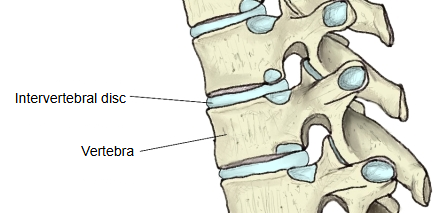
The cervical, thoracic and lumbar vertebrae are joined to one another mainly by intervertebral discs between their bodies, and also by synovial joints between their articular processes and by ligaments.
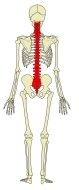 Vertebral column (posterior view)
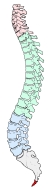 Regions of the vertebral column
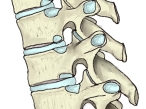 Vertebrae and intervertebral discs
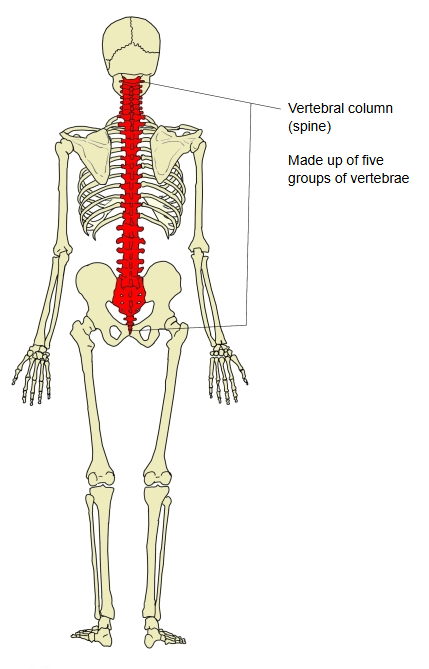
General structure of a vertebra
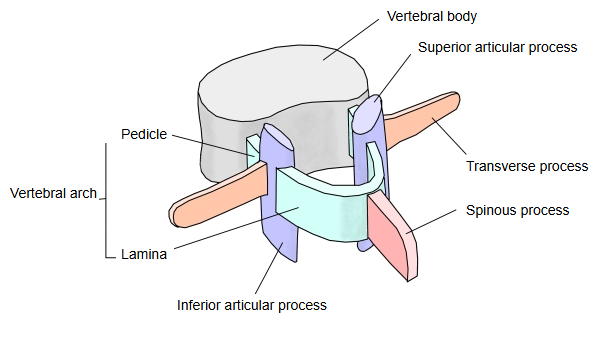
A vertebra is generally made of three parts, as shown below: the vertebral body, the vertebral arch and the processes. Their shape changes from region to region, and in some vertebrae parts are reduced or greatly altered.
The most striking change: the sacral and coccygeal vertebrae finally fuse to form the sacrum and the coccyx respectively.
structure
of a
vertebra
- Vertebral body : the cylindrical front part, joined to the vertebrae above and below by intervertebral discs.
- Vertebral arch
- Processes
- Spinous process : the long process pointing backwards.
- Transverse process : the processes to the left and right sides ⇒ in the lumbar vertebrae: the costal process.
- Superior and inferior articular processes : processes going up and down from the arch.
Vertebrae with especially distinctive features
| Region / name | Characteristic change of shape | |
|---|---|---|
| 1 | 1st cervical vertebra (atlas) | No vertebral body. Ring-shaped (the vertebral foramen is very large). |
| 2 | 2nd cervical vertebra (axis) | The dens (a tooth-like process, like the tip of a pen) projects up from the vertebral body. |
| 3 | Thoracic vertebrae (T1–T12) | Surfaces for the ribs (costal facets) on the sides of the vertebral body and on the transverse processes. |
| 4 | Lumbar vertebrae (L1–L5) | The vertebral body is very large and thick. The processes are short and sturdy. |
| 5 | Sacral vertebrae (S1–S5) | The five fuse into a single sacrum. The processes are lost or fused together. |
| 6 | Coccygeal vertebrae | The vertebral arch and processes are reduced. A short chain of small bony nodules. |
Reference websites
[Wikipedia]
· Vertebra, Wikipedia.
· Vertebral column, Wikipedia.
[Websites with illustrations]
· The vertebral column (TeachMeAnatomy)
· A typical thoracic vertebra from above (Gray's Anatomy) (Wikimedia Commons)

· A lumbar vertebra from above and behind (Gray's Anatomy) (Wikimedia Commons)

Related terms
- Vertebral arch
- Vertebral foramen
- Lumbar region
- Intervertebral foramen
- Intervertebral disc
- Vertebral column
- Vertebral body
- Spinous process
- Transverse process
- Atlas
- Axis
- Sacrum
References and sources
- Further reading: Vertebra, Wikipedia.
- Further reading: Vertebral column, Wikipedia.
- Federative International Programme for Anatomical Terminology (FIPAT). Terminologia Anatomica, 2nd ed. (TA2), 2019.