Spongy bone (Latin: substantia spongiosa)
Also called the cancellous bone or the trabecular bone
What is spongy bone?
substance
- Compact bone : the bone tissue, mainly in the outer layer of the bone, that is dense.
- Spongy bone : the bone tissue, mainly in the inner layer of the bone, that is loose and sponge-like.
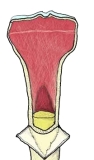 End of a long bone (section)
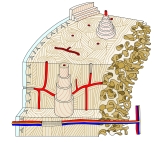 Structure of compact bone
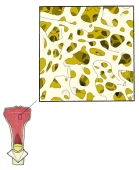 Trabeculae of spongy bone
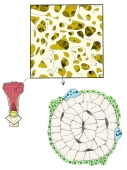 Bone cells and lamellae (enlarged)
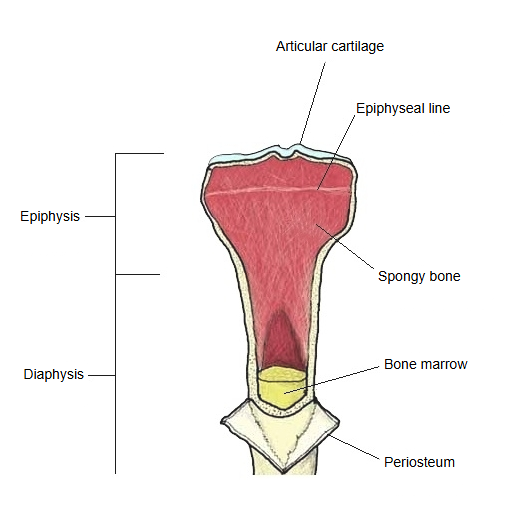
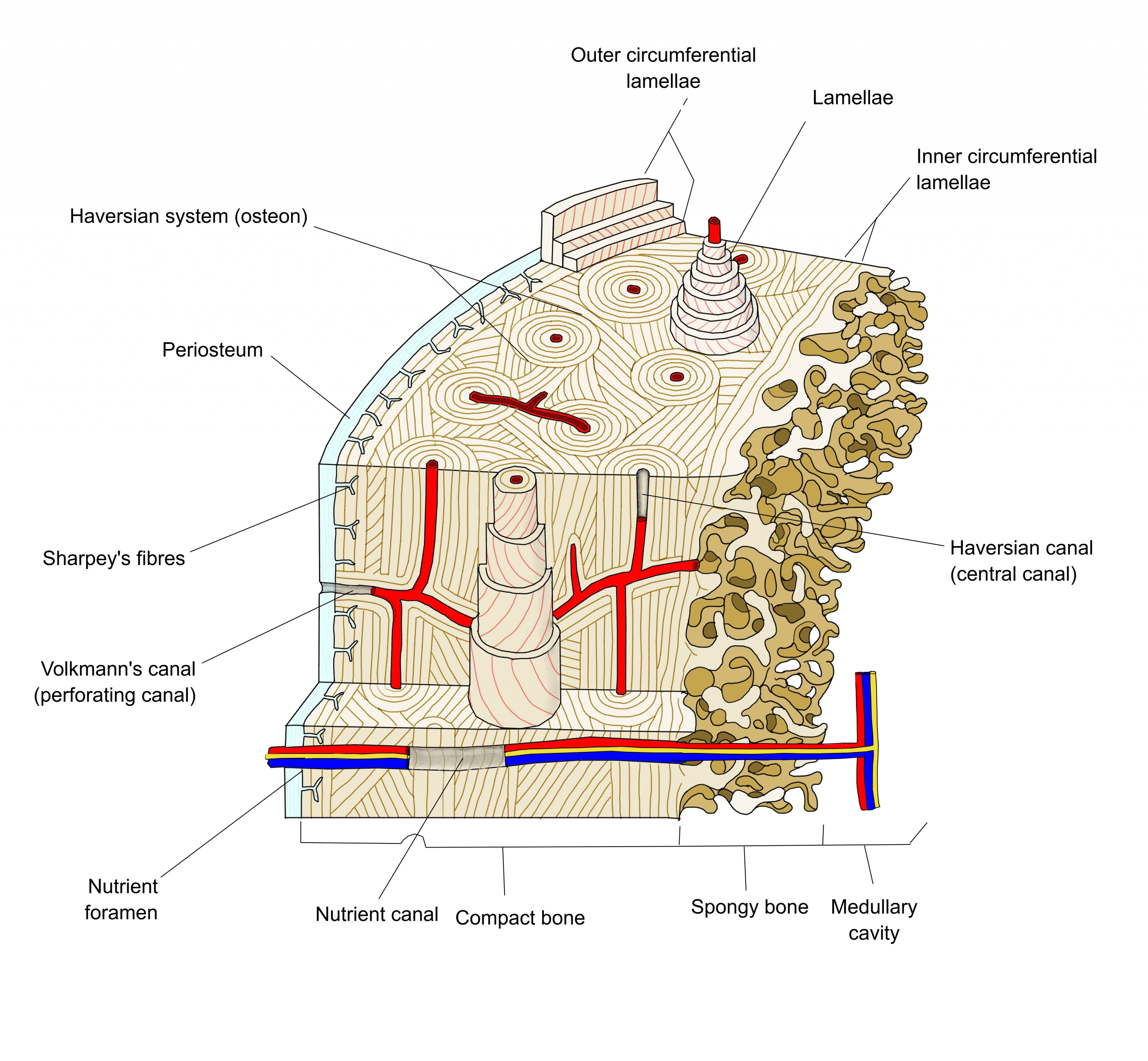
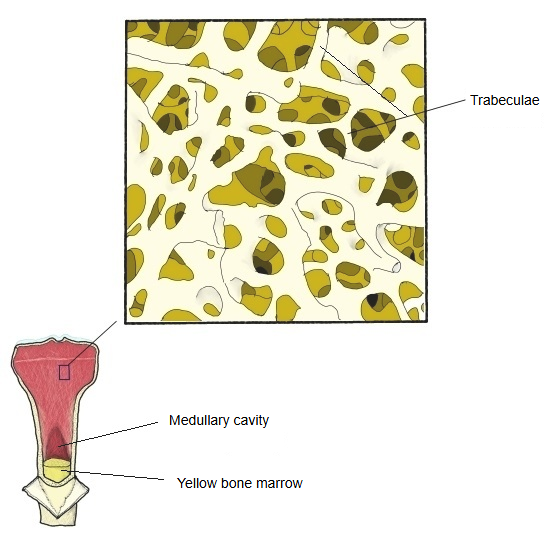
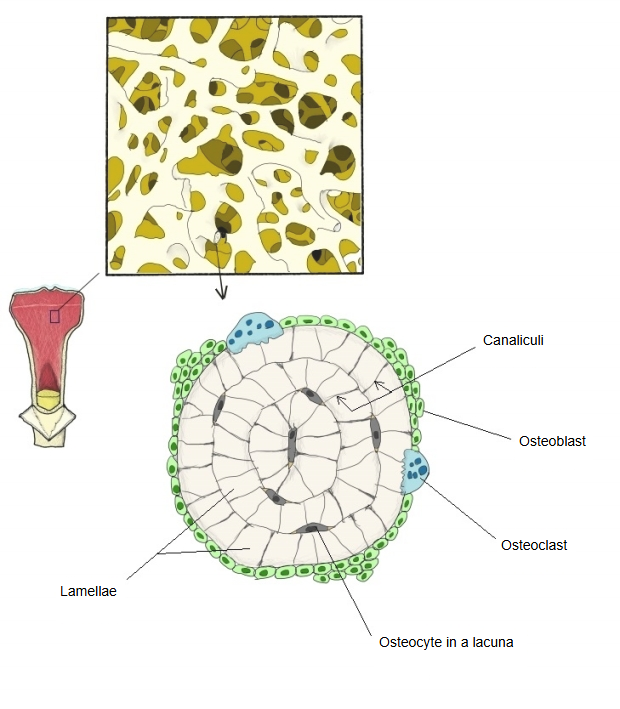
The last figure shows bone tissue arranged in concentric rings. Thick trabeculae can contain a few osteons, but in most trabeculae the lamellae lie parallel to the surface.
The outer layer of our bones is a dense layer (compact bone), so that the bone keeps its shape when force acts on it from outside. The inner layer is formed by bony trabeculae (trabeculae) joined together like a sponge; this part is called spongy bone. Unlike compact bone, most of it has no osteons: its lamellae run along the trabeculae, and the osteocytes are nourished from the marrow spaces.
Spongy bone may look fragile, but it is a very strong structure that spreads the forces acting on the bone and keeps its form: the trabeculae line up along the lines of stress. It also keeps the skeleton light. In adults its spaces hold much of the red bone marrow, where blood cells are formed.
The distribution and proportion of the two kinds of bone substance differ with the shape of the bone, as the table below shows.
| 1 | Long bones | e.g. the femur and humerus. The shaft is made of strong compact bone around the medullary cavity; at the ends (epiphyses) only a thin surface layer is compact bone and the rest is spongy bone. |
| 2 | Flat bones | e.g. the sternum and scapula. Spongy bone lies between two plates of compact bone, the inner and outer tables; in the bones of the skull vault it is called the diploë. |
| 3 | Short bones Irregular bones | e.g. the carpal bones and vertebrae. They are made of spongy bone covered by a thin layer of compact bone. |
Video
Related terms
References and sources
- Further reading: Bone (Cancellous bone), Wikipedia.
- Further reading: Trabecula, Wikipedia.
- Federative International Programme for Anatomical Terminology (FIPAT). Terminologia Anatomica, 2nd ed. (TA2), 2019.